
New Syndic Law in Morocco: What Changes in 2025-2026
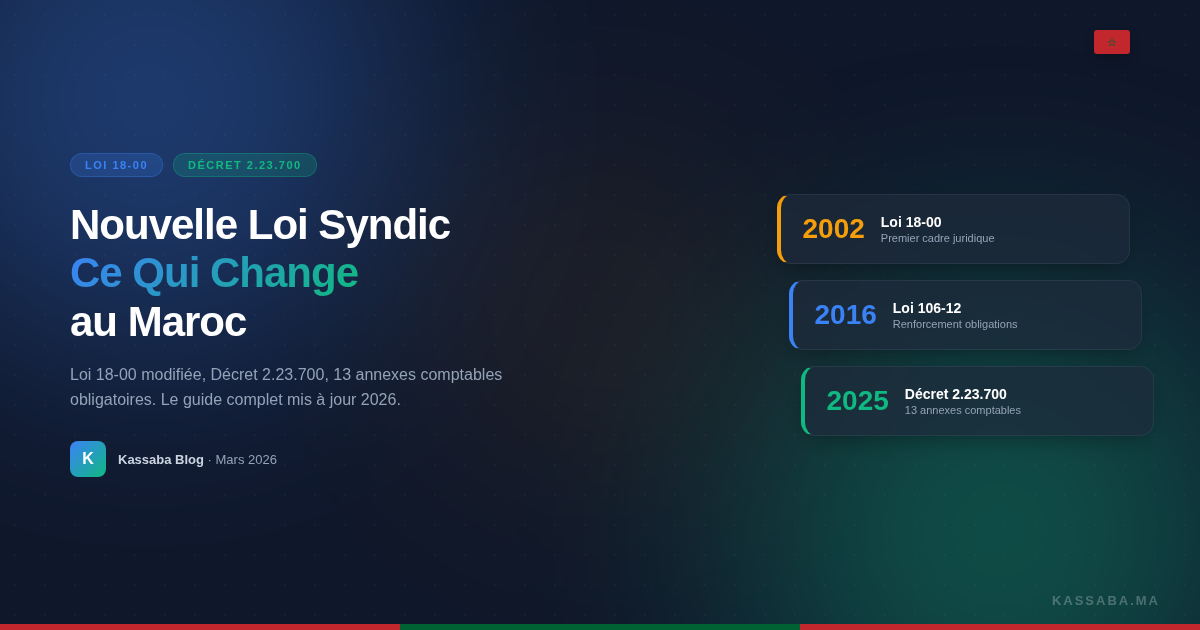
Co-ownership legislation in Morocco has gone through major changes in recent years. If you're a syndic (the term used in Morocco for a property manager or HOA manager, whether volunteer or professional), you need to know your new obligations. The consequences of non-compliance are real: removal at a general assembly, civil liability, and conflicts with co-owners.
This guide covers everything that's changed. The original Loi 18-00 from 2002, the 2016 amendments (Loi 106-12), and most importantly, Décret 2.23.700, which imposes a new accounting framework. We'll explain what it all means in practice for your co-ownership. And honestly, it's less complicated than it sounds.
If you're looking for a full overview of the syndic's role, check out our syndic guide for Morocco. Here, we're focusing on the recent legislative changes.
History: from Loi 18-00 to Décret 2.23.700
To understand where things stand today, we need to go back a bit.
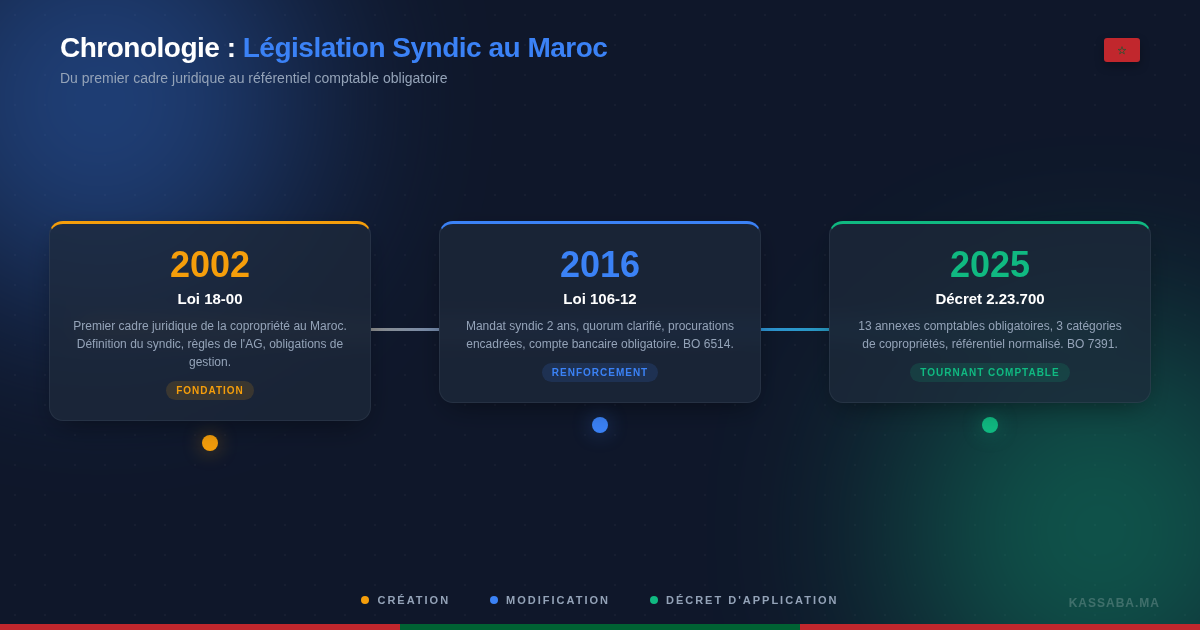
2002: Loi 18-00, the first legal framework
Before 2002, co-ownership in Morocco operated in a legal vacuum. Every building was on its own. Loi 18-00 changed everything by creating a legal framework: it defined the role of the syndic, set rules for the general assembly, and established financial management obligations.
It was a huge step forward. For the first time, the syndic had legal responsibilities: collect charges (the Moroccan term for HOA fees or service charges), maintain accounts, and convene assemblies. The law established a 2-year term for the syndic (Article 19), required at least one general assembly per year (Article 16ter), and mandated opening a bank account in the name of the co-ownership association, called a "syndicat" (Article 26).
But the text stayed vague on many practical points, especially accounting. No templates, no required format. Article 24 simply stated that the syndic must "report on their management." How? With what documents? The text didn't say. The result: every syndic did it their own way, and co-owners had no way to verify anything.
2016: Loi 106-12 strengthens the framework
Fourteen years later, Loi 106-12 (published in Official Bulletin 6514 on November 3, 2016) amended and supplemented Loi 18-00. The key changes:
- Syndic's term set at 2 years (Article 19), renewable by 3/4 vote
- Quorum clarified: half of co-owners as people, not as shares/tantièmes (Article 18). In Moroccan co-ownership law, "tantièmes" are the ownership shares that determine each co-owner's voting weight and share of expenses
- Proxies regulated: a maximum of 3 co-owners can be represented, and their combined tantièmes can't exceed 10% of the total (Article 16decies)
- Mandatory bank account in the name of the syndicat (Article 26)
- Notice period for general assemblies: 15 days minimum, by registered mail (Article 16quinquies)
These changes improved transparency. But a precise accounting framework was still missing. That's where the Decree comes in.
2024-2025: Décret 2.23.700, the accounting turning point
Décret 2.23.700 was published in Official Bulletin no. 7391 on March 31, 2025. It's the text everyone calls "the new syndic law." Technically, it's an implementing decree for Loi 18-00, not a new law. But its impact is significant.
For the first time, Morocco has a mandatory accounting standard for co-ownerships. The Decree defines 12 accounting annexes, distributed according to the size of the co-ownership. For everything about the Decree, see our Décret 2.23.700 guide.
Key changes in the Moroccan syndic law
So what actually changes for a syndic? Here are the points that matter.
Precise accounting obligations
Before the Decree, Article 24 of Loi 18-00 required the syndic to "maintain accounts" without saying how. Everyone did it their own way. Some with a notebook, others with Excel, and many with nothing at all.
Décret 2.23.700 puts an end to the ambiguity. It requires standardized accounting documents: the now-famous 12 annexes. No more excuses for "I didn't know what to produce."
For a detailed breakdown of these annexes, our syndic accounting guide explains each one.
Three categories of co-ownerships
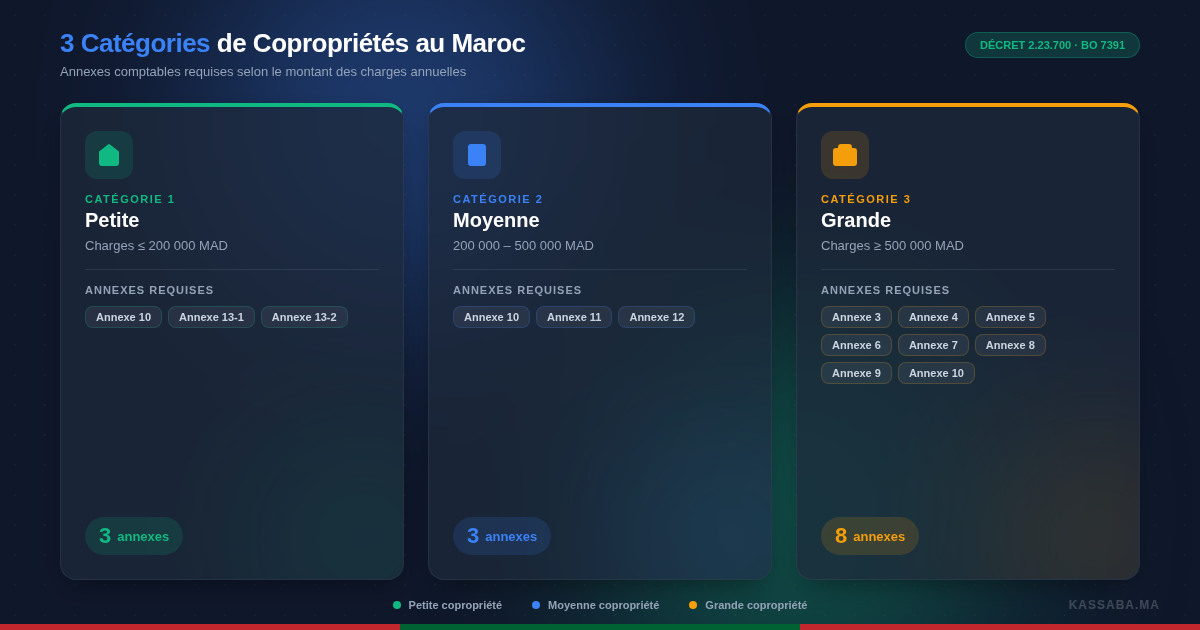
The Decree creates three categories based on the total amount of charges called during the fiscal year. Charges are expressed in MAD (Moroccan Dirham, the national currency):
Small co-ownerships (charges of 200,000 MAD or less, roughly 18,000 EUR/20,000 USD): they produce Annexes 10 (co-owner contribution tracking), 13-1 (very simplified balance sheet), and 13-2 (very simplified income and budget statement). This is the lightest format.
Medium co-ownerships (charges between 200,000 and 500,000 MAD): they produce Annexes 10, 11 (simplified financial statements), and 12 (simplified income and budget). One step up, but still manageable.
Large co-ownerships (charges of 500,000 MAD or more): they produce Annexes 3 through 10, a total of 8 documents. Balance sheet, general management account, budget comparison, reserve fund tracking, loan tracking, equipment tracking, and co-owner contributions.
| Category | Charges threshold | Required annexes | Count |
|---|---|---|---|
| Small | ≤ 200,000 MAD | 10, 13-1, 13-2 | 3 |
| Medium | > 200,000 and < 500,000 MAD | 10, 11, 12 | 3 |
| Large | ≥ 500,000 MAD | 3, 4, 5, 6, 7, 8, 9, 10 | 8 |
Mandatory financial transparency
The syndic must present the accounting annexes at the annual general assembly. Co-owners have the right to review them. This is a cultural shift: we're moving from a system where the syndic "managed" without accountability, to a system where everything is documented and verifiable. To learn more about the general assembly, read our general assembly guide.
Penalties for non-compliance
What does a syndic risk if they don't meet these obligations?
Loi 18-00 provides for the removal of the syndic by the general assembly with a 3/4 majority vote (Articles 19 and 21). A syndic who fails to present their accounts, or presents them in a non-compliant format, gives co-owners legitimate grounds for removal.
Co-owners can also pursue civil liability against the syndic for mismanagement. If funds have been misused or can't be accounted for, the syndic can be required to reimburse.
Strengthened role of the general assembly
The general assembly (AG) remains the decision-making body. It approves accounts, votes on the budget, and elects (or removes) the syndic. With the new accounting framework, co-owners have standardized documents to evaluate the management. It's progress for everyone: serious syndics can show their work, and co-owners can actually verify it.
The 12 accounting annexes of Décret 2.23.700 explained
Here's the complete list of annexes, with their official names (from the Official Bulletin 7391 Arabic text):
| No. | Name | Arabic | Used by |
|---|---|---|---|
| 3 | Balance Sheet | الحصيلة | Large co-own. |
| 4 | General Management Account | حساب التسيير العام | Large co-own. |
| 5 | Budget Comparison | مقارنة الميزانية | Large co-own. |
| 6 | Non-Current Works | الأشغال غير الجارية | Large co-own. |
| 7 | Reserve Fund Tracking | صندوق الاحتياط | Large co-own. |
| 8 | Loan Tracking | تتبع القروض | Large co-own. |
| 9 | Equipment Tracking | تتبع المعدات | Large co-own. |
| 10 | Co-owner Contributions | تتبع إسهامات المالك المشتركين | All |
| 11 | Simplified Statements | القوائم المبسطة | Medium co-own. |
| 12 | Simplified Income & Budget | الإيرادات والميزانية المبسطة | Medium co-own. |
| 13-1 | Very Simplified Balance | الحصيلة المبسطة جداً | Small co-own. |
| 13-2 | Very Simplified Income & Budget | الإيرادات والميزانية المبسطة جداً | Small co-own. |
Annexe 10 is common to all categories. It's the document that tracks each co-owner's contributions: what was called, what was paid, and what's still owed.
For a detailed breakdown of each annexe with practical examples, check out our syndic accounting guide for Morocco.
What syndics need to do to comply
Don't panic. Here are the concrete steps.
1. Identify your co-ownership category
Add up all the charges called during the last fiscal year. Compare against the thresholds:
- 200,000 MAD or less (approx. 18,000 EUR) = small
- 200,000 to 500,000 MAD = medium
- 500,000 MAD or more (approx. 45,000 EUR) = large
2. Prepare the required accounting annexes
Based on your category, you now know which documents to produce. If you manage a small co-ownership, 3 annexes are enough. It's doable, even for a volunteer property manager.
3. Set up regular charge tracking
Don't let the accounting pile up. Record income and expenses as they happen. Unpaid charges expire after 5 years (Article 43 of Loi 18-00). So if you're not tracking, you lose the right to collect.
4. Present accounts at the general assembly
The annual general assembly must be held within 30 days of the end of the fiscal year (Article 16ter). That's where you present your annexes. Co-owners vote to approve them by a majority of the votes of co-owners present or represented (Article 20).
5. Use compliant software
Filling in 8 annexes by hand or in Excel is a recipe for errors. Software like Kassaba automatically generates the Décret 2.23.700 annexes from your data. You enter charges and payments, and the documents are produced for you.
To pick the right tool, see our guide on how to choose property management software.
Quick compliance checklist
- Calculate the total amount of charges called
- Determine your category (small, medium, large)
- List the annexes you need to produce
- Record income and expenses as they happen
- Open a bank account in the name of the syndicat (Art. 26)
- Convene the general assembly within 30 days of the fiscal year end
- Present the annexes at the general assembly
- Keep accounting documents and assembly minutes on file
If your co-ownership has bylaws, make sure they're up to date. Our co-ownership bylaws template can serve as a reference.
Practical cases: 3 real-world examples
To make all of this more concrete, here's how the obligations apply depending on the size of your co-ownership.
Small building in Tetouan (12 units, 80,000 MAD in charges)
Ahmed is a volunteer syndic for a small 12-unit apartment building. Annual charges total 80,000 MAD (about 7,200 EUR), covering the concierge, common area water, stairwell electricity, and cleaning. It's a small co-ownership.
His obligations: produce 3 annexes (10, 13-1, 13-2). Annexe 10 lists each co-owner's contributions: amounts called, amounts paid, and remaining balances. Annexe 13-1 is a very simplified balance sheet (what the co-ownership owns and owes). Annexe 13-2 summarizes income and expenses against the budget approved at the general assembly.
Ahmed collects charges every month by bank transfer or cash. Three co-owners are behind on payments. With Annexe 10, he can show in black and white who owes what, and for how long. Unpaid charges expire after 5 years (Article 43), so this tracking is also legal protection.
In practice, with software like Kassaba, Ahmed enters his charges and payments as they come in. The 3 annexes are generated automatically before the general assembly. He prints them, presents them, and the assembly votes to approve.
Residential complex in Casablanca (60 units, 350,000 MAD in charges)
Fatima professionally manages a 60-unit residence. Elevator, pool, security guard, landscaping. Charges reach 350,000 MAD per year (about 31,500 EUR). It's a medium co-ownership.
Her obligations: Annexes 10, 11, and 12. Annexe 11 provides simplified financial statements (more detailed than the "very simplified" format used by small co-ownerships). Annexe 12 compares actual income and expenses against the approved budget.
Fatima must also maintain a bank account in the name of the syndicat (Article 26) and convene the general assembly within 30 days of the fiscal year end. With 60 co-owners, managing charge calls and follow-ups quickly becomes a full-time job. General assembly notices must go out 15 days before the date (Article 16quinquies), by registered mail or legal notification. For 60 units, that's 60 registered mailings to plan and budget for.
Large complex in Marrakech (200 units, 1,200,000 MAD in charges)
Karim administers a large residential complex. Three buildings, 200 units, underground parking, gym. Annual budget: 1.2 million MAD (about 108,000 EUR). It's a large co-ownership.
His obligations: all 8 annexes (3 through 10). Full balance sheet, general management account, budget comparison, non-current works tracking, reserve fund tracking, loan tracking, equipment tracking, and co-owner contributions. This is the highest level of detail.
For a complex of this size, manual management isn't realistic. Karim uses software that generates all 8 annexes, tracks unpaid charges by unit, and prepares assembly notices. Without the right tool, it would take him an entire week to prepare the year-end documents.
One point specific to large complexes: Annexe 7 (reserve fund tracking) and Annexe 8 (loan tracking) require tracking over time. It's not just an annual snapshot. You need to trace movements from one fiscal year to the next. And Annexe 9 (equipment tracking) inventories all shared equipment: elevators, pumps, fire safety systems, automatic gates. Each piece of equipment with its acquisition date and condition.
Check out our FAQ below for answers to the most common questions about the new law.
Key takeaways
The "new syndic law" in Morocco isn't a single law. It's a set of texts that complement each other: Loi 18-00, Loi 106-12, and Décret 2.23.700. Together, they create a complete framework for co-ownership management.
The key points:
- Décret 2.23.700 requires 12 standardized accounting annexes
- Three categories of co-ownerships, based on the amount of charges called
- The syndic (volunteer or professional) must produce and present these annexes at the general assembly
- Non-compliance exposes you to removal and civil liability
Managing a co-ownership? Kassaba automatically generates all 12 annexes of Décret 2.23.700 in 30 minutes. You enter your charges and payments, and the software produces compliant documents. Free for buildings.
Discover Kassaba, the free property management software for buildings in Morocco. And for more depth, check out our guide to property management in Morocco.
FAQ
What is the new syndic law in Morocco?
The current legal framework is based on Law 18-00 (Loi 18-00), amended by Law 106-12 (Loi 106-12) in 2016, and supplemented by Decree 2.23.700 (Décret 2.23.700) published in Official Bulletin 7391 on March 31, 2025. This decree imposes new mandatory accounting annexes for all co-ownerships.
When did Decree 2.23.700 come into effect?
Decree 2.23.700 (Décret 2.23.700) was published in Official Bulletin no. 7391 on March 31, 2025. It applies to all co-ownerships, regardless of their size.
What are the penalties for a non-compliant syndic?
A syndic (property manager) who fails to meet their accounting obligations can be removed by the general assembly (Article 19 of Law 18-00, 3/4 majority vote). Co-owners can also pursue civil liability claims for mismanagement.
How many accounting annexes are required?
Decree 2.23.700 defines 12 annexes in total (Annexes 3 through 13-2). The number you need to produce depends on your co-ownership category: 3 annexes for small (charges called of 200,000 MAD or less), 3 for medium (200,000 to 500,000 MAD), and 8 for large (500,000 MAD or more). MAD is the Moroccan Dirham.
Where can I download the text of Law 18-00?
The consolidated text of Law 18-00 (as amended by Law 106-12) is available on the website of the General Secretariat of Government (sgg.gov.ma) and in Official Bulletin no. 6514 dated November 3, 2016.
What is the difference between Law 18-00 and Law 106-12?
Law 18-00 (2002) is the founding text of the co-ownership regime in Morocco. Law 106-12 (2016) amended and supplemented it by strengthening the syndic's obligations, clarifying voting rules at general assemblies, and adding provisions on proxies and the syndic's term of office.
Is a volunteer syndic subject to the same obligations?
Yes, without exception. Law 18-00 makes no distinction between volunteer syndic and professional. Article 24 requires every syndic to report on their management and present accounts at the general assembly. The accounting obligations under Decree 2.23.700 apply equally. In practice, small co-ownerships managed by a volunteer usually fall into the 'small' category (charges called of 200,000 MAD or less), which limits obligations to just 3 annexes (10, 13-1, 13-2). This is an intentionally lightweight format, designed to be accessible without accounting training.
Simplify your property management
Kassaba automates accounting, payment reminders, and resident communication.
Create your free syndic accountFree during beta. No credit card required.
Related articles
Pest Control in Moroccan Co-Ownership: Who Pays, Who Manages
Who pays for pest control in Moroccan co-ownership? Common areas usually fall under the syndic's Article 26 duties; private units need separate proof.
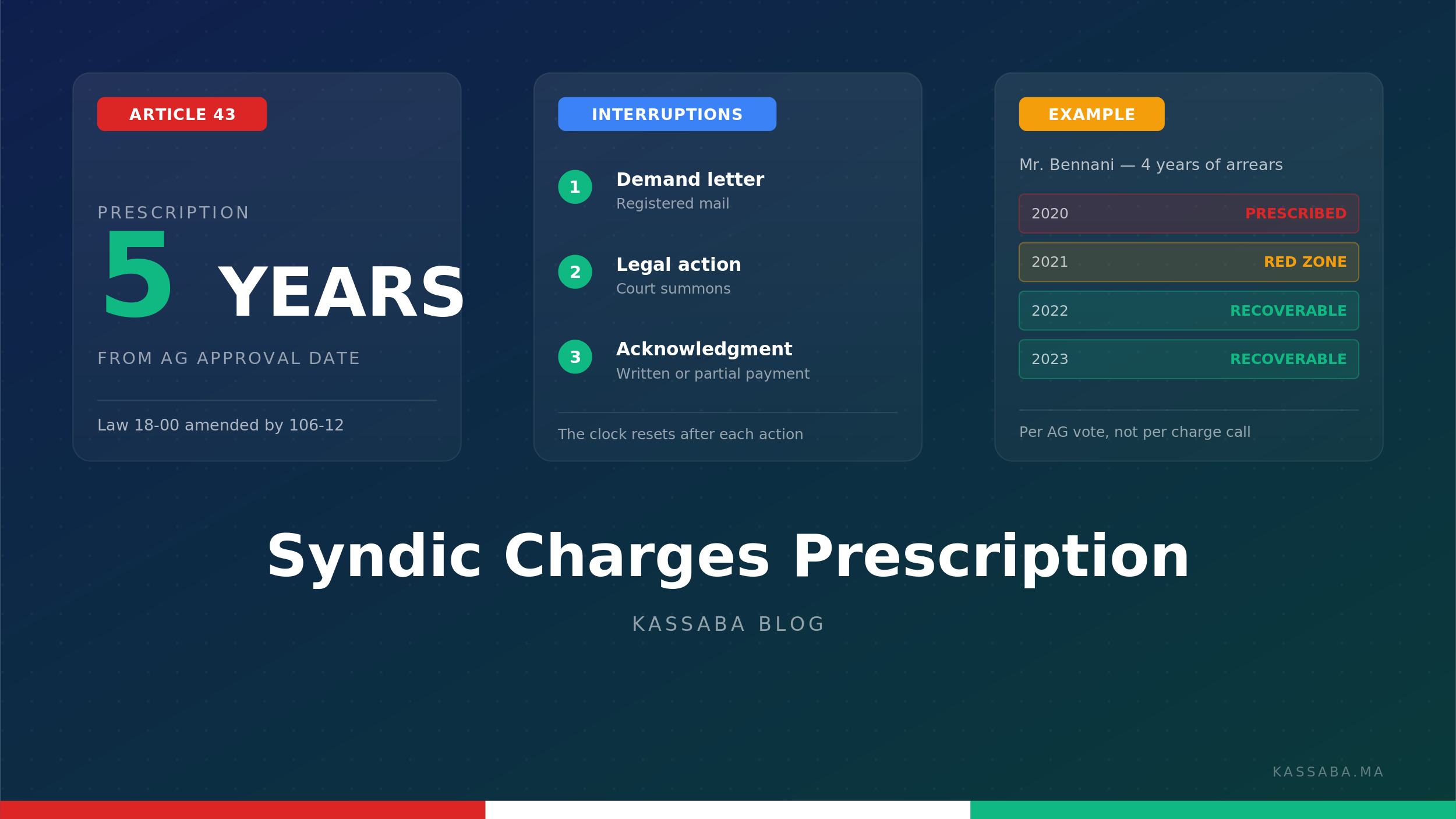
Syndic Charges in Morocco: The 5-Year Prescription Rule (Article 43)
In Morocco 2026, syndic charges expire 5 years after approval by the General Assembly (Art. 43 Law 18-00). How to calculate and interrupt.
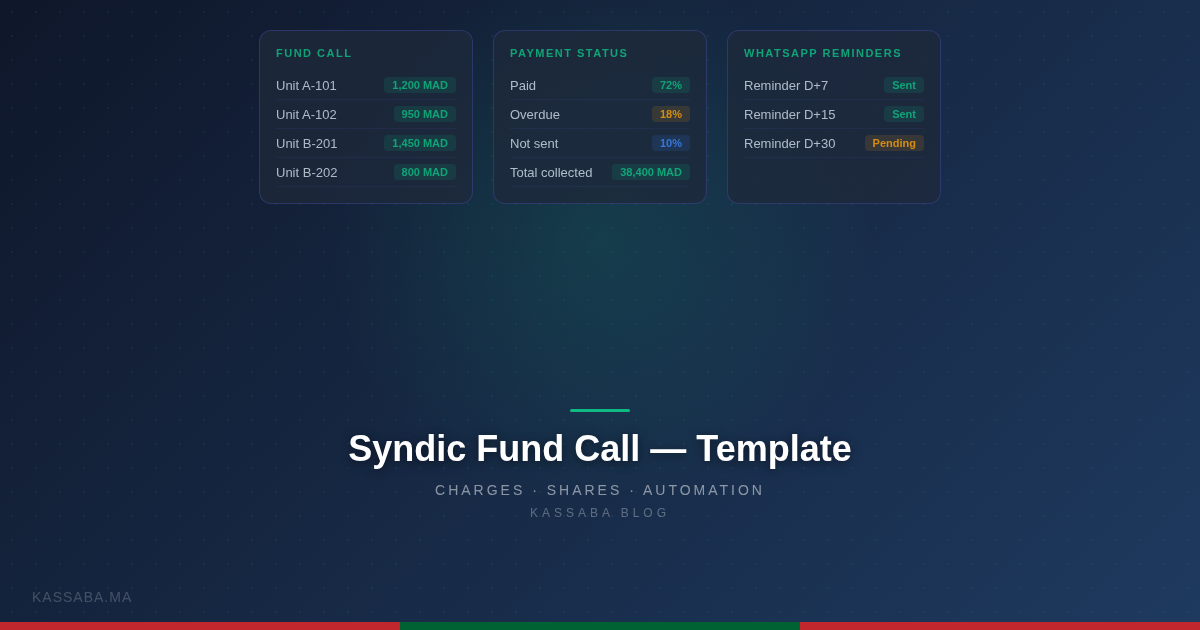
Charge Calls for Syndics in Morocco: Templates and Automation
How to draft a charge call as a syndic in Morocco, calculate tantièmes, and follow up on unpaid charges. Concrete template and practical tips.