
Charge Calls for Syndics in Morocco: Templates and Automation
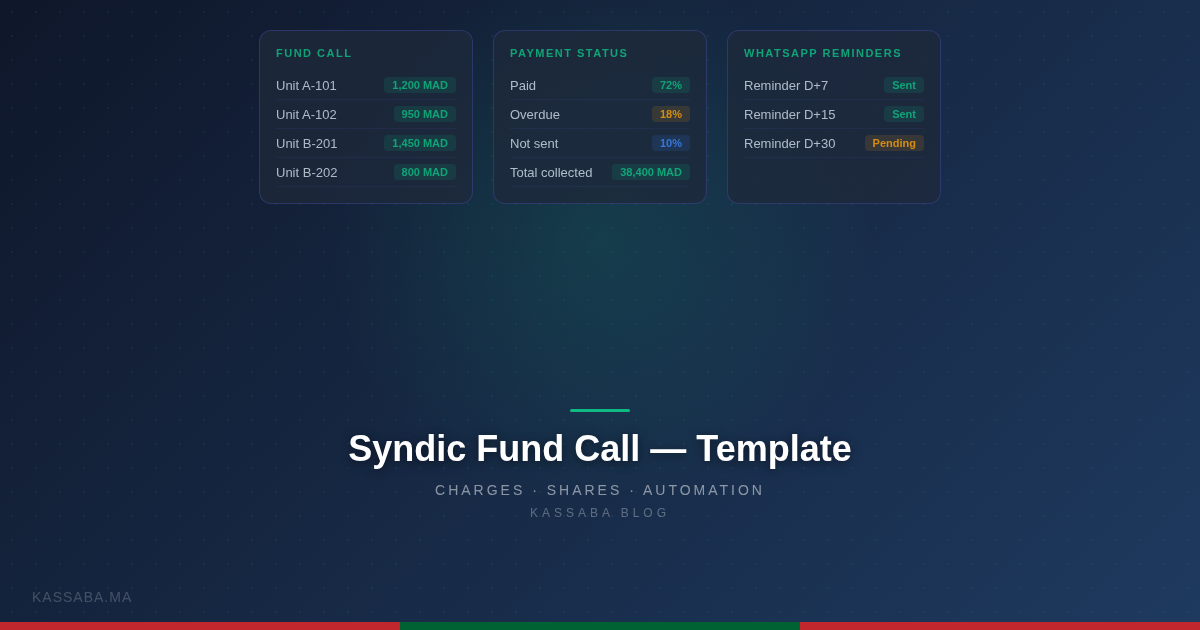
Your real problem isn't the budget. It's getting people to pay.
You held your AG. The budget was voted by a 3/4 majority (Article 21, Law 18-00). Great. But now, co-owners actually have to pay. And that's where things get difficult.
A charge call is the document you send to each co-owner telling them how much they owe, when they need to pay, and why. It's also the document that proves you did your job if someone challenges you later.
This guide gives you a concrete template, explains how to calculate the amounts, and walks you through handling late payments. In most Moroccan co-ownerships, the collection rate remains the syndic's biggest headache.
What the law says about co-ownership charges in Morocco
Before we get to the template, let's cover the legal basics. You need to understand where your authority to collect money comes from.
The annual budget (Article 24)
Article 24 of Law 18-00 requires the syndic to prepare a forecast budget and submit it to the general assembly. This budget must be voted by a 3/4 majority of all co-owners' votes (Article 21).
Once voted, the budget becomes enforceable. The syndic has not only the right but the obligation to collect it. Article 26 specifies that the syndic must collect charges from co-owners.
Tantièmes: the allocation key
Every unit in a co-ownership has a tantièmes count. This number reflects the surface area, floor, exposure, and other criteria defined in the co-ownership bylaws.
Tantièmes serve two purposes:
- Calculating voting rights at the AG
- Splitting charges among co-owners
If your building has 1,000 total tantièmes and a co-owner holds 80, they pay 8% of the annual budget. Simple as that.
The mandatory bank account (Article 26)
Article 26 requires the syndic to open a bank account in the co-ownership's name. All charge payments must go through this account. No cash payments to the concierge, no transfers to the syndic's personal account.
Many co-ownerships still ignore this rule, but the law is clear. If you're a volunteer syndic, this obligation applies to you too.
How to calculate a charge call
The math is mechanical once you have the right inputs. Here's the process.
Step 1: Start from the voted budget
A concrete example. Your co-ownership voted an annual budget of 180,000 MAD for 2026. This covers:
| Item | Annual Amount |
|---|---|
| Concierge (salary + social security) | 72,000 MAD |
| Electricity (common areas) | 24,000 MAD |
| Water | 12,000 MAD |
| Routine maintenance | 18,000 MAD |
| Building insurance | 6,000 MAD |
| Bank fees | 3,000 MAD |
| Elevator (maintenance contract) | 30,000 MAD |
| Cleaning | 12,000 MAD |
| Miscellaneous | 3,000 MAD |
| Total | 180,000 MAD |
Step 2: Split by tantièmes
Your building has 1,000 tantièmes divided among 20 units. Here's how to calculate each co-owner's share:
Formula: Annual share = Total budget x (Unit's tantièmes / Total tantièmes)
Example for 3 different units:
| Unit | Type | Tantièmes | % | Annual Charge | Monthly Charge |
|---|---|---|---|---|---|
| Apt 1 (ground floor) | 2-bed, 80 m² | 65/1,000 | 6.5% | 11,700 MAD | 975 MAD |
| Apt 8 (3rd floor) | 3-bed, 110 m² | 85/1,000 | 8.5% | 15,300 MAD | 1,275 MAD |
| Apt 15 (5th, terrace) | Duplex, 140 m² | 110/1,000 | 11% | 19,800 MAD | 1,650 MAD |
The logic is clear: bigger units have more tantièmes, so they contribute more.
Step 3: Choose the frequency
The law doesn't mandate a specific payment frequency. You can call charges:
- Monthly: most common, easier for co-owners to pay
- Quarterly: less administrative tracking, but larger amounts
- Semi-annually: rare, makes cash flow management harder
Most Moroccan co-ownerships use monthly charge calls. It's the format we recommend.
Charge call template
Here's a template you can adapt for your co-ownership. The charge call should contain enough information for the co-owner to understand what they're paying, why, and how.
CO-OWNERSHIP RESIDENCE LES ORANGERS Address: 12, Rue Al Mourabitine, Tetouan Bank account: XXXX-XXXX-XXXX-XXXX (Banque Populaire)
CHARGE CALL - March 2026
Co-owner: Mr. Ahmed BENALI Unit: Apartment #8, 3rd floor Tantièmes: 85/1,000
Description Amount Regular charges (March 2026) 1,275.00 MAD Arrears from 2025 2,550.00 MAD Total due 3,825.00 MAD
Monthly charge breakdown:
- Concierge: 510.00 MAD
- Electricity: 170.00 MAD
- Water: 85.00 MAD
- Maintenance: 127.50 MAD
- Insurance: 42.50 MAD
- Elevator: 212.50 MAD
- Cleaning: 85.00 MAD
- Miscellaneous: 42.50 MAD
Payment deadline: March 10, 2026 Payment method: Bank transfer only RIB: XXXX-XXXX-XXXX-XXXX
Budget approved at the AG on January 15, 2026 Minutes ref. 12/2026
The Syndic, Signature
What this template includes (and why)
Every element serves a purpose:
- Co-ownership identity and bank account: the co-owner knows exactly where to send the money
- Unit tantièmes: they can verify the calculation is correct
- Item-by-item breakdown: transparency reduces disputes. A co-owner who sees "concierge: 510 MAD" understands where their money goes
- Arrears separated from current charges: avoids confusion
- AG minutes reference: that's your proof the budget was voted. In a dispute, this document is what counts
- Payment deadline: a clear date encourages timely payment
Regular charges vs exceptional works
Be careful not to mix these two types of charges in your calls.
Regular charges (Article 20)
Regular charges cover the building's day-to-day operations: concierge, electricity, water, cleaning, elevator, insurance. They're voted in the annual budget by a 3/4 majority (Article 21) and called regularly.
Decisions about routine maintenance fall under majority of the votes of co-owners present or represented (Article 20). Practically, if the concierge reports a leak, the syndic can authorize the repair without calling an extraordinary AG, as long as the amount stays within the approved budget.
Exceptional works (Article 21 or 22)
Major works (facade renovation, elevator replacement, terrace waterproofing) require a specific vote:
- Article 21 (3/4 of all co-owners): improvement works, bylaw amendments, major works
- Article 22 (unanimity): new construction, selling common areas, adding floors
For these works, you issue a separate charge call referencing the specific AG vote. Never mix a regular charge call with an exceptional works call. It creates confusion in your syndic accounting and makes producing the Décret 2.23.700 annexes much harder.
Accounting annexes linked to charge calls
Your charge calls feed directly into your accounting. Décret 2.23.700 requires different annexes depending on total charges called:
| Size | Charges Called | Required Annexes |
|---|---|---|
| Small co-ownership | Up to 200,000 MAD | 10, 13-1, 13-2 |
| Medium | 200,000 to 500,000 MAD | 10, 11, 12 |
| Large | 500,000 MAD or more | 3, 4, 5, 6, 7, 8, 9, 10 |
Annexe 10 (co-owner contribution tracking) is common to all sizes. It's the document that traces, unit by unit, how much was called, how much was paid, and how much is still owed. In other words, it's the summary of all your charge calls for the fiscal year.
If you use software like Kassaba, this annexe generates itself from your calls and payments. Doing it manually (Excel or paper) means considerable work at year-end.
Managing unpaid charges: the 4-step strategy
This is the real issue. In many Moroccan co-ownerships, 30 to 40% of co-owners pay late. Some don't pay at all. Here's a method that works.
Step 1: Friendly SMS or WhatsApp reminder (Day 5)
Five days after the deadline, send a short, factual message:
"Hello Mr. Benali, your March 2026 co-ownership charge (1,275 MAD) has not yet been received. Please transfer to account XXXX. The Syndic."
No threats, no aggressive tone. Just a reminder. Many people simply forget. An SMS is often enough to trigger payment.
Step 2: Formal written reminder (Day 30)
If payment doesn't arrive after the first reminder, send a more detailed letter or message:
- Amount owed (current charges + any arrears)
- References to unpaid charge calls
- Reminder of the AG minutes and voted budget
- Request to settle within 15 days
Keep a copy. WhatsApp screenshot, letter copy, delivery receipt. These records will be useful if you need to escalate.
Step 3: Formal notice (Day 60)
After two months without payment, send a formal notice (mise en demeure) by registered mail with return receipt. This letter should mention:
- The detailed amounts owed
- The dates of previous reminders
- A 15-day deadline to settle
- A warning that legal action will follow if payment isn't made
A formal notice isn't legally required, but it's practically essential. A judge will always check whether you tried to resolve things amicably before going to court.
Step 4: Legal proceedings
If nothing works, the syndic can go to court. But watch out: Article 43 of Law 18-00 sets a 5-year limitation period. If a co-owner hasn't paid their 2020 charges, you have until 2025 to claim them in court. After that, it's too late.
That's why quick follow-up matters so much. Letting unpaid charges sit for years means risking losing them permanently.
Mistakes that kill your collection rate
After working with dozens of syndics, here are the most common charge call mistakes.
Mistake 1: No written charge call
"Everyone knows how much they owe." No. Without a written document, the co-owner can always say they weren't informed. And you have no proof of your follow-up.
Mistake 2: No payment deadline
A charge call with no deadline is an invitation to pay "whenever." Set a date (the 5th or 10th of the month) and stick to it.
Mistake 3: Mixing regular charges and works
A charge call that says "March charges: 1,275 MAD + terrace waterproofing: 3,000 MAD" creates confusion. The co-owner doesn't know what they're paying for, and in a dispute, you can't prove they agreed to pay for the works.
Issue two separate calls. One for regular charges, one for works voted separately.
Mistake 4: Following up too late
Three months of unpaid charges means three months of reduced cash flow to pay the concierge and the electricity bill. Follow up from the first late payment. The co-owner who pays 5 days late because they forgot is not the same as the one who pays 6 months late because they don't want to.
Mistake 5: Accepting cash payments
Law 18-00 (Article 26) requires a bank account. Cash payments leave no verifiable trace. If a co-owner claims they paid in cash and you don't have a signed receipt, it's your word against theirs. A bank transfer is the strongest proof.
How to automate your charge calls
Drafting 20 individual charge calls every month, checking payments one by one, manually reminding late payers: that's time-consuming work. Especially if you're a volunteer syndic doing this on top of your day job.
What software can do for you
A dedicated property management app built for co-ownership management in Morocco automates the entire chain:
- Automatic calculation: you enter the voted budget and tantièmes, the software calculates each co-owner's share
- Call generation: one click to generate all monthly calls, personalized per unit
- Delivery by WhatsApp and SMS: calls go directly to co-owners on their phones
- Payment tracking: automatic reconciliation between transfers received and calls issued
- Automated reminders: the software sends reminders on the schedule you define (Day 5, Day 30, etc.)
- Annexe 10 generated: the co-owner contribution tracking (Annexe 10 of Décret 2.23.700) fills itself
That's exactly what Kassaba does. The time savings are significant: what takes 3 to 4 hours per month manually takes 15 minutes with software.
The MRE case (Moroccans Living Abroad)
Many co-owners live in France, the Netherlands, Spain, or elsewhere. They only visit the building during holidays. For them, receiving a charge call by WhatsApp with bank details for an international transfer is far more practical than a paper notice slipped under a door.
Automated SMS reminders work internationally too. The co-owner in Amsterdam gets the same reminder as the one living on the 3rd floor.
What to do when a co-owner contests the amount
It happens regularly. "I don't agree with my tantièmes." "I didn't vote for this budget." "Why am I paying for the elevator when I live on the ground floor?"
Here's how to respond.
"My tantièmes are wrong"
Tantièmes are set in the co-ownership bylaws, a notarized document. Changing them requires a unanimous vote (Article 22). If a co-owner believes their tantièmes are incorrect, they need to get it added to the next AG agenda. Until then, the current tantièmes apply.
"I didn't vote for this budget"
The budget was voted at the AG by a 3/4 majority (Article 21). The vote binds all co-owners, including those who voted against and those who were absent. An absent co-owner who didn't grant a proxy can't refuse to pay afterward.
A note on proxies: a proxy holder can represent a maximum of 3 co-owners, and their combined tantièmes must not exceed 10% of total votes (Article 16decies).
"I shouldn't pay for the elevator, I live on the ground floor"
Unless the co-ownership bylaws say otherwise, all common charges are split by tantièmes. The elevator is common equipment. The only way to change this allocation is to amend the bylaws at an AG (Article 21 for bylaw amendments).
Checklist: your charge call review
Before sending your charge calls, make sure everything is in order:
- The budget was voted at the AG (minutes signed, reference noted)
- Each unit's tantièmes are up to date
- The charge call contains: co-owner name, unit number, tantièmes, amount, item-by-item breakdown
- Arrears are separated from current charges
- The co-ownership's bank account details (RIB) are included
- A payment deadline is set
- You have a reminder system in place (Day 5, Day 30, Day 60)
- Charge calls are archived (digital or paper copy)
If you checked every box, you're in a good position to manage charges properly and defend your management to co-owners, and if needed, in court.
For more on day-to-day building management, check our volunteer property manager guide or our practical syndic accounting guide.
Automate your charge calls and reminders. Kassaba calculates tantièmes, generates calls, and sends automatic reminders by SMS and WhatsApp. Try Kassaba syndic software for free
FAQ
How do you calculate a co-owner's share of charges?
Multiply the total voted budget by the co-owner's percentage of tantièmes. For a budget of 120,000 MAD and a co-owner holding 80/1,000 tantièmes, their annual share is 9,600 MAD, or 800 MAD per month.
Do unpaid charges have an expiry date?
Yes. Article 43 of Law 18-00 sets a 5-year limitation period. After that, the syndic can no longer claim the charges in court. That's why it's critical to follow up quickly and keep a written record of every reminder.
How many reminders should you send before going to court?
The law doesn't set a minimum number. In practice, send at least 3 amicable reminders spaced 15 to 30 days apart (SMS, WhatsApp, then letter). If the co-owner still doesn't respond, a formal notice by registered mail is the last step before legal action.
Can the syndic cut off a non-paying co-owner?
No. The syndic cannot cut water, electricity, or block access to common areas for a co-owner who hasn't paid. Only judicial proceedings allow the recovery of unpaid charges.
Simplify your property management
Kassaba automates accounting, payment reminders, and resident communication.
Create your free syndic accountFree during beta. No credit card required.
Related articles
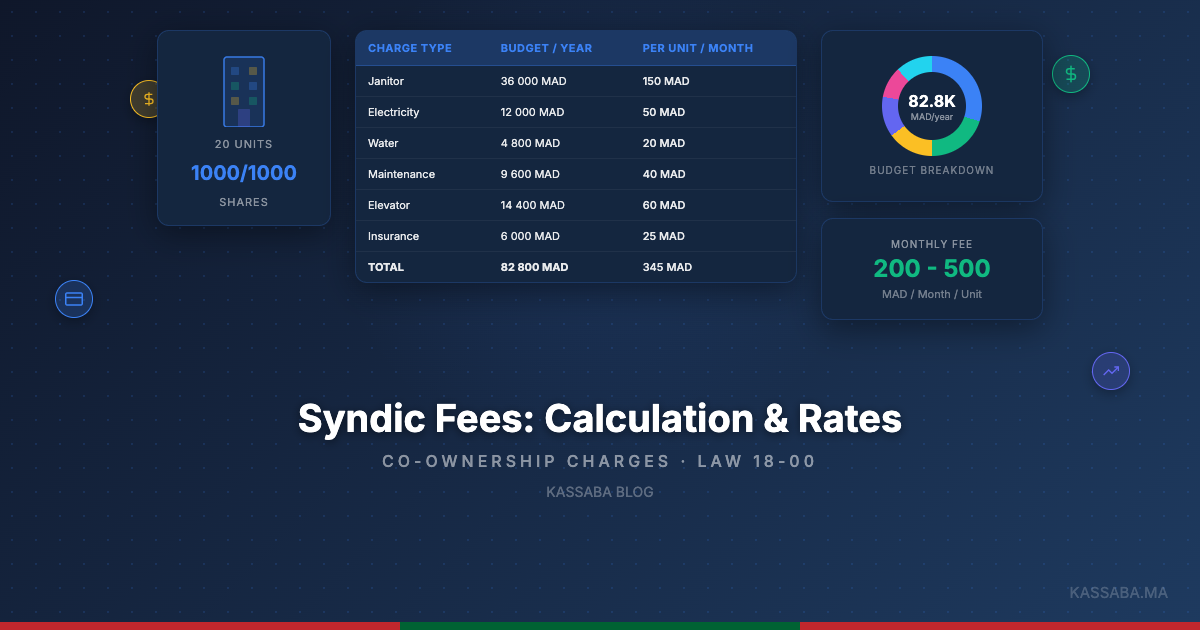
Syndic Fees in Morocco: How Much to Pay and How to Calculate Charges (2026)
Syndic fees in Morocco: typical budget breakdown by item, calculation by ownership shares, ranges from 100 to 1500 MAD/month depending on building type. What Law 18-00 says (Art. 37, 43).
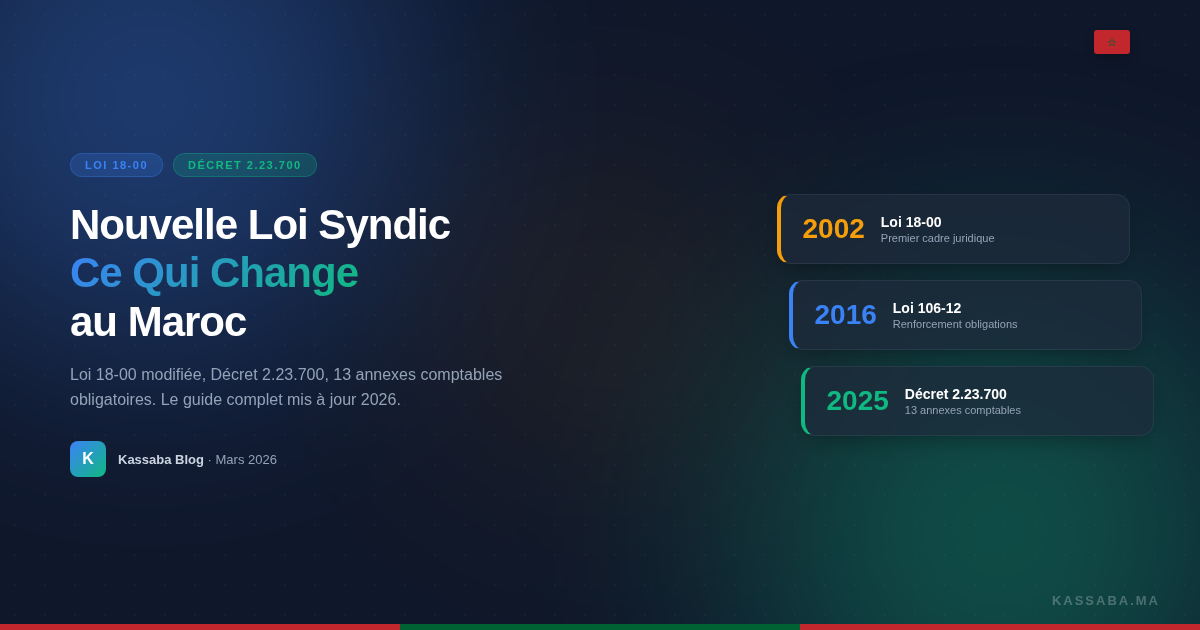
New Syndic Law in Morocco: What Changes in 2025-2026
Everything about the new syndic law in Morocco. Law 18-00 amendments, Decree 2.23.700, new accounting obligations and penalties. Updated guide 2026.
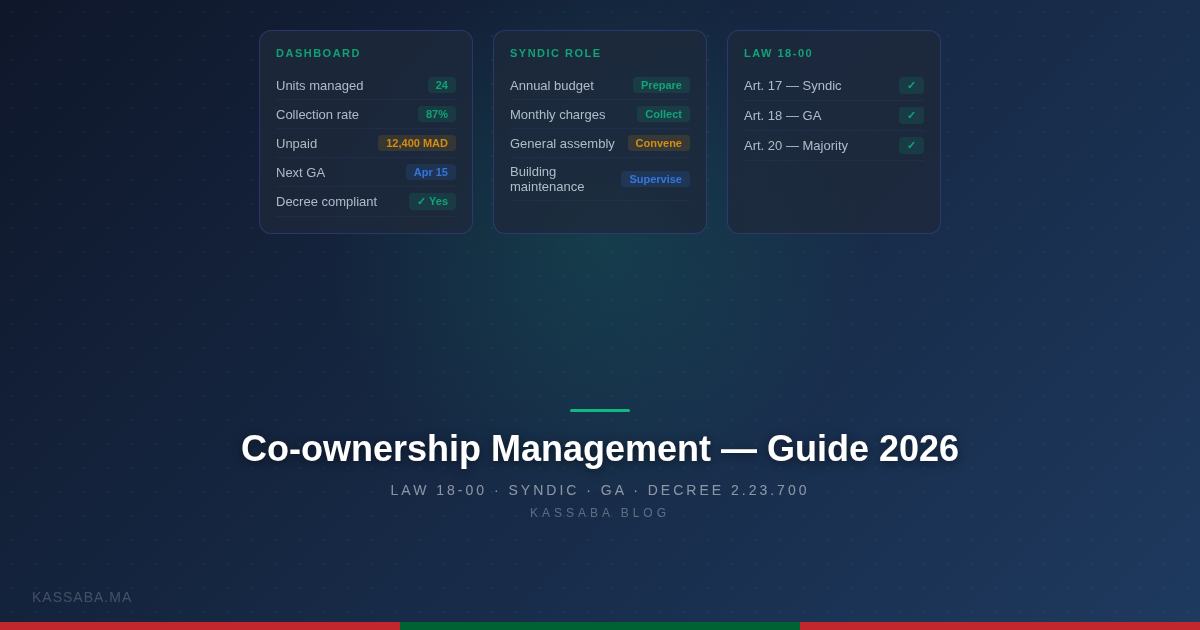
Co-Ownership Management in Morocco: A Complete Guide for 2026
How co-ownership management works in Morocco: the syndic's role, general assemblies, charges, Décret 2.23.700 accounting. A practical, up-to-date guide for property managers.