
Co-Ownership Management in Morocco: A Complete Guide for 2026
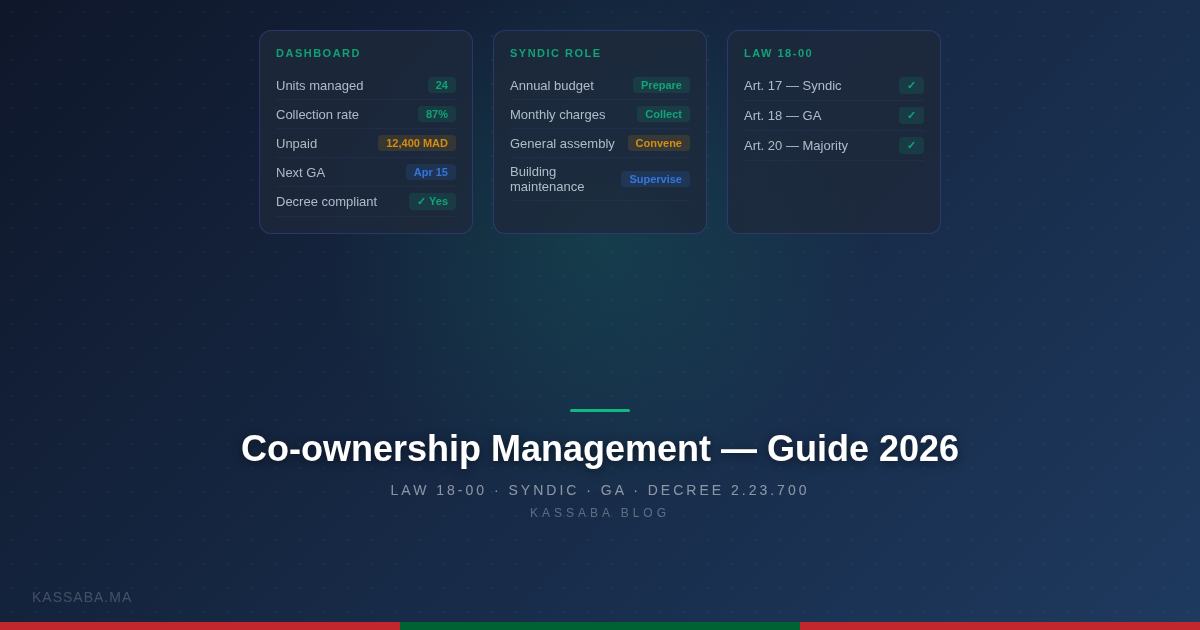
Why co-ownership management in Morocco feels so complicated
Managing a co-ownership (copropriété) in Morocco in 2026 means juggling co-owners who don't pay, a law that got updated, a brand-new accounting decree, and often nobody to explain how it all works in practice.
Were you "elected" at the last general assembly because nobody else wanted the job? Or are you a professional syndic (property manager) running five, ten, fifteen buildings? Either way, the obligations are identical. Law 18-00 (modified by Law 106-12, B.O. 6514, November 3, 2016) doesn't go easy on anyone.
This guide goes beyond the overview. For a high-level look, check our syndic management guide for Morocco. Here, we get practical: how to run a general assembly without losing your mind, how to deal with non-paying co-owners, how to produce the right accounting documents, and how to avoid breaking rules you didn't know existed.
The legal framework in 30 seconds
Two texts govern co-ownership in Morocco. Not three. Not five. Two.
Law 18-00 (modified by Law 106-12) sets the ground rules: who does what, how voting works, what the syndic must do, what rights co-owners have.
Décret 2.23.700 (B.O. 7391, March 31, 2025) added a standardized accounting framework. Before this decree, every syndic presented accounts however they wanted. Now there are mandatory annexes with a specific format.
For a detailed breakdown of the decree, see our full Décret 2.23.700 analysis.
The syndic's role: what the law actually requires
Election and term
The syndic is elected at the general assembly by a 3/4 majority of all co-owners' votes (Article 19). Not 3/4 of those present. Of all co-owners. That distinction matters a lot.
The term lasts exactly 2 years, renewable. Not one year. Not three. Two years. Article 19 is explicit.
You can serve as a volunteer syndic (a co-owner who takes on the role) or as a professional. The legal obligations are the same.
The 6 core obligations of a syndic
Article 26 of Law 18-00 lists what the syndic must do. Here's the practical version:
1. Open a separate bank account. Not a sub-account in your personal name. A real account in the name of the co-ownership syndicate. All income and expenses go through this account. A syndic who collects charges into their personal account is breaking the law.
2. Collect charges. That's your job. Co-owners must pay, but you're the one who has to follow up, track, and if necessary take action. One critical detail: charge claims expire after 5 years (Article 43). If you haven't done anything for 5 years, the debt disappears.
3. Maintain common areas. Hallways, stairs, roof, elevator, green spaces. Routine maintenance falls under your responsibility without needing a special vote.
4. Convene the annual general assembly. At least once a year, within 30 days of the end of the fiscal year (Article 16ter). More on this below.
5. Present the accounts. Every year, you report on your management to the assembly (Article 24). Since Décret 2.23.700, the documents you must produce are standardized.
6. Keep archives. Assembly minutes, invoices, contracts, correspondence. Everything must be kept and handed over to the next syndic if there's a change.
Resignation and handover
A syndic can resign. If they do, they must convene a general assembly within 30 days to elect a successor (Article 26ter). In the meantime, documents are handed to the deputy syndic.
Once the new syndic is elected, the outgoing one has 15 days to complete the full handover: documents, archives, keys, bank account access (Article 28). These are two separate deadlines, 30 days and 15 days, that apply to different situations.
The general assembly: a practical guide
The general assembly (AG) is where everything gets decided. Budget, works, syndic election. Prepare it poorly, and you're guaranteed problems for the entire year.
The notice
Notices must go out at least 15 days before the AG date (Article 16quinquies). By registered mail or legal notification. Not by WhatsApp, not by email, not by a note slipped under the door.
Yes, it's a hassle. Yes, it costs money (figure 15 to 25 MAD per co-owner for registered mail). But that's the law. An AG convened by a simple text message can be challenged in court.
The notice must include:
- The date, time, and location
- A detailed agenda
- Supporting documents (accounts, forecast budget)
Quorum
This is the most common mistake in Moroccan co-ownership. Quorum means half of the co-owners as individual people, or their representatives (Article 18).
A concrete example. Your building has 20 co-owners. For the AG to be valid, you need at least 10 people present or represented. It doesn't matter if one co-owner holds 40% of the tantièmes (voting shares). They count as one person for quorum purposes.
Tantièmes count for votes. Not for quorum. Many syndics confuse the two, and that's a frequent source of legal disputes.
If quorum isn't reached, you have to send new notices. At the second meeting, there's no quorum requirement.
The three voting levels
Law 18-00 provides for exactly three voting majorities. Not four, not two. Three. There is no two-thirds majority in Moroccan co-ownership law.
Majority of the votes of co-owners present or represented (Article 20). For routine decisions: maintenance, hiring or replacing the concierge, minor repairs. You total the votes of co-owners present or represented, and the decision passes if it gets more than 50% of that total.
Example: out of 1,000 total voting units, 600 are represented at the AG. The Article 20 majority threshold is 301 favorable votes.
3/4 majority of all co-owners' votes (Article 21). For major decisions: voting the budget, electing or removing the syndic, building insurance, major works, amending the co-ownership bylaws. Here, you calculate against the total votes of the entire co-ownership (not just those present).
Example: out of 1,000 total votes, you need 750 favorable votes to pass the budget. If only 600 votes are represented, the decision can't pass even if all 600 vote yes.
Unanimity (Article 22). For extreme cases: new construction on common areas, selling common areas, adding floors to the building.
Proxies
An absent co-owner can grant a proxy. But the law sets two limits (Article 16decies): a proxy holder can represent a maximum of 3 co-owners, AND the combined tantièmes of their grantors must not exceed 10% of total votes.
Scenario: you have a co-owner who owns 4 apartments in the building (it happens). They can't give proxy to a single person for all 4 units if the tantièmes exceed 10%.
Day-to-day financial management
Charge calls and the budget
The forecast budget is voted each year at the AG by a 3/4 majority (Article 21). The syndic then calls charges from co-owners proportional to their tantièmes.
Take a building with 24 apartments and an annual budget of 180,000 MAD. If you call charges quarterly, each co-owner gets a bill proportional to their tantièmes, four times a year.
A co-owner holding 50/1,000 tantièmes pays: 180,000 x 50/1,000 = 9,000 MAD per year, or 2,250 MAD per quarter.
Tracking unpaid charges
Unpaid charges are every syndic's nightmare. Here's a method that works:
- Day 15 after due date: Friendly SMS or call. "Your quarterly charge of 2,250 MAD is overdue. Please settle."
- Day 30: Second reminder, more formal. In writing this time.
- Day 60: Formal notice by registered mail. Mention the amount owed and the relevant law article.
- Beyond 90 days: Consider legal proceedings. But document everything: every reminder, every exchange.
Don't forget the 5-year limitation (Article 43). If you let unpaid charges sit too long without acting, you lose your legal recourse.
Software like Kassaba automates SMS reminders and tracks payments in real time, which prevents situations from getting out of hand. See our page on property management apps in Morocco for more.
The reserve fund question
Law 18-00 (Article 37bis) allows the creation of a reserve fund. It's not mandatory, but it's strongly recommended. Creating one requires a 3/4 assembly vote.
A reserve fund fed by 5 to 10% of the annual budget works out to 9,000 to 18,000 MAD per year for a building with a 180,000 MAD budget. After 5 years, you've got between 45,000 and 90,000 MAD to handle an elevator replacement, roof waterproofing, or facade renovation.
Without a reserve fund, every major unexpected expense requires an extraordinary charge call. And convincing 20 co-owners to come up with 5,000 MAD each on short notice is rarely easy.
Décret 2.23.700: accounting in practice
Décret 2.23.700 introduced a standardized accounting framework for co-ownerships. In practice, it classifies buildings into three tiers based on total charges called, and requires different documents for each.
The three tiers
Small co-ownership (charges up to 200,000 MAD). This covers the majority of residential buildings in Morocco. You need to produce:
- Annexe 10: co-owner contribution tracking
- Annexe 13-1: very simplified balance sheet
- Annexe 13-2: very simplified income, expenses, and budget statement
A small building with 12 units and 96,000 MAD in annual charges falls into this tier.
Medium co-ownership (charges between 200,000 and 500,000 MAD). Required documents:
- Annexe 10: co-owner contribution tracking
- Annexe 11: simplified financial statements
- Annexe 12: simplified income, expenses, and budget statement
Large co-ownership (charges of 500,000 MAD or more). The most detailed level:
- Annexes 3 through 10: balance sheet, general management account, budget comparison, non-current works, reserve fund tracking, loan tracking, equipment tracking, and co-owner contribution tracking.
How to produce these annexes
If you manage a small building, Annexes 13-1, 13-2, and 10 are relatively manageable. Annexe 10, for example, is a table listing each co-owner, their tantièmes, what they owe, and what they've paid.
For medium and large co-ownerships, producing these documents by hand gets unmanageable fast. This is exactly the kind of task Kassaba automates: you record transactions as they happen, and the annexes are generated in a few clicks. Our syndic accounting guide covers the full process.
The conseil syndical: a common confusion
Many co-owners talk about "creating a conseil syndical" (advisory council) to oversee the syndic. This idea comes from French law, but Moroccan law says something different.
Article 29 of Law 18-00 limits the conseil syndical to multi-building complexes (ensembles immobiliers). A single building with 20 apartments? No conseil syndical under Moroccan law.
That doesn't mean co-owners can't organize. Nothing prevents creating an informal monitoring committee. But it won't have legal standing, and its decisions don't bind anyone.
7 mistakes that get syndics into trouble
After hundreds of conversations with Moroccan syndics, here are the most common pitfalls.
1. No separate bank account. Some syndics, especially volunteers, collect charges into their personal account "to keep things simple." That's a direct violation of Article 26, and it makes accounting unverifiable.
2. Confusing quorum and majority. Quorum (Article 18) is counted in people. Voting majorities are counted in votes. Mix the two up, and your AG decisions could be invalidated.
3. Forgetting the charge limitation period. 5 years (Article 43) and the claim is gone. Many syndics discover this rule too late, sitting on 3 or 4 years of arrears they never followed up on.
4. Sending AG notices by WhatsApp. Convenient, fast, but legally insufficient. Article 16quinquies requires registered mail or legal notification. The unhappy co-owner who challenges a decision because they "never received a proper notice" will be right in front of a judge.
5. Ignoring Décret 2.23.700. Presenting accounts in a homemade Excel spreadsheet doesn't cut it anymore. Standardized annexes are mandatory.
6. Exceeding your mandate. A syndic who starts major works without an AG vote (3/4 majority, Article 21) takes on personal liability.
7. Not documenting the handover. When a syndic leaves, the handover must happen within 15 days (Article 28). Without clear documentation, the new syndic inherits chaos and the former one faces potential legal action.
Practical checklist: is your building compliant?
Review your co-ownership against this list:
- Separate bank account in the syndicate's name: opened and active
- Annual AG held within 30 days of the fiscal year end
- Notices sent 15 days in advance by registered mail
- Forecast budget voted by 3/4 majority
- Accounts presented with the required Décret 2.23.700 annexes
- Charges called and tracked (reminders documented)
- No unpaid claims older than 4 years without action
- Complete archives (minutes, invoices, contracts, correspondence)
- Proxies compliant (max 3 co-owners, no more than 10% of tantièmes)
If you checked every box, your management is solid. If several boxes are empty, it's time to act before an unhappy co-owner takes the matter to court.
Managing from abroad: the MRE challenge
Thousands of Moroccans living abroad (MRE, Marocains Résidents à l'Étranger) own property in Morocco. Some are even syndics, which creates real logistical challenges.
How do you convene an AG when you're in Paris or Amsterdam? How do you check that the concierge is doing their job? How do you track payments in real time?
This is exactly the kind of situation where a property management app makes the difference. Track charges from your phone, send automatic reminders, get a real-time dashboard. Physical distance shouldn't be a barrier to proper management.
For MRE co-owners who want to understand their rights, our article on Law 18-00 explains the legal framework in accessible terms.
What's changing in 2026
2026 is a turning point for co-ownership management in Morocco. Décret 2.23.700, published in the Official Bulletin in March 2025, is now fully in effect. Syndics who haven't yet adopted the standardized accounting framework risk having their accounts challenged at the AG.
The trend is clear: more formality, more transparency, more documentation. Co-owners are better informed about their rights and expect properly formatted accounts.
For syndics who want to get compliant, the simplest approach is to identify your co-ownership's tier (small, medium, large), then produce the corresponding annexes for the next fiscal year.
Manage your co-ownership with full legal compliance. Automated accounting, Décret 2.23.700 annexes, SMS reminders. Try Kassaba syndic software for free
FAQ
What are a syndic's legal obligations in Morocco?
The syndic must open a separate bank account in the co-ownership's name (Art. 26), convene the general assembly at least once a year within 30 days of the fiscal year end (Art. 16ter), collect charges, maintain common areas, keep archives, and present annual accounts in the format required by Décret 2.23.700.
How is quorum calculated at a general assembly in Morocco?
Quorum requires the presence of half the co-owners as individual people, or their representatives (Article 18). It is the number of people that matters for quorum, not tantièmes. Tantièmes are only used for calculating votes.
Which accounting annexes does my building need to produce?
It depends on total charges called per year. Small co-ownership (up to 200,000 MAD): Annexes 10, 13-1, and 13-2. Medium (200,000 to 500,000 MAD): Annexes 10, 11, and 12. Large (500,000 MAD or more): Annexes 3 through 10.
Does a volunteer syndic have the same obligations as a professional one?
Yes. Law 18-00 makes no distinction between volunteer and professional syndics. Accounting obligations, the annual general assembly, the separate bank account, and producing Décret 2.23.700 annexes all apply equally to both.
Simplify your property management
Kassaba automates accounting, payment reminders, and resident communication.
Create your free syndic accountFree during beta. No credit card required.
Related articles
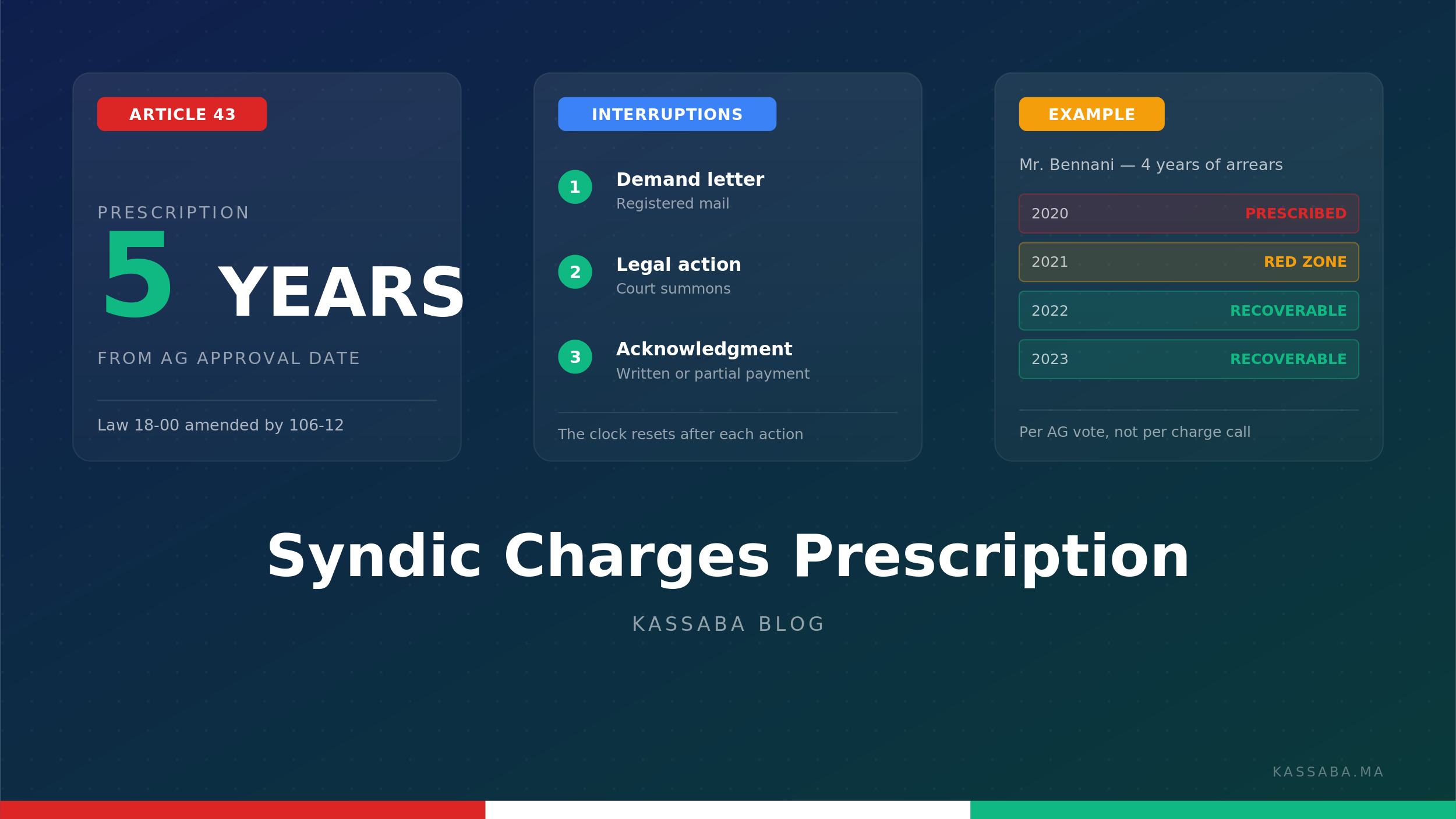
Syndic Charges in Morocco: The 5-Year Prescription Rule (Article 43)
In Morocco 2026, syndic charges expire 5 years after approval by the General Assembly (Art. 43 Law 18-00). How to calculate and interrupt.
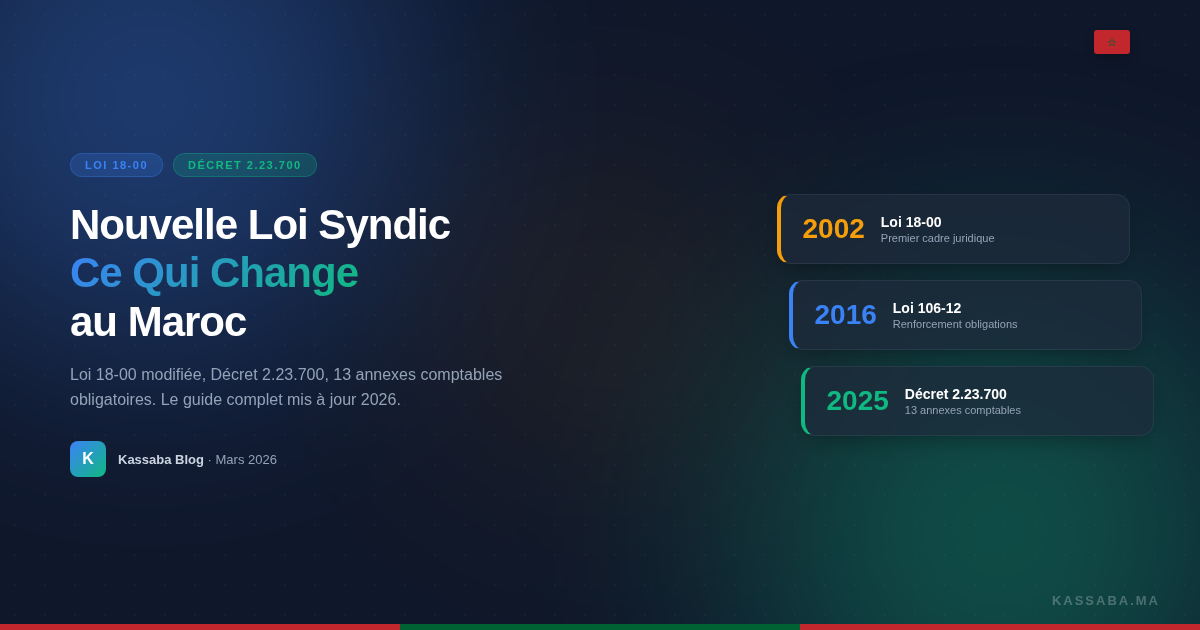
New Syndic Law in Morocco: What Changes in 2025-2026
Everything about the new syndic law in Morocco. Law 18-00 amendments, Decree 2.23.700, new accounting obligations and penalties. Updated guide 2026.
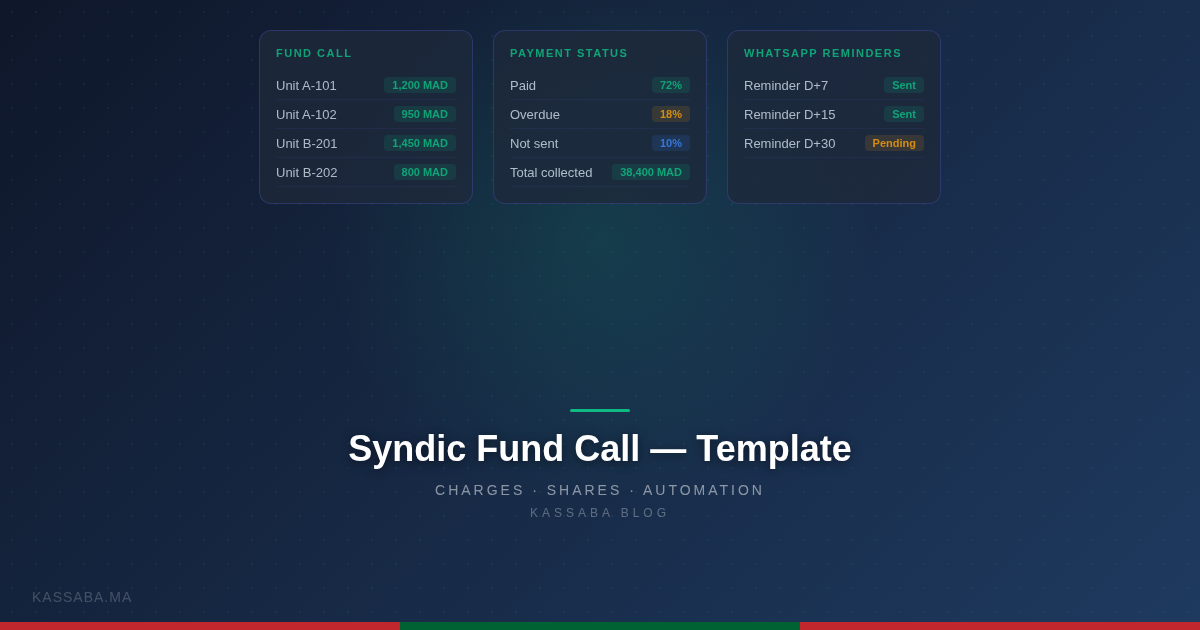
Charge Calls for Syndics in Morocco: Templates and Automation
How to draft a charge call as a syndic in Morocco, calculate tantièmes, and follow up on unpaid charges. Concrete template and practical tips.