
Syndic Charges in Morocco: The 5-Year Prescription Rule (Article 43)
The rule that can cost you dearly if you forget it
There's a rule in Law 18-00 that many syndics discover too late: unpaid charges expire after five years. Past that deadline, you can no longer claim them. Legally, the debt no longer exists.
Five years sounds long. Day to day, it's a window that closes faster than you'd think, especially when a co-owner accumulates several years of unpaid charges and no one launches the formal collection procedure.
Here's how prescription works in Morocco, how to keep it from catching you off guard, and what to do if it's already started.
What Article 43 says
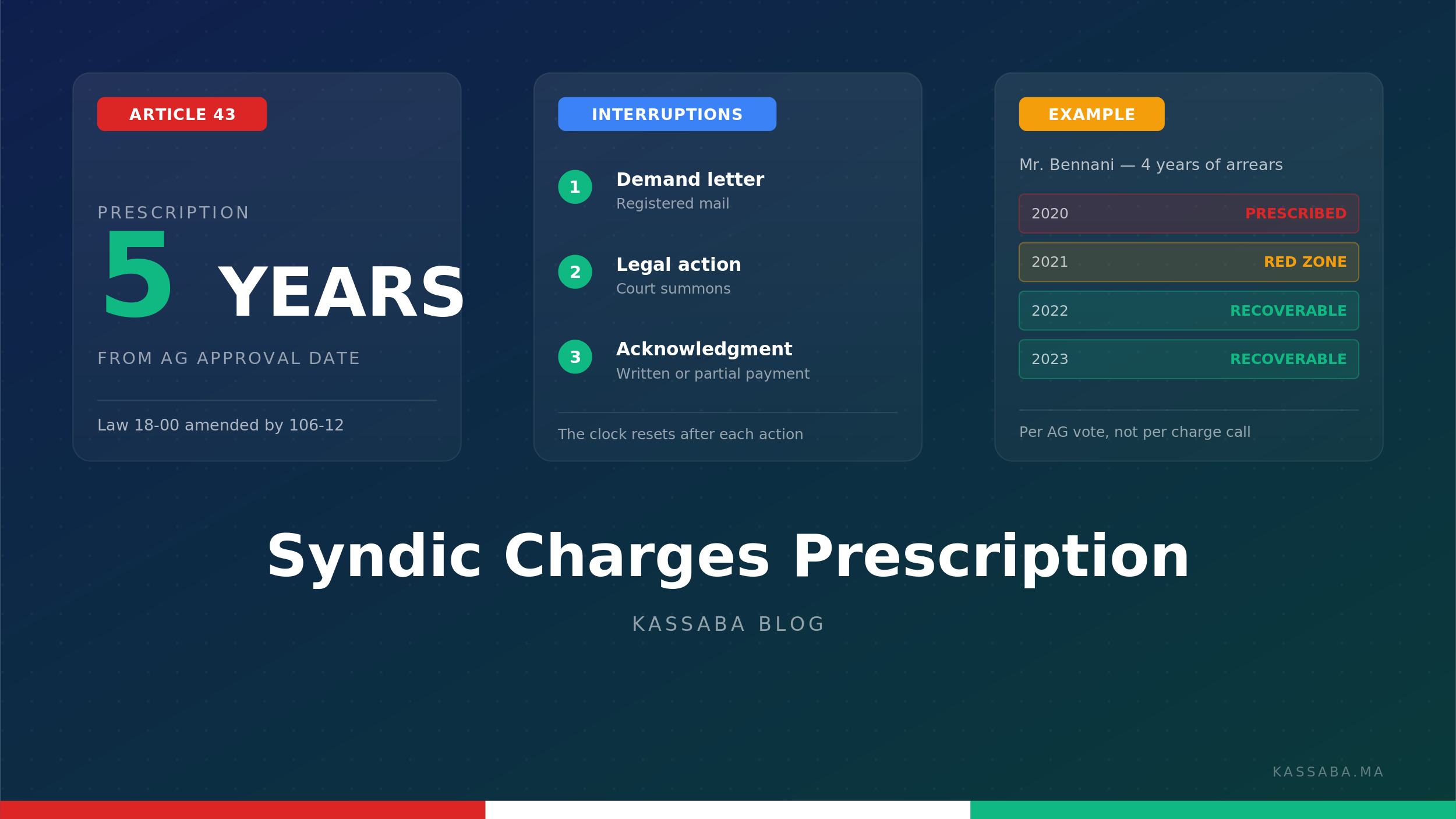
Article 43 of Law 18-00 (as amended by Law 106-12) is clear: claims by the co-owners' association concerning common charges are prescribed after five years from the date those charges were approved by the General Assembly.
Three words to remember: prescription, five years, AG approval.
Prescription is the extinction of a right by the passage of time. Five years is the exact period set by Moroccan law. The starting point is NOT the due date on the charge call, nor the date the co-owner should have paid. It's the date of the General Assembly minutes that voted those charges.
For example: if the AG of March 15, 2024, votes the 2024 budget, every charge under that budget (whether called in Q1, Q2, or year-end) shares a single prescription deadline: March 15, 2029. After that, the co-owner can legitimately invoke prescription to refuse payment.
That's a particularity of Moroccan law worth knowing. Many syndics think in terms of charge due dates, but Article 43 is anchored on the AG approval date.
Prescription is per-AG-vote, not per-charge-call
A point that's often misunderstood. Prescription is calculated per assembly decision, not per individual charge call.
Take a concrete example. Mr. Bennani owes the association five years of arrears. To calculate what's still recoverable, look at each AG that voted an annual budget:
- 2020 budget voted at the AG of March 12, 2020 → 2020 charges prescribed since March 12, 2025
- 2021 budget voted at the AG of February 28, 2021 → 2021 charges prescribed February 28, 2026
- 2022 budget voted at the AG of March 5, 2022 → 2022 charges still recoverable until March 5, 2027
- 2023 budget voted at the AG of March 18, 2023 → 2023 charges still recoverable until March 18, 2028
- 2024 budget voted at the AG of March 22, 2024 → 2024 charges still recoverable until March 22, 2029
Out of five years of arrears, two are already lost if nothing interrupted prescription. If an extraordinary AG voted special works (Article 21) during the year, those charges have their own prescription clock, separate from the annual budget.
That's exactly why you have to act fast, and act formally.
How to interrupt prescription
Two regimes coexist in Moroccan law for interrupting prescription:
- The general civil law regime (Dahir des Obligations et des Contrats, or DOC), which applies to all civil debts, including syndic charges.
- The syndicate's special procedure (Articles 25, 25bis and 36bis of Law 18-00), which creates an accelerated debt-recovery path specific to co-ownerships.
The general regime: three actions interrupt prescription
The three actions below come from Moroccan general civil law (Dahir des Obligations et des Contrats). They are not listed in Law 18-00 itself, but they apply to any civil debt, including syndic charges. After a valid interruption, a fresh 5-year period starts running.
1. The demand letter (mise en demeure). A registered letter with acknowledgment of receipt, addressed to the debtor co-owner, requiring payment within a specified deadline. To interrupt prescription, it must be formal:
- Sent by registered mail with acknowledgment of receipt (or by bailiff)
- Specify the charges concerned with their dates and amounts
- Grant a reasonable payment period (15 to 30 days)
- State the consequences of non-payment
A WhatsApp message, an email, or a regular letter is not enough. Proof of sending and receipt is what gives the demand letter its legal value.
2. Legal action. A summons before the court of first instance permanently interrupts prescription for the charges concerned. Before going to court, you generally need to have exhausted the amicable route. The judge almost always requires a prior demand letter.
3. Acknowledgment of debt. If the co-owner acknowledges in writing that they owe the amount, that acknowledgment interrupts prescription. It can take the form of a signed letter, a payment plan agreement (settlement protocol), or the signature of a document recapping amounts owed. A partial payment can also count as implicit acknowledgment, but judges examine each case individually.
The Law 18-00 special procedure: accelerated recovery
Law 18-00 gives the syndicate its own faster debt-recovery path:
- Article 25: the syndic's demand letter. If the co-owner doesn't pay within 30 days of a formal demand letter, all future installments for the fiscal year become immediately due. You no longer have to chase them charge by charge.
- Article 25bis: the derogation. The syndic can request a payment order by explicitly departing from Article 155 et seq. of the Code of Civil Procedure.
- Article 36bis: the judge's deadline. The court must issue the payment order within a maximum of three (3) months.
Why this procedure exists: the Moroccan legislator wanted to give syndicates a fast tool so that unpaid charges don't drag on. In practice, this is the path that should be preferred for material amounts, rather than the standard civil procedure.
The critical role of follow-up
If you're a syndic, the worst enemy of prescription is forgetfulness. A charge forgotten for five years is a lost receivable.
Without a tracking system, here's what happens in practice. The co-owner doesn't pay. The syndic sends a WhatsApp reminder. The co-owner promises to settle up. The syndic moves on, busy with claims and general assemblies. Six months later, the reminder is repeated. A year later, repeated again. Three years later, no one knows exactly which charge has been formally reminded and which hasn't. Five years later, some charges are prescribed without anyone noticing.
A well-organized syndic, whether professional or volunteer, keeps a prescription schedule for each debtor co-owner. For each unpaid charge, they note the due date, the prescription deadline, and any interrupting actions taken.
That's exactly the kind of follow-up Kassaba automates: prescription alerts at 6 months and 3 months before the deadline, traceability of every demand letter, automatic calculation of prescription dates per charge. For syndics managing several buildings, manual tracking becomes impossible.
What to do if a charge is already prescribed
When the deadline has passed, your room to maneuver is limited.
On the accounting side, the receivable stays on the books until the general assembly decides to write it off. This matters: as long as the receivable appears in the accounts, it shows up in Annexe 10 of Decree 2.23.700 (per-co-owner contribution tracking) and distorts the financial reading of the co-ownership.
The general assembly therefore needs to make a clear decision. Either it acknowledges the prescription and writes off the receivable (with explicit mention in the minutes). Or it decides to attempt amicable collection anyway, knowing that the co-owner can invoke prescription if things go to court.
Either way, the syndic must present co-owners with the precise list of prescribed receivables, with amounts and names (or unit numbers if confidentiality requires it). It's often an uncomfortable moment, but a necessary one so that everyone understands why the cash balance doesn't match the theoretical individual balances.
The partial-payment trap
Here's a practical case that comes up often. A co-owner owes 30,000 MAD in charges accumulated over four years. They offer to pay 5,000 MAD to settle everything. You accept out of weariness, without formalizing.
Several problems arise. First, without a written agreement qualifying this payment as a full and final settlement, the partial payment can be considered an acknowledgment of debt for the total. That interrupts prescription for the remaining 25,000 MAD, which can be beneficial for the co-ownership.
Second, accepting a partial payment without a formal framework doesn't extinguish the debt. The syndic cannot, on their own initiative, grant a discount. Only the general assembly is authorized to settle the co-ownership's receivables (or to vote on a settlement protocol).
The right reflex: if a co-owner offers a partial payment or installment plan, formalize it through a signed settlement protocol, presented to the next general assembly for ratification. That protects everyone.
Prescription and change of syndic
When a syndic is replaced, Article 28 of Law 18-00 requires that documents be handed over to the new syndic within 15 days. Among these documents are the statements of unpaid charges and their collection history.
If the previous syndic doesn't transmit this information correctly, or has let charges expire without acting, their liability can be triggered. Collection management is part of the syndic's duties (Article 26), and Article 27 paragraph 2 explicitly provides that "the syndic or their deputy is held liable for any breach of the duties entrusted to them." A syndic who lets receivables prescribe through negligence can therefore be required to reimburse them out of their own pocket.
A point that volunteer syndics often underestimate. Accepting the mandate without rigorously tracking charges means taking a personal financial risk. For a complete overview of syndic obligations, see our complete guide for volunteer syndics in Morocco.
Deadlines to remember
Here are the numbers to keep in mind.
| Subject | Deadline | Article |
|---|---|---|
| Prescription of charges (from AG approval date) | 5 years | Article 43 Law 18-00 |
| Demand letter → all installments become due | 30 days | Article 25 |
| Court must issue payment order | 3 months max | Article 36bis |
| Deadline to convene the annual GA | 30 days after fiscal year-end | Article 16ter |
| Convocation notice deadline | Minimum 15 days before the GA | Article 16quinquies |
| Syndic mandate | 2 years renewable | Article 19 |
| Document handover to new syndic | 15 days | Article 28 |
| Convening the GA after syndic resignation | 30 days | Article 26ter |
Five years can seem long when you sign a charge call. Five years passes quickly when you're a volunteer syndic juggling claims, repairs, general assemblies, and a collection file slips under the pile.
Three things to do today
If you're a syndic and you're reading this, here are three concrete actions to put in place this week:
1. Take inventory. List every debtor co-owner. For each fiscal year of arrears, note the date of the AG that approved the charges and calculate the prescription date (5 years after that AG). Any year whose prescription falls within the next 12 months is in the red zone.
2. Prioritize the red zones. For each at-risk charge, send a formal demand letter by registered mail. This single action buys you five more years of margin.
3. Set up tracking. Whether in an Excel spreadsheet, your management software, or a shared calendar, create a system that automatically alerts you when a charge approaches prescription. This tracking must survive changes of syndic. If you are still choosing the tool, our full framework for evaluating syndic software in Morocco covers what to verify in a vendor demo, including how the system anchors prescription dates on the AG approval date rather than the due date.
Prescription isn't an abstract legal subject. It's money flowing out of your co-ownership's accounts simply because no one looked at the calendar at the right time.
FAQ
What is the prescription period for co-ownership charges in Morocco?
In Morocco, Article 43 of Law 18-00 sets the prescription period for co-ownership charges at five (5) years. Past this deadline, the co-owners' association can no longer claim unpaid charges in court. The clock starts running from the date the General Assembly (AG) approved the charges, NOT from the payment deadline shown on the charge call.
When does the prescription period start?
The 5-year period starts on the date the General Assembly approved the charges, not on the payment due date of the charge call. If the AG of March 15, 2024, votes the 2024 budget, all charges issued under that budget share a single prescription deadline: March 15, 2029, regardless of when individual charge calls fall during the year.
How do you interrupt the prescription of a syndic charge?
Three actions interrupt prescription: a formal demand letter sent by registered mail with acknowledgment of receipt, legal action (court summons), or written acknowledgment of the debt by the co-owner. After each interruption, a new 5-year period starts running.
What happens when a charge is prescribed?
A prescribed charge can no longer be claimed in court. The co-owner can invoke prescription as a defense. For the association, the receivable remains morally due but is no longer enforceable. That's why deadline tracking is essential: letting a charge prescribe is the same as losing the money.
Can the syndic waive prescription in favor of the co-owner?
No. The syndic does not have the power to waive the co-ownership's receivables. Prescription is a legal rule that protects the co-owner. If a charge is prescribed, it's prescribed. Only the general assembly can decide on the accounting write-off of a debt, and even that decision has no retroactive effect on prescription itself.
Simplify your property management
Kassaba automates accounting, payment reminders, and resident communication.
Create your free syndic accountFree during beta. No credit card required.
Related articles
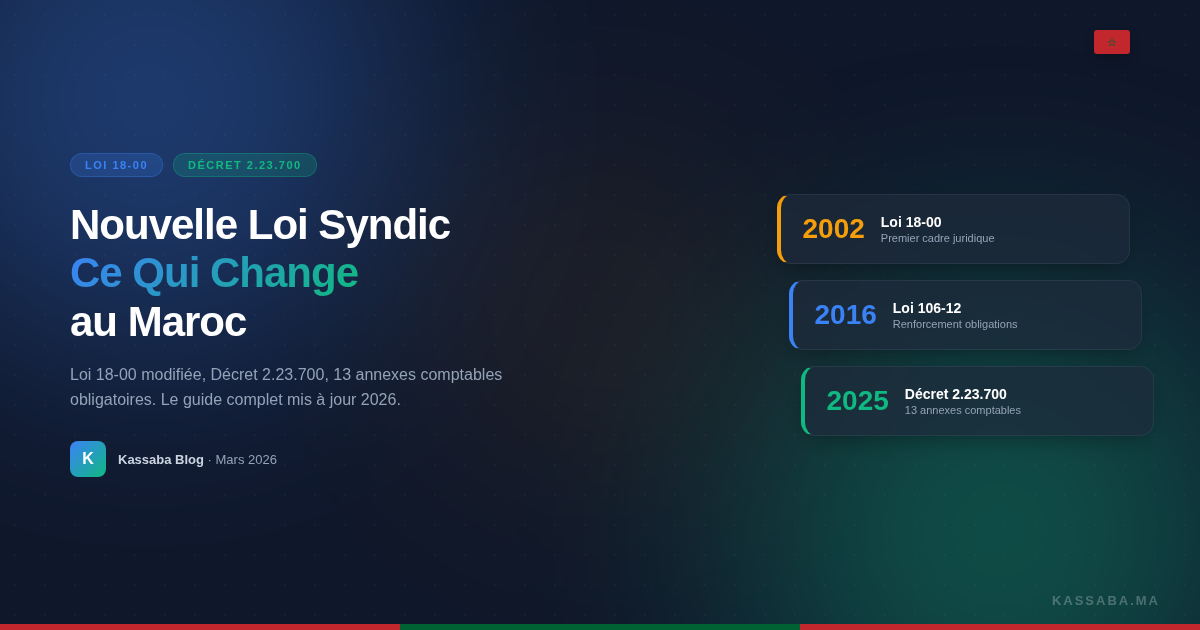
New Syndic Law in Morocco: What Changes in 2025-2026
Everything about the new syndic law in Morocco. Law 18-00 amendments, Decree 2.23.700, new accounting obligations and penalties. Updated guide 2026.
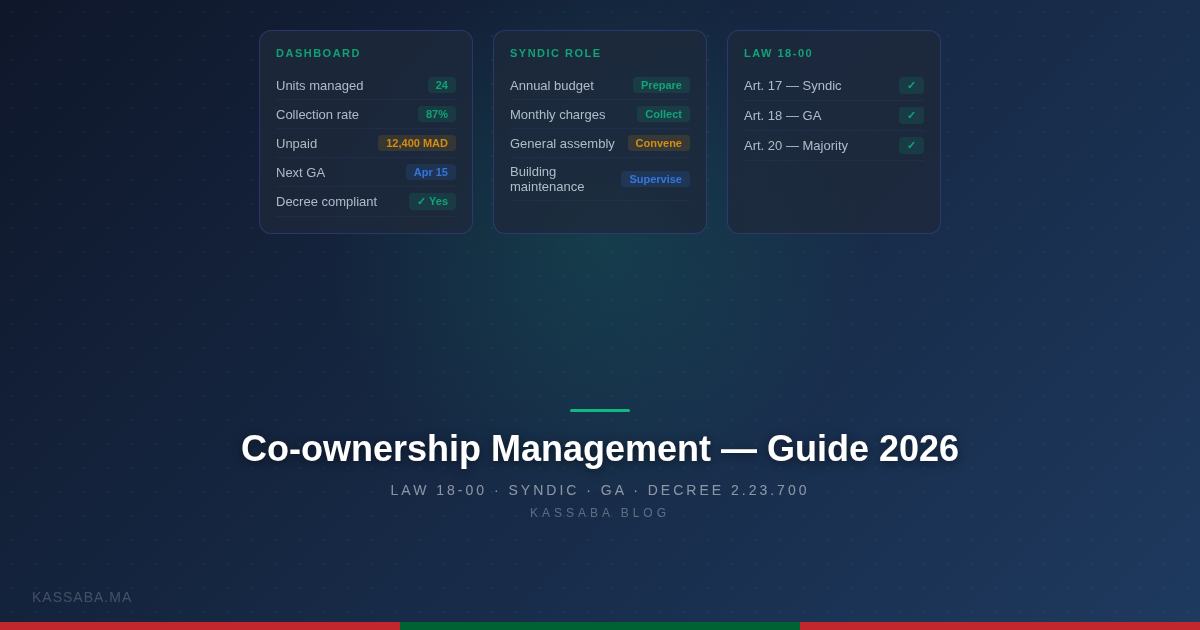
Co-Ownership Management in Morocco: A Complete Guide for 2026
How co-ownership management works in Morocco: the syndic's role, general assemblies, charges, Décret 2.23.700 accounting. A practical, up-to-date guide for property managers.
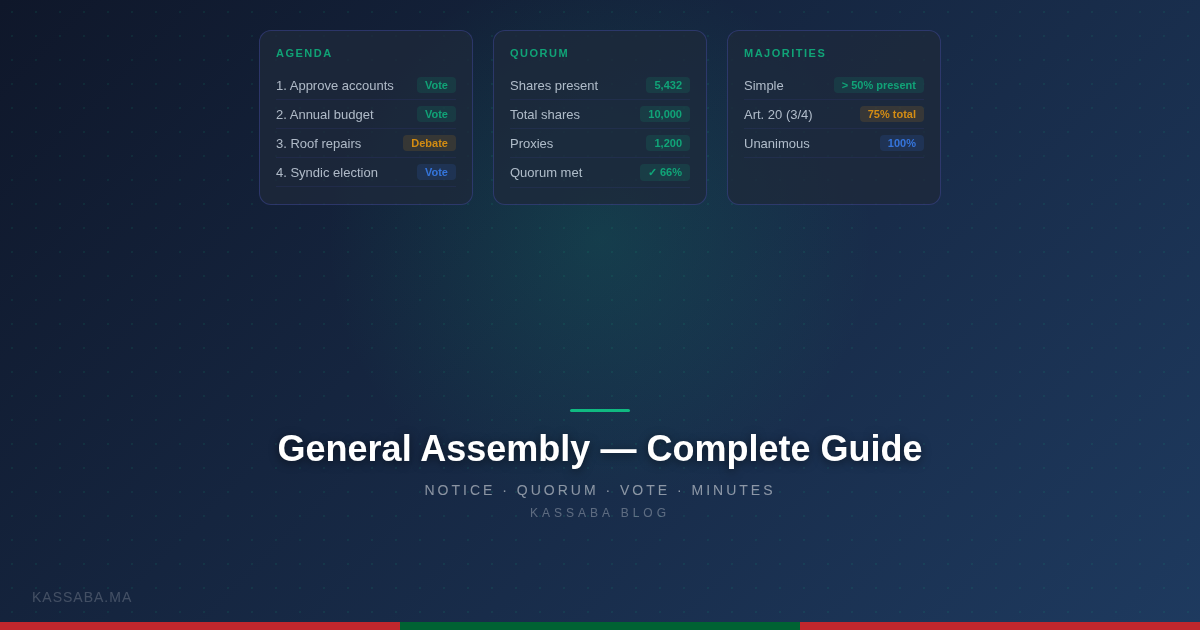
General Assembly for Co-Ownership in Morocco: A Complete Guide
How to organize a general assembly for co-ownership in Morocco: notices, quorum, voting majorities, minutes. A practical guide for syndics and co-owners.