
General Assembly for Co-Ownership in Morocco: A Complete Guide
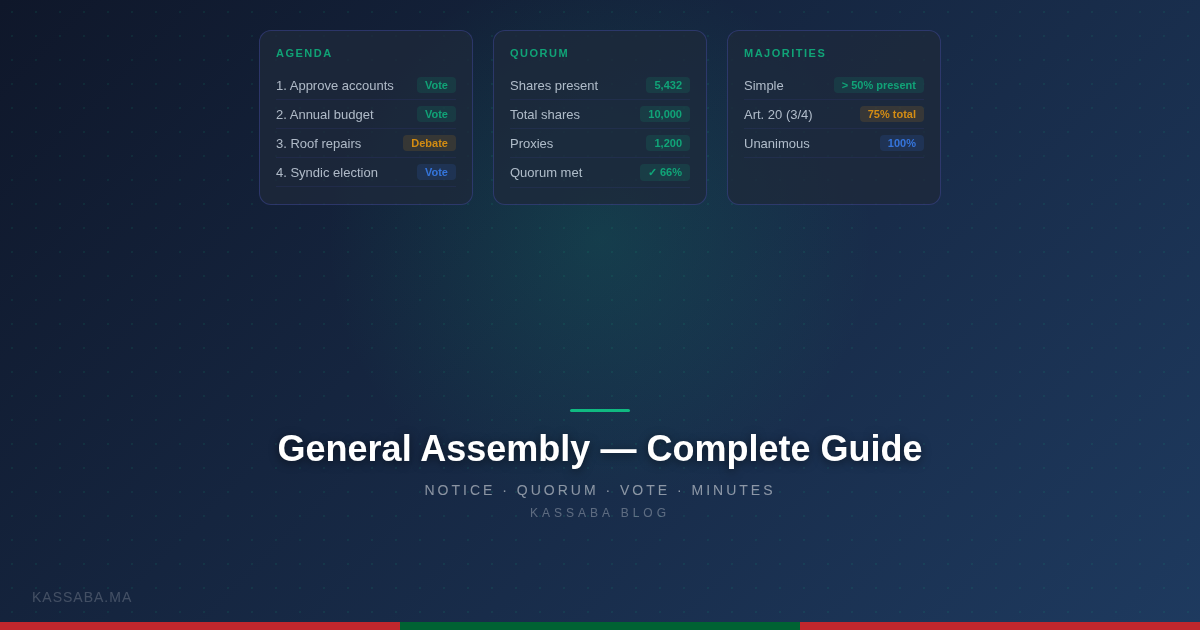
The AG: where everything gets decided
You're the syndic (property manager) and you need to organize the annual general assembly. Or maybe you're a co-owner who wants to understand your rights before attending. Either way, the general assembly (AG, from the French "assemblée générale") is the most important event in the life of a Moroccan co-ownership.
It's during the AG that the budget is voted, the syndic is elected or reconfirmed, and works are approved. Prepare it poorly, and you risk decisions that can be challenged. Misunderstand the voting rules, and you risk blocking the building for a year.
Law 18-00 (modified by Law 106-12, B.O. 6514, November 3, 2016) governs everything: the notice, quorum, voting majorities, proxies. Here's how it works in practice.
When to convene the general assembly
The ordinary AG must be held at least once a year (Article 16ter). The syndic has 30 days after the end of the fiscal year to convene it.
A concrete example. If your fiscal year ends December 31, the AG must take place before January 31. Not in March. Not "when we get around to it." Before January 31.
Many volunteer syndics postpone the AG because they haven't finalized the accounts, or because finding a date that works for everyone seems impossible. The problem: the law doesn't accept excuses. If you don't convene the AG on time, any co-owner can ask the court to have it called.
Ordinary AG vs extraordinary AG
The ordinary AG is the one you must hold every year. It covers the previous year's results, the forecast budget vote, the syndic's reconfirmation or election, and planned works.
An extraordinary AG can be called at any time to deal with an urgent matter that can't wait until the next ordinary AG. The rules for notices, quorum, and voting majorities are the same. The only difference is the one-off, urgent nature of the topic.
Notices: rules and content
The notice is a formal legal act. Not a WhatsApp message in the building's group chat. Not a paper posted in the lobby. The law is specific.
Timing and delivery method
Article 16quinquies requires a minimum of 15 days between sending the notice and the AG date. Delivery must be by registered mail or legal notification (via a huissier de justice, a judicial officer).
15 days is the minimum. In practice, plan for 20 to 25 days. Why? Registered mail in Morocco sometimes takes several days to arrive. And if a co-owner lives abroad (there are many MRE in Moroccan co-ownerships), the postal delay is even longer.
What must the notice include?
The notice must state:
- Date, time, and location of the meeting
- Detailed agenda, point by point
- Supporting documents (management accounts, forecast budget, any contractor quotes)
The agenda is particularly important. Any decision made on a topic not listed in the agenda can be challenged in court. If you want to vote on facade renovation, that item must appear clearly in the notice, not get added under "miscellaneous" on the day.
Who can convene the AG?
The syndic convenes the AG. But if the syndic fails to do so within the legal timeframe, co-owners representing at least a quarter of votes can request convocation. As a last resort, the court can order the AG to be held.
This is an important safeguard. A syndic who refuses to call the AG, often because they don't want to present their accounts, can't block the co-ownership indefinitely.
Quorum: the most misunderstood rule
Quorum is the minimum number of participants required for the AG to make valid decisions. And it's probably the most misunderstood rule in all of Moroccan co-ownership.
Quorum = people, not tantièmes
Article 18 of Law 18-00 is clear: quorum requires the presence (or representation) of half of the co-owners as individual people. Not half of the tantièmes.
An example. Your co-ownership has 20 co-owners. For the AG to be valid, at least 10 must be present or represented by a proxy holder. It doesn't matter if those 10 hold 30% or 80% of the tantièmes. It's the number of people that counts for quorum.
Voting rights are separate from quorum. A co-owner may carry more voting weight in a decision, but for quorum they count as one person, the same as every other co-owner.
This distinction is fundamental. In many co-ownerships, a single owner holds a large share of tantièmes (a developer who hasn't sold all units yet, for example). That owner can swing a vote, but they can't single-handedly satisfy quorum.
What if quorum isn't reached?
The classic scenario. You sent 30 notices by registered mail, booked the room, prepared the accounts. On the day, only 8 out of 30 co-owners show up. Quorum (15 people) isn't reached.
Don't worry. The law provides for a second meeting.
The second meeting: the safety net
If quorum isn't reached at the first AG, the syndic can call a second assembly. This time, no quorum requirement applies. The AG can validly make decisions regardless of how many co-owners are present.
The voting majorities remain the same (more on those below). Only the quorum requirement disappears.
In practice, here's how it works:
- The first AG is called normally (15-day notice, registered mail)
- Quorum isn't reached. The syndic records the failure
- A new notice is sent for a second AG, following the same procedures (registered mail, 15-day notice)
- The second AG is held with no quorum requirement
Some syndics put both dates (first and second meeting) on the same letter, 30 minutes apart. The practice is common, but be careful: the spirit of the law is to give co-owners a genuine second chance to participate. If the second notice is sent the same day as the first, a co-owner could challenge the procedure.
The safest approach is to send two separate notices. More work, but legally bulletproof.
The three voting majorities
This is the heart of how the AG works. Law 18-00 provides for exactly three majority levels. Not four. Not five. Three. There is no two-thirds majority in Moroccan co-ownership law.
Simple majority (Article 20)
Majority of the votes of co-owners present or represented. This is the default majority for routine decisions.
What it covers:
- Routine maintenance of common areas
- Hiring or dismissing the concierge
- Minor maintenance works
- Any matter that doesn't fall under Articles 21 or 22
Concrete example. 10 co-owners are present, with 600 voting units represented out of 1,000. For a decision to pass under Article 20, the favorable votes must exceed half of the votes present or represented.
3/4 majority (Article 21)
Three-quarters of all co-owners' votes (not just those present). This is a qualified majority, much harder to reach.
What it covers:
- Voting the annual budget
- Electing the syndic (2-year term exactly, Article 19)
- Taking out building insurance
- Major works (facade renovation, roof repairs, bringing up to code)
- Amending the co-ownership bylaws
Watch the calculation. If your co-ownership totals 1,000 votes, you need 750 favorable votes to reach 3/4. Even if only 15 out of 20 co-owners are present. The 3/4 is calculated on the entire co-ownership total, not on those present.
This is what makes this majority hard to achieve. If 5 absent co-owners represent 250 votes, you need to convince almost everyone present. That's why proxies (coming up next) matter so much.
Unanimity (Article 22)
Unanimity of all co-owners. All of them. No exceptions.
What it covers:
- New construction on common areas
- Selling common areas
- Adding floors to the building (surélévation)
In practice, unanimity is nearly impossible in large co-ownerships. A single absent or opposed co-owner blocks the decision. That's intentional: these decisions change the very substance of the building and cannot be imposed on a co-owner against their will.
Majority summary
| Majority | Calculation Basis | Examples |
|---|---|---|
| Simple (Art. 20) | Tantièmes of those present/represented | Maintenance, concierge, minor works |
| 3/4 (Art. 21) | Tantièmes of ALL co-owners | Budget, syndic, insurance, major works |
| Unanimity (Art. 22) | ALL co-owners | New construction, selling common areas |
Proxies: two limits to respect
Not every co-owner can attend the AG. MRE living in France, the Netherlands, or Spain. Elderly co-owners. People traveling for work. Proxies (mandates) allow them to be represented.
But Article 16decies sets two cumulative limits:
- A proxy holder can represent a maximum of 3 co-owners
- The combined tantièmes of their grantors must not exceed 10% of total votes
Both conditions must be met simultaneously. A co-owner who already holds 8% of tantièmes can only accept one proxy (as long as the total stays under 10%). And even if they only represent 2% of tantièmes, they cannot hold more than 3 proxies.
Why this double limit? To prevent a single co-owner from accumulating proxies and controlling the AG alone. It's a democratic safeguard.
In practice, check proxies before the AG starts. Software like Kassaba can automatically calculate whether the limits are respected, which avoids disputes during the meeting.
How the AG runs
Opening and verification
The AG begins with quorum verification. The syndic (or the meeting chairperson) prepares the attendance sheet, checks proxies, and counts the number of co-owners present or represented.
If quorum is reached (half the co-owners as people), the AG can begin. If not, a failure is recorded and a second notice will be needed.
Electing the chairperson and secretary
The AG elects a chairperson from among the co-owners present. The chairperson directs the proceedings and ensures the meeting runs smoothly. A secretary is also appointed to draft the minutes.
Discussion and voting, point by point
Each agenda item is discussed then put to a vote. The chairperson should clearly announce the required majority before each vote.
This is where many AGs go off the rails. Someone proposes a topic that wasn't on the agenda. The discussion drags on. Co-owners argue. The chairperson's job is to stay on course: address the agenda, point by point, in order.
A practical tip: prepare a table with three columns (topic, required majority, vote result). It structures the meeting and makes drafting the minutes much easier. If you use Kassaba, this table generates automatically from the agenda.
Minutes (PV): a legal document
The minutes of the AG are not a simple summary. They're a legal document that serves as proof of the decisions made. They can be produced in court if a decision is challenged.
What should the minutes include?
- Date, time, and location of the AG
- List of co-owners present and represented (with their tantièmes)
- Quorum verification (number of people, not tantièmes)
- Detail of each vote: topic, required majority, votes for/against/abstention, result
- Decisions taken
- Any reservations or objections raised by co-owners
- Signatures of the chairperson and secretary
Common mistakes in minutes
Three errors come up repeatedly.
Not distinguishing quorum from votes. The minutes should separately mention the number of co-owners present (for quorum) and the votes represented. Mixing the two opens the door to a challenge.
Omitting votes against. Minutes that only state "adopted by majority" without specifying the vote breakdown are legally fragile. Systematically record: X votes for, Y votes against, Z abstentions.
Drafting minutes weeks later. Minutes should be written quickly after the AG, while details are fresh. The ideal is to have them signed on the same day. If that's not possible, send them to co-owners within a few days.
Syndic election: a special vote
The syndic election follows specific rules set by Article 19. The syndic is elected by a 3/4 majority of all co-owners' votes. The term is exactly 2 years. Not one year. Not three years. Two years, renewable by AG vote. Once the new syndic is elected, the outgoing one has 15 days to hand everything over: see our syndic handover guide if that handover goes badly.
If nobody runs, or if no candidate gets the 3/4 majority, the co-ownership ends up without a syndic. In that case, any co-owner can ask the court to appoint a provisional syndic.
The syndic can be a volunteer co-owner or a professional. The legal obligations are identical in both cases. To understand the specifics of being a volunteer, check the volunteer syndic guide for Morocco.
Accounts and budget: what the AG must vote on
The annual AG is when the syndic presents the past year's accounts and submits the forecast budget to a vote. Article 24 requires co-ownership accounting to be kept on an accrual basis.
Since Décret 2.23.700 came into effect, accounting documents must follow a standardized format. The required annexes depend on the co-ownership's size (total charges called):
- Small co-ownership (charges up to 200,000 MAD): Annexes 10, 13-1, 13-2
- Medium co-ownership (200,000 to 500,000 MAD): Annexes 10, 11, 12
- Large co-ownership (charges of 500,000 MAD or more): Annexes 3 through 10
Account approval and the budget vote both require a 3/4 majority (Article 21). That's a demanding threshold. Prepare your documents in advance, share them with co-owners before the AG if possible, and be ready to answer questions. A syndic who shows up to the AG with poorly prepared or incomplete accounts will struggle to get the 3/4 needed.
Challenging AG decisions
A co-owner who feels harmed by an AG decision can challenge it in court. Common grounds: quorum not respected, voting majorities not followed, decision made on a topic not on the agenda, irregular notices (15-day minimum not observed, delivery by email instead of registered mail).
That's why procedural rigor isn't pointless formality. Each step (notice by registered mail, quorum verification in people, voting with the correct majorities, detailed minutes) protects the co-ownership against challenges.
If you've adopted a co-ownership bylaws template that complies with the law, the internal rules can provide additional procedures, as long as they don't contradict Law 18-00.
Practical checklist: preparing your AG in 10 steps
Here's a checklist so you don't miss anything:
- Close the accounts for the fiscal year and prepare accounting documents compliant with Décret 2.23.700
- Draft the agenda listing every item to vote on, with the required majority for each
- Write the notice with the date, time, location, and detailed agenda
- Send notices by registered mail at least 15 days before the date
- Attach supporting documents: fiscal year accounts, forecast budget, any contractor quotes
- Prepare proxy forms for absent co-owners
- Prepare the attendance sheet with the full list of co-owners and their tantièmes
- On the day: verify quorum (half of co-owners as people)
- Vote on each item, announcing the required majority and counting votes
- Draft and have the minutes signed with the detail of every vote
Mistakes that cost money
After working with dozens of syndics, certain errors come up every time.
Sending notices by WhatsApp or email. The law requires registered mail or notification by judicial officer. An email, even with a read receipt, has no legal standing for AG convocation in Morocco.
Confusing quorum and majority. Quorum is counted in people. Majorities are counted in votes. Mix the two, and you risk an unhappy co-owner getting every AG decision annulled.
Voting the budget at simple majority. The budget is voted by a 3/4 majority of all co-owners (Article 21), not a simple majority of those present. If you vote the budget at simple majority, the decision is open to challenge.
Not drafting minutes. Without minutes, AG decisions have no proof. If a co-owner challenges a charge call based on a budget voted without minutes, you have nothing to prove the vote happened.
Accepting too many proxies. A proxy holder can represent only 3 co-owners maximum, with a ceiling of 10% of total tantièmes (Article 16decies). Check before the AG, not during.
Key takeaways
The general assembly in Moroccan co-ownership follows precise rules, all defined by Law 18-00. Quorum is counted in people (Article 18). Notices go out by registered mail 15 days ahead (Article 16quinquies). There are three voting majorities and not one more (Articles 20, 21, 22). Proxies are limited to 3 mandates and 10% of tantièmes (Article 16decies).
Following these rules protects your co-ownership. Decisions made by the book are unassailable. Those made in a rush or improvised sometimes end up in court.
Whether you're a volunteer or professional syndic, the key is preparation. Prepare your accounts, draft a clear agenda, send notices on time, and document everything in the minutes. The rest follows naturally.
Prepare your AG with confidence. Kassaba generates notices, calculates quorum, and produces minutes automatically. Try Kassaba syndic software for free
FAQ
What is the quorum for a co-ownership general assembly in Morocco?
Quorum requires the presence of half of the co-owners as individual people, or their proxies (Article 18 of Law 18-00). It is the number of people that counts for quorum, not tantièmes. Tantièmes are only used for vote calculations. If quorum isn't reached, a second meeting can be called with no quorum requirement.
What are the three voting majorities in Moroccan co-ownership?
Law 18-00 provides exactly three majority levels. Majority of the votes of co-owners present or represented (Article 20) for routine maintenance and minor works. A 3/4 majority of all co-owners' votes (Article 21) for the budget, syndic election, insurance, and major works. Unanimity of all co-owners (Article 22) for new construction and selling common areas.
How do you send notices for a general assembly in Morocco?
Notices must be sent at least 15 days before the AG date (Article 16quinquies), by registered mail or legal notification. They must contain the agenda, the date, time, and location. The annual AG must be held within 30 days of the fiscal year end (Article 16ter).
What happens if quorum isn't reached at the first AG?
If half the co-owners (as people) are neither present nor represented at the first meeting, the syndic can send a second notice. At this second assembly, no quorum is required: decisions can be made regardless of how many are present, following the standard voting majorities.
Simplify your property management
Kassaba automates accounting, payment reminders, and resident communication.
Create your free syndic accountFree during beta. No credit card required.
Related articles
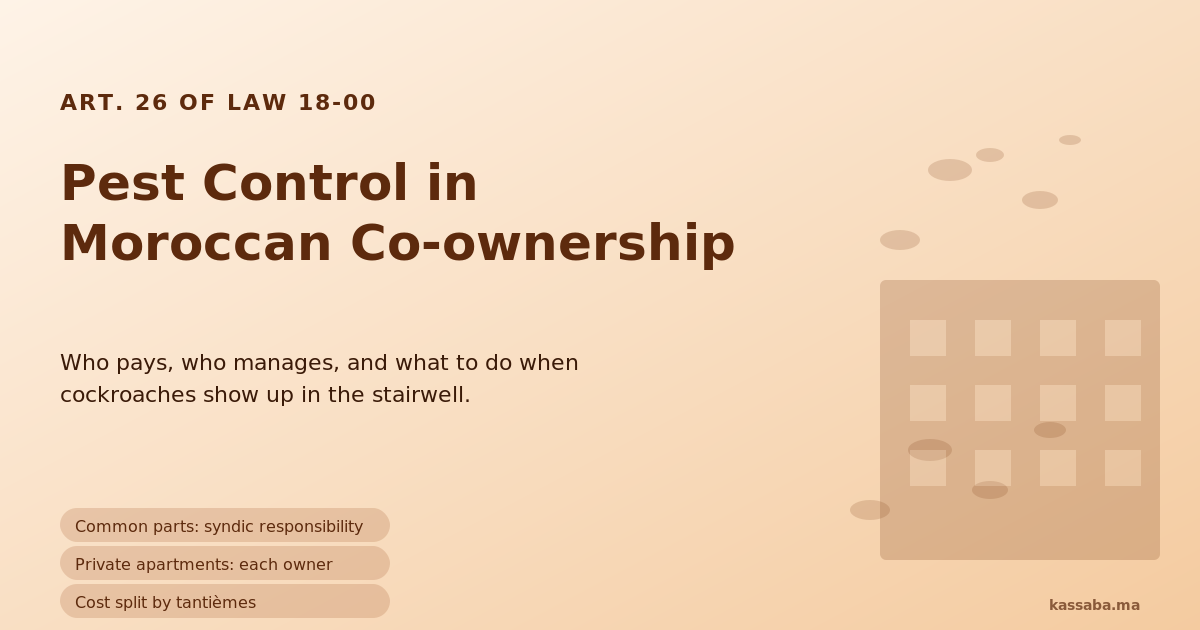
Pest Control in Moroccan Co-Ownership: Who Pays, Who Manages
Who pays for pest control in Moroccan co-ownership? Common areas usually fall under the syndic's Article 26 duties; private units need separate proof.
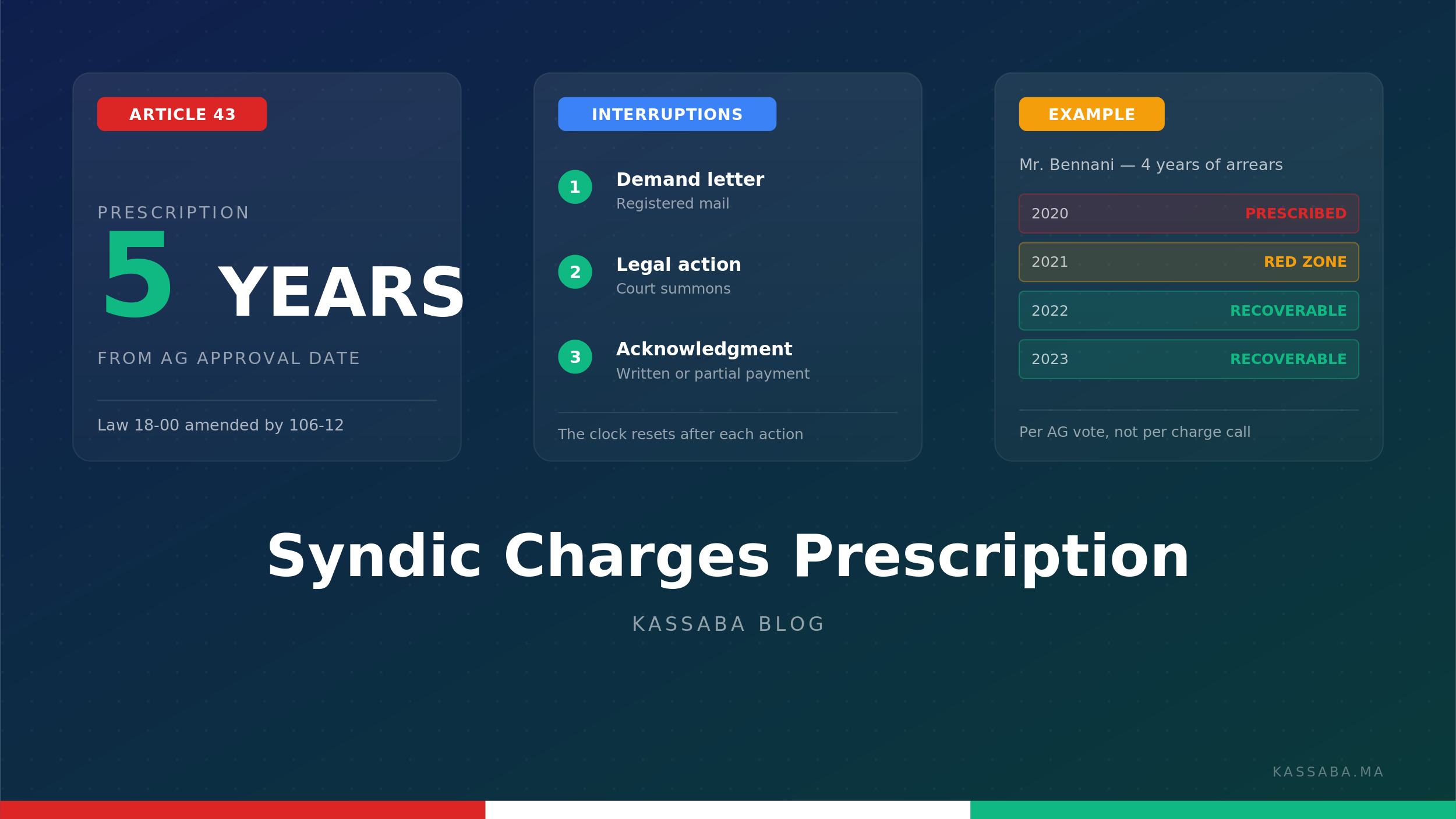
Syndic Charges in Morocco: The 5-Year Prescription Rule (Article 43)
In Morocco 2026, syndic charges expire 5 years after approval by the General Assembly (Art. 43 Law 18-00). How to calculate and interrupt.
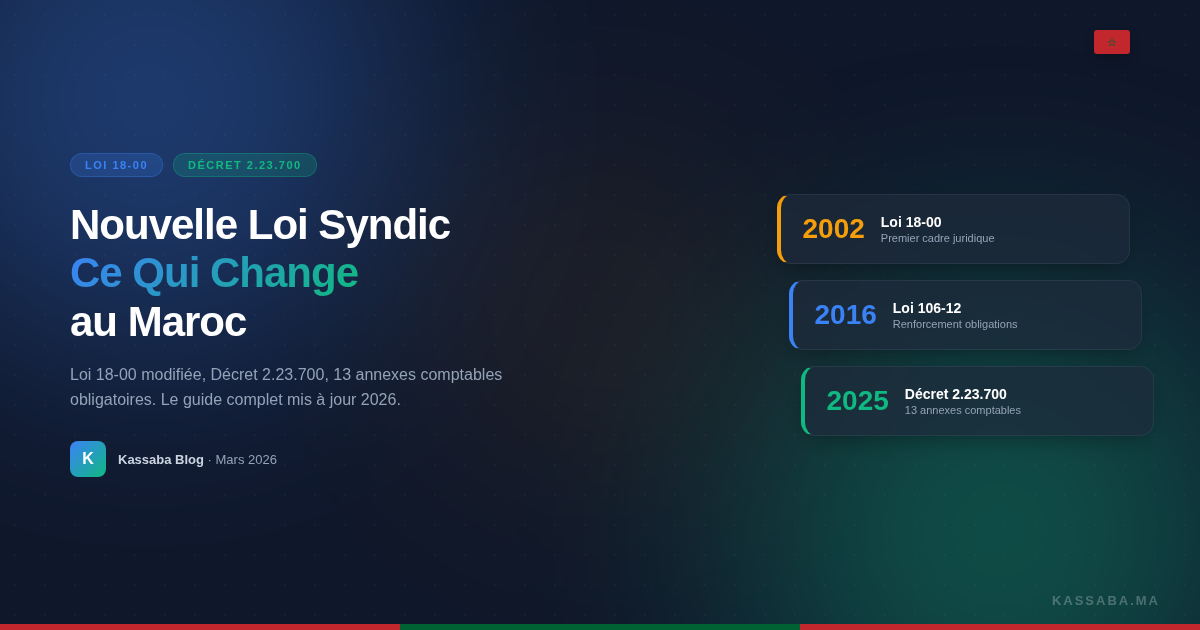
New Syndic Law in Morocco: What Changes in 2025-2026
Everything about the new syndic law in Morocco. Law 18-00 amendments, Decree 2.23.700, new accounting obligations and penalties. Updated guide 2026.