
How to Evaluate Syndic Software in Morocco Under Loi 18-00 and Décret 2.23.700
A 7-criteria framework for buyers, conseils syndicaux, and auditors evaluating compliance with Moroccan co-ownership law.
Last reviewed: · 13-minute read
Why this evaluation matters
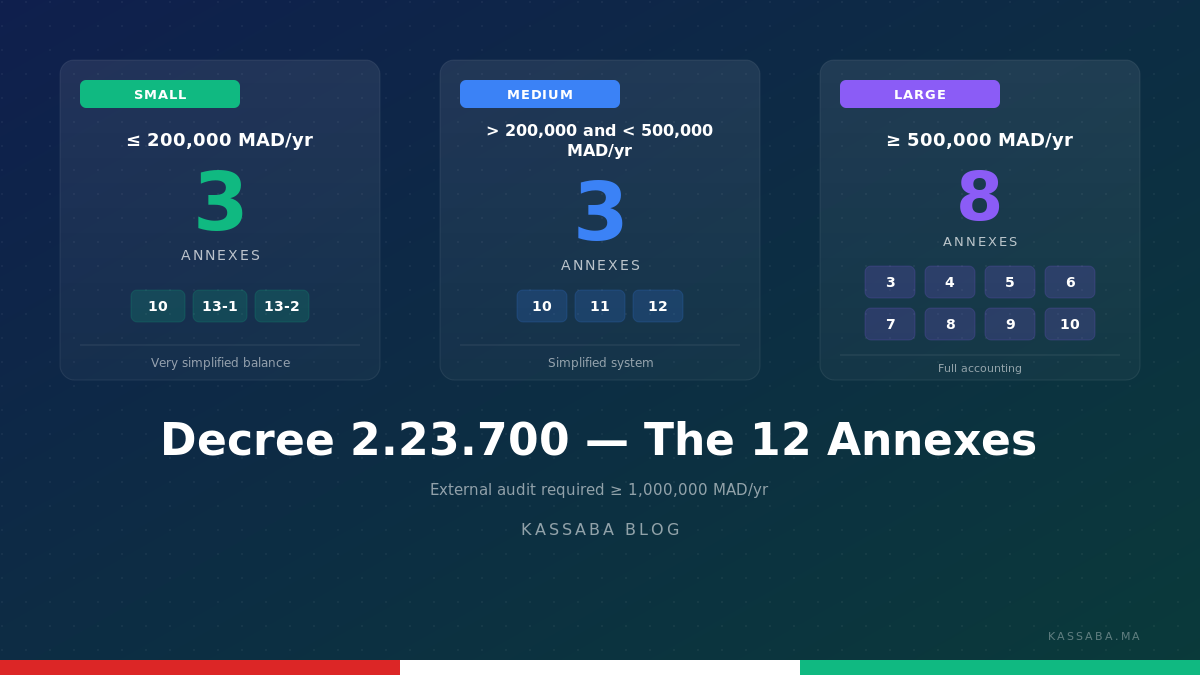
In March 2025, Morocco published Décret n° 2.23.700 in Bulletin Officiel 7391, finalizing the accounting framework that completes Loi 18-00 (modified by Loi 106-12 in 2016). Every syndic, volunteer or professional, single building or portfolio, now operates under a precise set of obligations: 12 regulatory annexes, three tier categories based on annual charges, and an audit threshold at 1,000,000 MAD per year.
The software market has not fully caught up. Marketing copy frequently claims Décret 2.23.700 compliance without specifying how. Some products show polished dashboards that may not stand up to audit review. Some still cite “13 annexes,” a counting error the regulatory text never made.
Use the seven criteria below as a checklist when comparing vendors. Each is testable in a live demo, anchored on a specific article of Loi 18-00 or Décret 2.23.700. A serious product passes all seven with answers you can verify, not promises you have to trust.
The 7 criteria at a glance
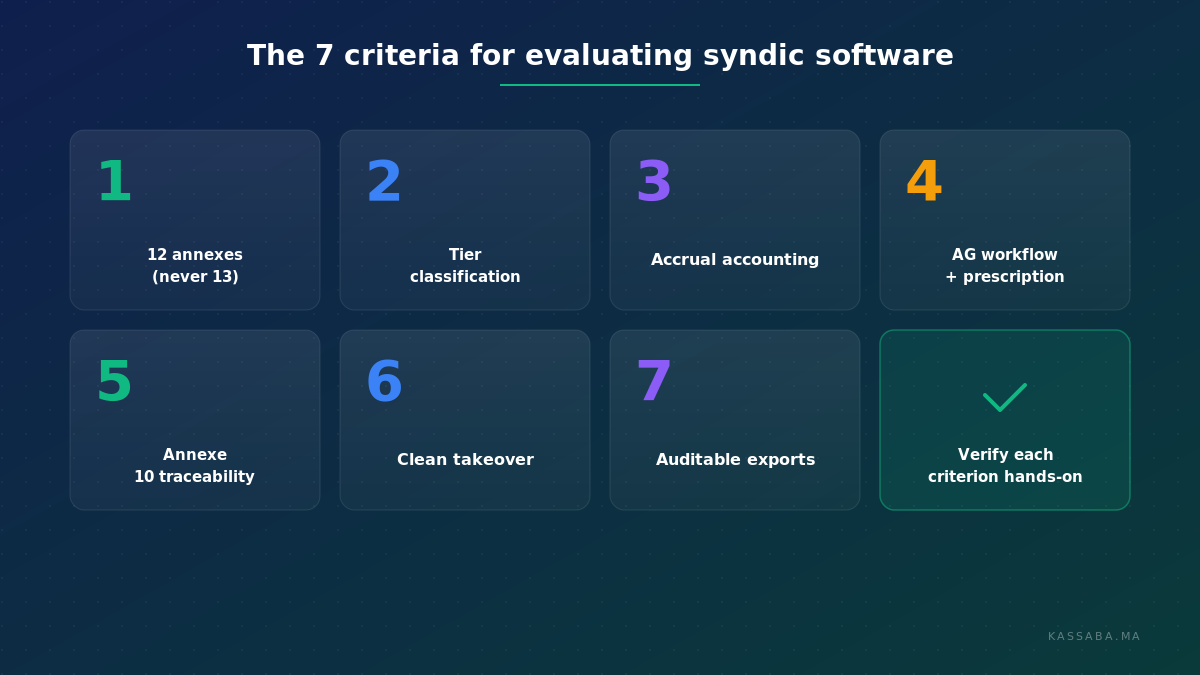
- The software generates exactly the 12 regulatory annexes, never 13, in the correct subset for each tier.
- It classifies tiers correctly at the 200,000, 500,000, and 1,000,000 MAD boundaries, with inclusion logic that matches the decree.
- It uses accrual accounting (droits constatés), with charges called and payments received tracked as two separate flows.
- Its AGM workflow respects Moroccan law: presence-based meeting validity, the decision thresholds surfaced by Articles 20–22, a 2-year syndic mandate, and 5-year prescription anchored on the AG approval date.
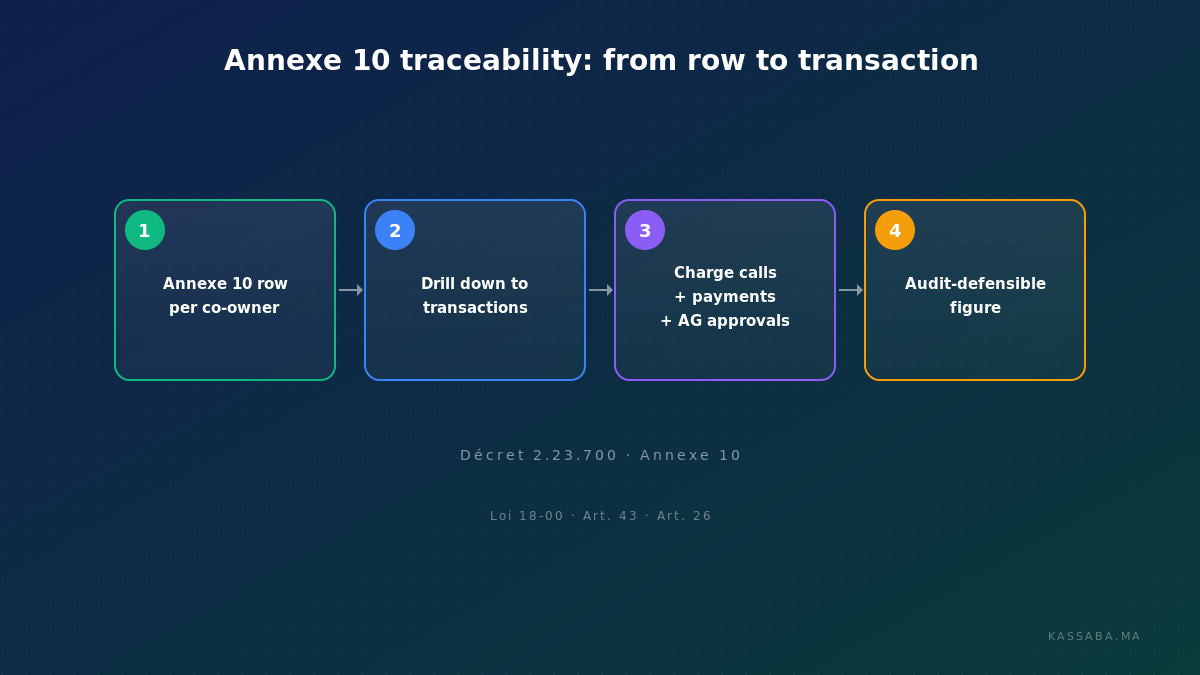
- Every per-co-owner figure on Annexe 10 traces back to underlying transactions, with corrections preserved alongside the originals.
- Takeover from a previous syndic supports opening balances, provisional flags, and parallel operation during reconciliation.
- Exports are reliable across formats, current operations stay distinct from historical carryover, and the change history is complete.
Criterion 1. Does the software generate exactly the 12 regulatory annexes in the correct subset per tier?
Legal basis.
What to ask in the demo.
- “How many annexes does the system produce in total?”
- “For a Small tier, generate the required annexes. Now for Medium. Now for Large.”
- “Export one annex from each tier as PDF and as a spreadsheet.”
What to verify.
- The total annex count is 12, never 13.
- Small tier outputs exactly 10, 13-1, 13-2 (three annexes).
- Medium tier outputs exactly 10, 11, 12 (three annexes).
- Large tier outputs exactly 3 through 10 (eight annexes).
- Exports preserve enough structure that an external auditor could work from them alone.
Red flag.
Marketing materials or vendor speech says “13 annexes.” This usually reveals pre-decree content that was never updated, or a product team that has not read BO 7391 closely.
Why it matters.
Producing the wrong annex count or the wrong subset for a tier means the report package will not pass audit. Regulatory responsibility for the filed package sits with the syndic, regardless of which software produced it.
Criterion 2. Does the software classify tiers correctly at the boundaries?
Legal basis.
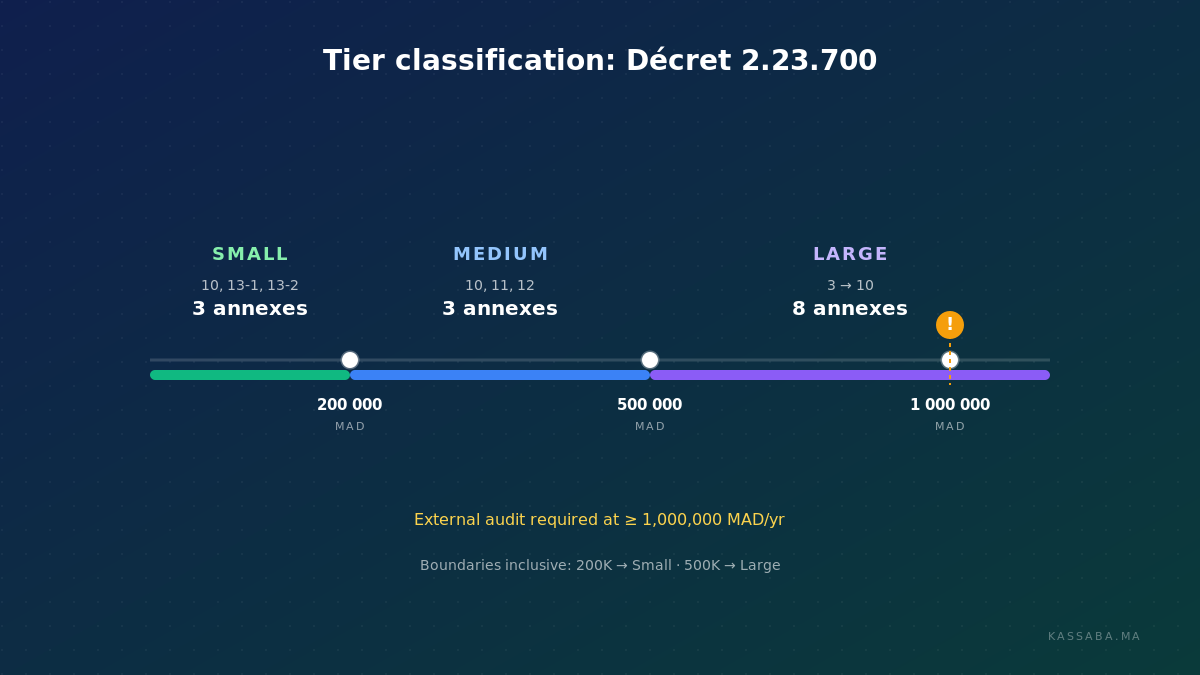
- Small: ≤ 200,000 MAD per year. Requires annexes 10, 13-1, 13-2.
- Medium: > 200,000 AND < 500,000 MAD per year. Requires annexes 10, 11, 12.
- Large: ≥ 500,000 MAD per year. Requires annexes 3 through 10.
- External audit by a commissaire aux comptes: required at ≥ 1,000,000 MAD per year, in addition to the Large-tier annexes.
What to ask in the demo.
- “Enter 200,000 MAD as annual charges. What tier do you return?”
- “Enter exactly 500,000 MAD. What tier?”
- “Enter 1,000,000 MAD. Does the system raise an external audit flag automatically?”
What to verify.
- 200,000 MAD returns Small (the lower boundary is inclusive).
- 500,000 MAD returns Large (the upper boundary is inclusive).
- 1,000,000 MAD returns Large with the audit requirement flagged.
- Refuse vague answers like "the system handles those values."
Red flag.
A common implementation risk is treating the boundary values incorrectly, especially 200,000 MAD, 500,000 MAD, and 1,000,000 MAD. Ask the vendor to test the exact boundary values live.
Why it matters.
A building misclassified by 1 MAD produces the wrong annex set. At the 500,000 MAD boundary, the difference is three Medium-tier annexes versus eight Large-tier annexes, an entirely different audit profile and a different workload.
Criterion 3. Does the software use accrual accounting (droits constatés)?
Legal basis.
What to ask in the demo.
- “Open one co-owner's record. Show me where charges called appear separately from payments received.”
- “Walk me through what the system does when a payment arrives before the corresponding charge is called.”
What to verify.
- Charges called and payments received are stored as two separate flows, not netted into a single field.
- The per-co-owner balance is computed as the difference between the two, not as a cash position.
- A payment received before a charge is called is held as a deposit, not silently applied to a future charge.
Red flag.
A single “balance” field per co-owner with no exposed underlying flows. The system describes accounting in cash-flow language (“paid”, “unpaid”) rather than accrual language (“called”, “received”, “outstanding”).
Why it matters.
Every Décret 2.23.700 annex is built on the accrual gap between charges called and payments received. A cash-basis system underneath the UI cannot produce a correct Annexe 10, which means no tier's annex package will pass audit.
Criterion 4. Does the software respect Moroccan AGM legal workflow (governance and prescription)?
Legal basis.
- Article 18. A general assembly is validly held when at least half of copropriétaires (or their representatives) are present. If that threshold is not reached, a second assembly may be held within 30 days regardless of the number present.
- Article 19. Syndic mandate is 2 years, renewable; the syndic is designated by a 3/4 majority of copropriétaires' voices.
- Articles 20, 21, 22. The decision thresholds surfaced by the law are relative majority, 3/4, and unanimity.
- Article 43 (as modified by Loi 106-12, BO 6514 of 3 November 2016). Common-charge claims prescribe 5 years from approval by the General Assembly.
What to ask in the demo.
- “Show me how the assembly module determines whether an AG is validly held.”
- “List every decision threshold the system surfaces for an AG vote.”
- “What syndic mandate lengths does the system support?”
- “Open an unpaid balance from 2021. Show me its prescription reference date and where the originating AG approval date is recorded.”
What to verify.
- Meeting-validity logic is tied to the presence of copropriétaires or their representatives, consistent with Article 18.
- Decision-threshold options align with the relative majority, 3/4, and unanimity thresholds surfaced by Articles 20, 21, and 22.
- Syndic mandate defaults to 2 years, with a clear warning if the user attempts to deviate from Article 19.
- Each normal budget charge can be traced to the AG-approved fiscal-year budget, and ad-hoc, emergency, or historical reprise charges can be traced to their specific AG approval, ratification, or legal basis. Prescription is referenced to that approval basis, not to the charge's due date.
Red flag.
A decision-threshold option appears that is not among those surfaced by Articles 20, 21, and 22 (for example, a 2/3 majority) without a clear legal mapping. Or meeting-validity logic uses units that do not match the presence-based test in Article 18. Or the syndic mandate is freely configurable to any duration without warning. Or prescription anchors on the charge's due date instead of the AG approval date.
Why it matters.
A decision adopted under a threshold that does not match Articles 20, 21, or 22 may be vulnerable to challenge by a copropriétaire. Meeting-validity logic that does not align with Article 18 creates similar exposure. Separately, if prescription is referenced to the wrong date, the syndic may face complications in pursuing recovery before the 5-year period closes.
Criterion 5. Can every per-co-owner figure on Annexe 10 be traced back to underlying transactions?
Legal basis.
What to ask in the demo.
- “Open one row of Annexe 10 for a specific co-owner. Show me the underlying charge calls, payments, AG approvals, and prescription dates.”
- “Generate Annexe 10 for the current quarter. Click on three random rows. Drill down.”
- “Record a correction on a charge call from six months ago. Now show me how it appears on Annexe 10.”
What to verify.
- Drill-down reaches the transaction level, not a summary or a calculation note.
- The breakdown is per-co-owner, not only building-level totals.
- PDF and spreadsheet exports preserve enough detail for someone without access to the software to verify the figures independently.
- Corrections appear alongside the original entry. The original is never silently overwritten.
Red flag.
Annexe 10 shows only building-level totals with no per-co-owner breakdown. Or the drill-down stops at “this comes from a calculation” without exposing contributing transactions. Or corrections replace the original entry without leaving an audit trail.
Why it matters.
Annexe 10 is the document the conseil syndical, the external auditor, and individual co-owners actually inspect. Figures that cannot be defended without the syndic narrating them create exposure to challenge by co-owners and complications during audit. If the report requires the syndic with a laptop to be intelligible, it is not stand-alone audit material.
Criterion 6. Does the software support a clean takeover from a previous syndic?
Legal basis.
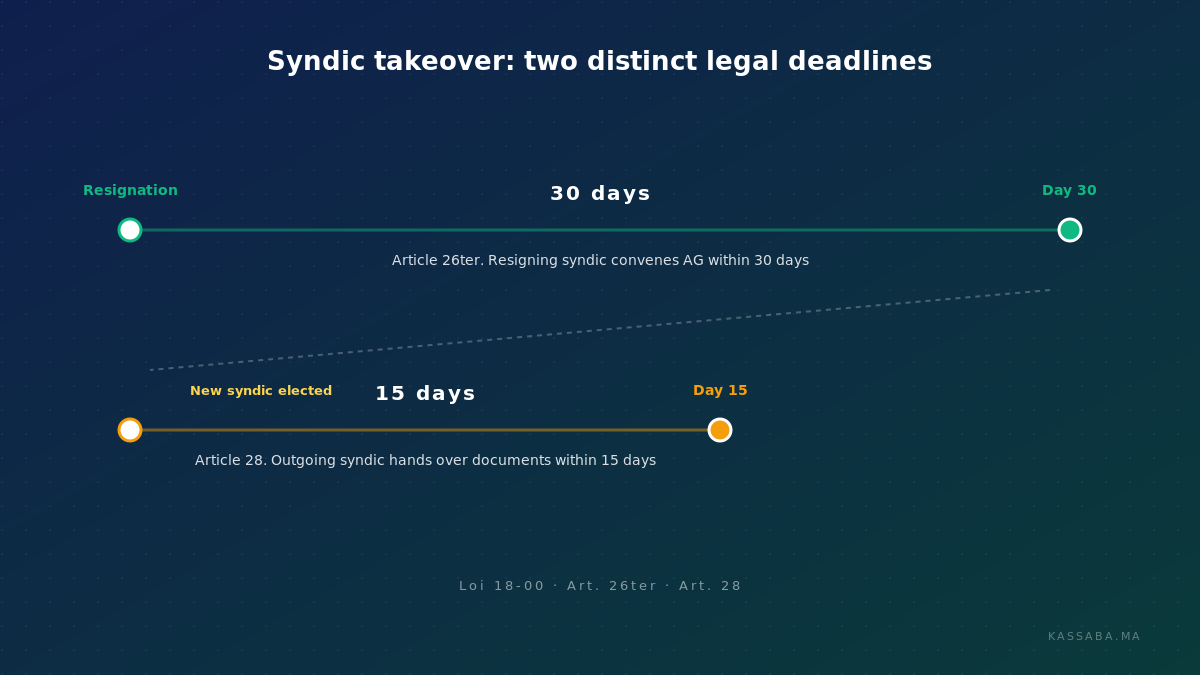
- Article 26ter. A resigning syndic must convene a general assembly within 30 days.
- Article 28. The outgoing syndic must hand over all documents within 15 days of the new syndic's election.
These are two distinct deadlines and should not be confused.
What to ask in the demo.
- “Walk me through importing opening balances per co-owner without entering five years of past transactions.”
- “Show me how a balance flagged as 'provisional' appears in reports.”
- “Can current charge calls and payments be processed while historical reconciliation is still ongoing?”
- “Generate the export package the outgoing syndic would deliver within 15 days.”
What to verify.
- Opening balances can be entered as starting points without requiring full historical detail.
- Provisional balances are visibly flagged so the conseil syndical knows what is verified versus what is still being reconciled.
- Current operations proceed in parallel with historical reconciliation.
- The handover export is concrete, producible, and fits within the 15-day window.
Red flag.
“We will import your data” with no detail on opening balances, no provisional flag, and no parallel-operation model. Or a system that refuses to operate until every historical transaction has been entered.
Why it matters.
Many Moroccan co-ownerships changing syndic in 2026 are switching from paper records or Excel. If the new software cannot accept incomplete historical records gracefully, the 15-day legal deadline becomes irrelevant in practice. The new syndic cannot actually function with what they received.
Criterion 7. Does the software produce auditable, reliable exports?
Legal basis.
What to ask in the demo.
- “Export the same annex three times: once as PDF, once as Excel, once as CSV. Open all three side by side.”
- “Show me the change history on one record that was corrected. Who made the change, when, and why?”
- “Show me how the system separates this year's operations from historical carryover.”
- “Run the same year-end report twice with a week between. Compare the figures.”
What to verify.
- The same report exported in different formats produces identical figures.
- Every change to a record is logged with timestamp and user attribution; originals are preserved alongside corrections.
- Current-year operations and historical carryover are visibly separated in reports and dashboards.
- Re-running the same report produces the same numbers as long as no underlying transaction has changed.
Red flag.
The same report exports with different figures in different formats. Or the change history is missing, partial, or hidden behind a paywall. Or current operations and historical balances mix in the same view, making reports confusing.
Why it matters.
When the conseil syndical or an external auditor asks “explain this figure,” you need to answer cleanly. Inconsistent exports, missing change history, or mixed current-historical views all fail this test. Audit issues often arise not because the underlying accounting is wrong, but because the software cannot defend the figures it produced.
How to use this framework in a real evaluation
Score each shortlisted product against the seven criteria on a simple pass / partial / fail basis. Eliminate any product that fails Criterion 1, Criterion 3, or Criterion 5. Without correct annex generation, accrual accounting, and per-co-owner traceability, the rest does not matter.
Run the verifications hands-on, whether through a vendor-led demo or a trial account. Don't accept marketing slides as evidence. Each criterion takes less than 5 minutes to test, so the full set fits inside a single 45-minute session with time left for follow-up questions.
Take the top one or two candidates into a 14-day trial with real data. Generate the actual annexes for the trial period and have the conseil syndical verify three randomly chosen figures on Annexe 10 without the syndic narrating. If they can verify the figures independently, the audit trail is real. If they cannot, the software is not audit-grade regardless of how the demo went.
Legal source table
Quick reference to the legal anchors used throughout this framework.
| Topic | Source | What it controls |
|---|---|---|
| Annexes | Décret 2.23.700, BO 7391 | Regulatory report package |
| Tier thresholds | Décret 2.23.700 | Small / Medium / Large categories |
| Charge prescription | Loi 18-00, Article 43 | 5-year clock from AG approval |
| Budget approval | Loi 18-00, Article 24 | AG approval of annual budget |
| Recovery procedure | Loi 18-00, Articles 25 / 25bis | Mise en demeure / payment-order evidence |
Frequently asked questions
How do I verify Décret 2.23.700 compliance in syndic software?
Run Criteria 1 through 3 from this framework. Confirm the software generates exactly the 12 regulatory annexes (never 13) in the correct per-tier subset, classifies tiers correctly at the 200,000, 500,000, and 1,000,000 MAD boundaries, and uses accrual accounting (droits constatés) with charges called and payments received tracked as separate flows. A product that fails any of these three is not compliant in operational terms.
How many annexes are required under Décret 2.23.700?
Twelve total regulatory annexes: 3, 4, 5, 6, 7, 8, 9, 10, 11, 12, 13-1, and 13-2. The pair 13-1 and 13-2 is two distinct annexes, not subparts of a single annex 13. The required subset depends on the tier: 3 annexes for Small (10, 13-1, 13-2), 3 for Medium (10, 11, 12), 8 for Large (3 through 10). At or above 1,000,000 MAD per year, an external commissaire aux comptes audit is also required.
Does compliant software need to generate all annexes?
It must generate the correct subset for the building's tier, plus Annexe 10 which is universal across tiers. A product that produces only some of the required annexes for the building's tier is not compliant. A product that can produce all 12 annexes across tiers but assigns the wrong subset to a building is also not compliant.
Can Excel work for a Moroccan co-ownership?
Below 200,000 MAD per year, a disciplined Excel approach can satisfy the Small-tier annex requirements if produced on an accrual basis with a documented audit trail. Above 200,000 MAD per year, traceability and audit-trail requirements typically make Excel impractical without significant manual discipline. Above 500,000 MAD per year, and especially at the 1,000,000 MAD audit threshold, a dedicated accounting system is the practical standard for both volume and auditor expectations.
What is the biggest red flag in a syndic software demo?
A vendor whose system cannot show, in a hands-on trial or guided walkthrough, how a single figure on Annexe 10 traces back to underlying transactions. If the figure cannot be explained on demand, the accounting is not audit-defensible. Every other concern is secondary.
What should a syndic ask a vendor to show live?
The seven verifications in this framework. Each takes under 5 minutes to test, whether through a vendor-led demo or by clicking through a trial account yourself. Be cautious about presentations that show only dashboards and never expose underlying ledger entries, charge calls, payments, AG approval dates, or correction history.
Does compliant software need to handle the 5-year prescription rule?
Article 43 of Loi 18-00 starts the 5-year prescription clock from approval by the general assembly, not from each charge's due date. For normal budget charges, software should trace the charge to the AG-approved fiscal-year budget. For ad-hoc, emergency, or historical reprise charges, it should record the specific AG approval, ratification, or legal basis used for recovery. The baseline deadline starts from AG approval, but valid formal recovery actions may interrupt or reset prescription depending on the legal act and evidence retained.
What proof should a syndic verify before committing?
At minimum: hands-on testing of annex generation against your own sample data (through a trial account, a guided demo, or both), clear documentation of how migration from your current records will work, and pricing you can verify in writing. If a vendor cannot enable these basic checks, the buyer goes in blind.
Legal note. This framework is an editorial software-evaluation checklist, not legal advice. For contentious recovery, litigation, or audit disputes, the syndic should confirm the treatment with a qualified professional.
Suggested citation
“How to Evaluate Syndic Software in Morocco Under Loi 18-00 and Décret 2.23.700. A 7-Criteria Framework. Kassaba.ma.”
Verified against Loi 18-00 (modified by Loi 106-12, BO 6514 of 3 November 2016) and Décret n° 2.23.700 (BO 7391 of 31 March 2025).
URL: https://www.kassaba.ma/en/evaluate-syndic-software-morocco