
Syndic charges collection in Morocco: automating unpaid-debt follow-up under Law 18-00
Last updated
Collecting unpaid charges is probably the heaviest mental load a syndic carries in Morocco. Between calculating penalties, sending formal demand letters by registered mail, tracking the 5-year prescription (Article 43 of Law 18-00), and possibly filing with the court for a payment order, the workflow can stretch over months. This guide walks you through every step, with the legal anchors, so nothing falls through the cracks.
How do you collect unpaid co-ownership charges in Morocco?
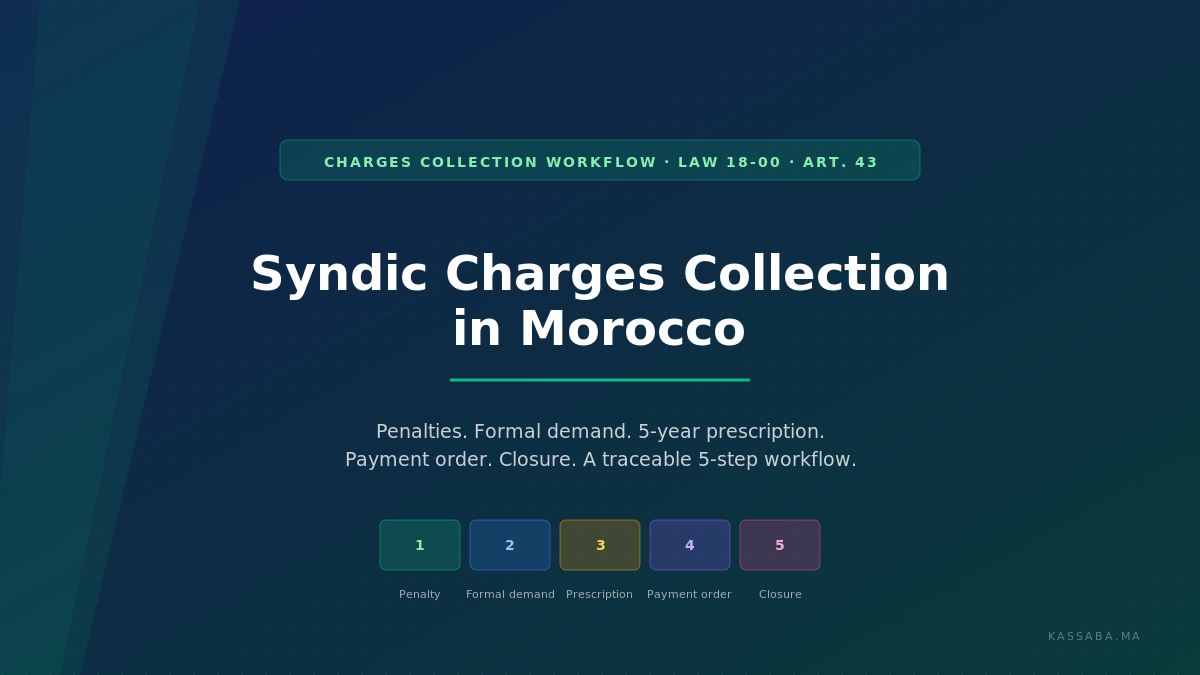
Collection follows a 5-step workflow that Kassaba organizes based on Law 18-00. Not one step more, not one step less. Skipping a step puts you at risk of a court procedure being rejected for procedural defects, forcing you to start over.
The order matters: automatic late-payment penalties, informal reminders (WhatsApp, SMS, phone), formal demand letter by registered mail with delivery receipt or by court bailiff (Article 25), tracking the 5-year prescription that runs from the GA approval date (Article 43), then a payment order from the court if nothing has moved (Article 25 bis).
In some cases, the occupant or tenant may be involved in regularizing the debt under applicable legal conditions. Treat this as a legal step, not an automatic shortcut, especially when the owner is an MRE who is hard to reach.
What that actually means in practice:
Every step you complete leaves a trace in the file: send date, notification method, delivery receipt. If you arrive at court without being able to prove that the earlier steps actually happened, your payment order gets rejected. The file must be complete before you file.
What is the prescription period for syndic charges in Morocco?
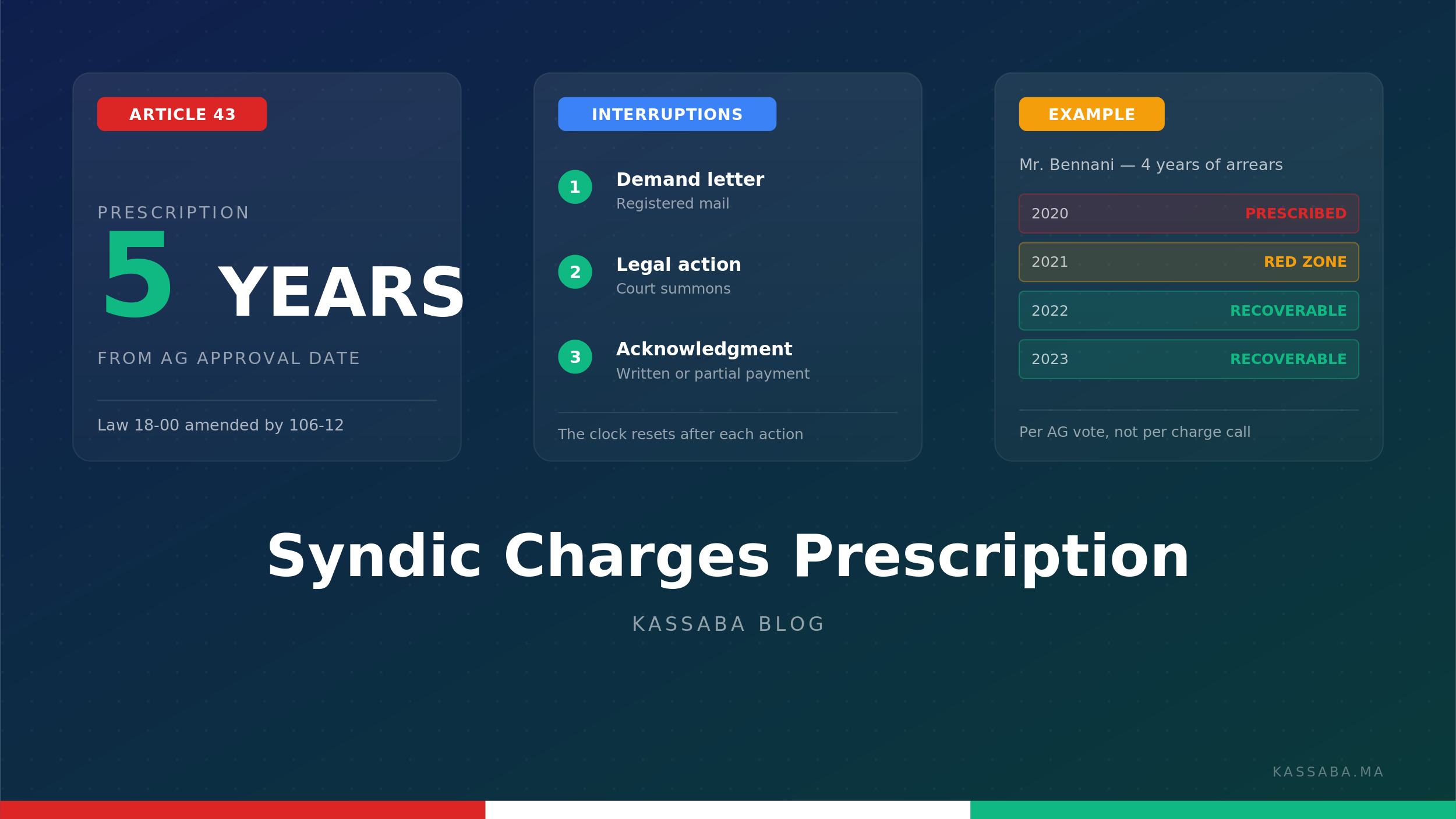
5 years under Article 43 of Law 18-00 (as modified by Law 106-12). But it's the starting point that trips up most syndics.
The clock does NOT start running from each charge's individual due date. It runs from the date the General Assembly approves the relevant charges for the fiscal year in question.
A concrete example. A charge due in January 2026, whose accounts are approved by the GA in June 2026. That charge doesn't prescribe in January 2031. It prescribes in June 2031. Five extra months to act. On a file worth tens of thousands of MAD, that changes everything.
Common mistake:
Plenty of syndics (and even some lawyers unfamiliar with Moroccan co-ownership law) calculate prescription from the due date. The result: they give up on receivables that would have been perfectly recoverable, or worse, the court dismisses their claim on the basis of a mis-dated prescription.
With automated tracking, the prescription date for every receivable is calculated as soon as the GA approves the relevant charges. An alert fires when a receivable nears prescription. No more silent prescriptions.
Does a WhatsApp reminder interrupt the prescription period?
No. Not WhatsApp. Not SMS. Not a phone call. Not an informal email. None of those channels creates a court-ready legal collection file.
Use a formal demand letter under Article 25 of Law 18-00 instead. It should be sent by registered mail with delivery receipt, by court bailiff (huissier de justice), or by an equivalent legal notification method so the file contains court-ready proof.
That doesn't mean WhatsApp reminders are useless. They're useful for two things: triggering payment when the co-owner is just distracted (which works in most cases), and documenting the syndic's good faith in the file that goes to court. But don't expect them to buy you time on prescription.
Classic trap:
A syndic who sends 30 WhatsApp messages over 3 years to a defaulting co-owner, without ever formalizing the claim. If the prescription deadline passes, those informal reminders will not replace a court-ready legal file.
What is a formal demand letter and how do you send it?
The formal demand letter (mise en demeure) is the formal act by which the syndic calls on a co-owner to pay their charges within a set deadline. It is the legal pivot of the collection workflow because it creates the proof trail for the payment-order file.
To carry legal weight, the demand letter must include:
- Precise identification of the defaulting co-owner (name, unit, address)
- The detail of the receivables: amounts per charge call, due dates, penalties already calculated
- The total amount due at the date of sending
- A payment deadline (typically 15 days from receipt)
- A warning about consequences of non-payment (court filing)
- The syndic's signature and the date of issue
Use a channel that leaves legally usable proof of delivery:
- Registered mail with delivery receipt. Moroccan post (Barid Al-Maghrib) handles the delivery receipt. Keep the original.
- Court bailiff (huissier de justice) notification. More expensive, but maximum evidentiary value. Recommended for high-value receivables.
- Any other equivalent legal notification recognized under Moroccan law.
Good practice:
Number every demand letter (prefix MED- followed by a sequential number and the year: MED-2026-001). Print in French and Arabic for co-owners who don't read French. Archive the demand letter, the delivery receipt, and the proof of sending for at least 5 years (the prescription period).
When should you provision a doubtful debt under Décret 2.23.700?
A debt that clearly becomes unrecoverable must be provisioned in the accounts, under the Décret 2.23.700 accounting framework. That's what gives the annexes a true picture of the financial situation. A rotten debt left as a normal asset distorts the balance sheet completely.
Three classic situations justify a provision:
- Insolvent debtor (personal bankruptcy, proven over-indebtedness, unsuccessful seizure)
- Co-owner gone abroad with no verifiable contact details
- Long-running dispute with no clear prospect of recovery, after accounting/legal review
The mechanism runs in four steps:
- Draft. The syndic prepares the allocation (amount, reason, co-owner concerned). No accounting entry at this stage.
- GA vote. The allocation is put to the General Assembly. Simple majority of votes of co-owners present or represented (Article 20, Law 18-00).
- Accounting entry. Use the accounts validated by the co-ownership accountant and keep the adjustment linked to the original receivable.
- Possible reversal. If the receivable is eventually collected, record the recovery separately and link it to the original receivable.
Keep every material adjustment tied to a documented decision, accountant validation, or GA item where required. That gives you a defensible audit trail instead of a silent balance-sheet change.
The 5-step collection workflow
Every unpaid receivable goes through a structured workflow, traceable from end to end. Here are the steps, with the legal anchors that back them up.
1. Automatic late-payment penalties
As soon as a charge passes its due date, the late-payment penalty is calculated based on the policy set for the building. Three formats are common in Morocco: fixed rate (for example, 50 MAD per month of delay), proportional rate (1% per month on the amount due), or progressive rate (1% the first month, 1.5% from the second month onwards).
Penalties are posted automatically in the accounting journal, following the Décret 2.23.700 chart of accounts. No manual intervention. The co-owner sees the penalty added to their balance in the Kassaba Resident mobile app, which is often enough to trigger payment.
2. Formal demand letter (Article 25)
When a receivable stays unpaid after several reminders, Kassaba generates the formal demand letter in line with the Law 18-00 collection workflow. The document is:
- Printable in French and Arabic
- Sequentially numbered (MED- prefix)
- Equipped with a verification QR code (a recipient or judge can confirm authenticity)
- Archived for at least 5 years (minimum retention period)
The syndic sends the demand letter by registered mail with delivery receipt, by court bailiff, or by equivalent legal notification. The channel used and the receipt date are recorded.
3. Prescription tracking (Article 43)
This is the most often forgotten step and the most expensive when missed. Article 43 sets the prescription period at 5 years, running from the approval by the General Assembly of the relevant charges (not from the due date).
The prescription date for each receivable is calculated automatically from the matching GA approval date. An alert badge appears in the side menu when receivables approach their prescription deadline. No more silent prescriptions.
4. Payment order (Article 25 bis)
If the formal demand has no effect, the syndic files with the court for a payment order (injonction de payer, Article 25 bis). The filing must include:
- The extract of the co-owner's account (Annexe 10)
- The history of every reminder and partial payment
- Copies of the formal demand letters with proof of sending
- A traceable audit trail of financial decisions and events
The file is ready to use directly by a lawyer or court bailiff. If an occupant or tenant is involved, the syndic should verify the applicable legal conditions before accepting payment on behalf of the owner or documenting any rent deduction.
5. Resolution and closing
The receivable is closed with an explicit reason. Each reason triggers the right accounting treatment:
| Reason | Accounting entry |
|---|---|
| Paid (collected) | Debit cash (5121), credit co-owner account (3422) |
| Written off | Debit exceptional charges (679), credit receivable (3422) |
| Provisioned (GA vote) | Validated accounting adjustment, linked to the original receivable |
| Cancelled (initial error) | Reversal of the original entry |
The closing reason stays visible in the co-owner's and the unit's history, preserving the case memory beyond the prescription period.
Why collection fails for most syndics
Three recurring traps cost Moroccan co-ownerships money. They come up in every audit we do, regardless of building size. If you recognize one of these patterns in your own work, there's a leak to plug.
1. Confusing the prescription start date
Plenty of syndics believe the 5 years run from each charge's due date. That's wrong. Article 43 sets the starting point at the date the GA approves the relevant charges. A charge due in January 2026 whose accounts are approved in June 2026 prescribes in June 2031, not January 2031.
Fix: Calculate prescription from the GA approval date. Software does this automatically from the GA date captured in the system.
2. Stacking up reminders without ever formalizing
WhatsApp, SMS, phone calls: none of these channels is enough for a court-ready collection file. Use a formal demand letter under Article 25, sent by registered mail with delivery receipt or by bailiff, and have counsel validate any prescription-interruption strategy.
Fix: Set a threshold past which the formal demand fires automatically (for example, 90 days after the due date). Don't let a receivable cross that threshold without a registered letter sent.
3. Filing with the court without a complete file
An incomplete file gets the payment order rejected for procedural defects. You need a traceable account extract, the reminder history, copies of the formal demand letters with proof of sending. The court won't fill in the gaps for you.
Fix: Prepare the full file before filing. A management tool centralizes every document and generates the file in one click, ready to hand to your lawyer or court bailiff.
Are your unpaid charges piling up?
Kassaba automates the whole workflow: penalties, formal demand letters, prescription alerts, payment-order files. Try it without a credit card.
Doubtful accounts and receivables impairment (Décret 2.23.700)
A receivable that clearly becomes unrecoverable should not remain hidden as an ordinary collectible balance. Treat it as an accounting-risk item: document the facts, keep the co-owner account traceable, and validate the accounting treatment with the building's accountant before it affects the financial statements.
The provision module, step by step
1Draft stage
The syndic prepares a draft note: amount concerned, reason (insolvency, no reliable contact, disputed recovery), co-owner, and unit. No accounting entry is posted at this stage. The proposal stays traceable until accounting/legal validation.
2GA vote
If the treatment requires co-owner approval, the item is placed on the agenda of the annual General Assembly or an extraordinary GA. The minutes record the decision, the amount, and the supporting reason.
3Accounting entry
Once validated, the accounting treatment is posted according to the chart of accounts used by the co-ownership. The original receivable stays traceable in the co-owner history so the audit trail is not lost.
4Possible reversal
If the receivable is eventually collected, the recovery is recorded separately and linked back to the original item. Any reversal or correction should follow the same validation path used for the original adjustment.
Watch out:
Do not make silent balance-sheet changes. Every material adjustment should be tied to accountant validation, a documented management decision, or a GA item where required, with the minutes number kept in the file.
For the detail of the accounting annexes and how they articulate with provisions, see also our complete guide to syndic accounting in Morocco.
Collection dashboard
For every managed building, a dashboard centralizes the entire collection pipeline. The idea: the syndic identifies, at a glance, the receivables that need immediate action, without digging through individual accounts.
Overview
- →Number of overdue receivables, grouped by aging bucket (0-30 d, 30-90 d, 90-180 d, 180 d+)
- →Total outstanding receivables, by co-owner and by unit
- →Collection rate for the year (collected / called)
Actions and alerts
- →Formal demand letters sent in the last 30 days
- →Receivables approaching prescription (automatic alert badge)
- →Payment orders currently being processed
- →Active impairment provisions
The dashboard is viewable from the web app and the mobile app. Council members and active co-owners see a filtered version, scoped to their role. Transparency improves the atmosphere of the GA a lot: when every co-owner can verify the pipeline themselves, there's less suspicion and more cooperation on collection.
Go further
Related guides
Syndic accounting in Morocco
The full guide to Décret 2.23.700 and Law 18-00 compliant accounting.
Syndic management guide
Our general pillar on syndic management in Morocco: roles, obligations, best practices.
Evaluate syndic software
The criteria for choosing syndic management software in Morocco, including the collection module.
Related articles
Syndic Charges in Morocco: The 5-Year Prescription Rule (Article 43)
In Morocco 2026, syndic charges expire 5 years after approval by the General Assembly (Art. 43 Law 18-00). How to calculate and interrupt.
Charge Calls for Syndics in Morocco: Templates and Automation
How to draft a charge call as a syndic in Morocco, calculate tantièmes, and follow up on unpaid charges. Concrete template and practical tips.
General Assembly for Co-Ownership in Morocco: A Complete Guide
How to organize a general assembly for co-ownership in Morocco: notices, quorum, voting majorities, minutes. A practical guide for syndics and co-owners.
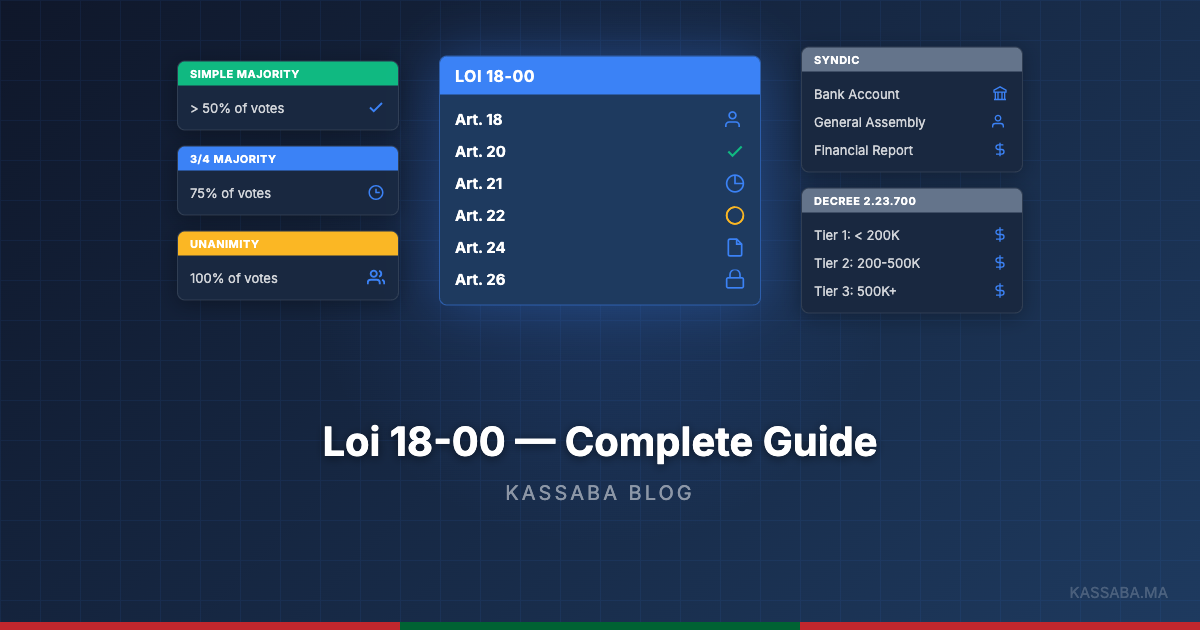
Morocco Co-Ownership Law 18-00: Key Articles, Voting Rules and Syndic Obligations (2026)
Law 18-00 explained article by article: quorum rules (Art. 18), 3 voting majorities (Art. 20-22), syndic 2-year term (Art. 19), mandatory bank account (Art. 26). With Law 106-12 amendments.
Frequently asked questions about syndic charges collection
When should you provision a doubtful debt?
Typical warning signs are insolvency, no reliable contact details, or a dispute with no realistic recovery path. Do not treat those examples as automatic legal triggers: document the facts, ask the accountant to validate the accounting treatment, and put any write-off or material adjustment on the General Assembly agenda when a decision by co-owners is required.
Can a tenant pay charges on the owner's behalf?
Yes, under applicable provisions of Law 18-00, a tenant of a co-owned unit may, under certain conditions, pay the charges directly to the syndic when the owner is in default, and then deduct that amount from the rent with supporting documentation provided to the owner. Verify the exact conditions of application with legal counsel. This is a useful mechanism in the Moroccan context, where many owners are MRE (Marocains Résidents à l'Étranger, Moroccans living abroad). Practically, Kassaba records the actual payer (owner or occupant) on every payment, which keeps the accounting trail clean and prevents disputes about who paid what.
Does Law 18-00 set late-payment penalty rates?
Law 18-00 itself doesn't set any penalty rate. It's the co-ownership rules of each building that may provide for a surcharge on late payments (fixed rate, per-day rate, or progressive rate depending on how old the debt is). If the rules say nothing about it, no penalty can be applied unilaterally by the syndic. Many older Moroccan buildings have rules that don't address this at all. In that case, the General Assembly needs to vote a modification of the rules (3/4 majority, Article 21) to add a penalty clause.
How long must a syndic keep collection records?
At least 5 years. That period matches both the prescription period for receivables (Article 43, Law 18-00) and the document-retention requirement from Décret 2.23.700. Keep originals or scanned copies of every reminder, formal demand letter, delivery receipt, bailiff statement, court ruling, and accounting entry. In practice, many syndics keep records for 10 years to be safe, which is good practice. With software, archiving is automatic and indexed, so searches during a late dispute become much faster.
What happens to active collection when the syndic changes?
The collection file is part of the documents the outgoing syndic must hand over to the new one within 15 days of the new election (Article 28, Law 18-00). That includes the list of outstanding receivables, the reminder history, copies of formal demand letters already sent, and any pending court files. If the handover is incomplete, the new syndic can lose receivables simply because they don't know how old the debts are. That's one of the reasons a centralized digital tool is valuable: the collection file is instantly viewable, and handover happens by transferring access, with no break in continuity.
Can you file with the court without sending a formal demand first?
In theory, certain emergency procedures allow filing without a prior formal demand. In practice, for syndic charges collection, the court will almost always require proof that a formal demand letter was sent and produced no result. Skipping that step usually means the payment order gets rejected for procedural defects, wasting time and forcing you to start over. The right reflex: send the formal demand (Article 25), wait for the deadline (usually 15 days), then file with the court with a complete file including the demand letter and its delivery receipt.
How do you calculate the late-payment penalty correctly?
The method depends on the rate set by your co-ownership rules. Common formats include a fixed amount per month of delay, a proportional rate on the unpaid amount, or a progressive rate by age of debt. Do not invent a penalty rate if the rules are silent, and have the clause reviewed if the rate is high or disputed. The calculation must be documented line by line in the co-owner's account, not applied as a single lump.
Can a volunteer syndic handle collection on their own?
Yes, and many do, especially in smaller buildings. For the early steps (penalties, reminders, simple formal demands), an organized volunteer syndic can manage everything on their own. Letter templates exist, Moroccan post offices know the registered-mail-with-receipt procedure. It's at the payment-order stage that things get more technical: the file must be complete, supporting documents properly attached, and a lawyer or court bailiff (huissier) is usually helpful. If you're managing several outstanding debts in parallel, software like Kassaba helps you not forget anything and stay within the deadlines.
Take back control of your unpaid charges
Kassaba automates penalties, formal demand letters, prescription alerts, and payment-order files. Create a free account, no credit card needed, and try the collection module.
Questions? [email protected]
This guide is provided for information purposes by the Kassaba team. It is not legal advice or an attorney's opinion. For any legal question about charges collection and the payment-order procedure, consult a lawyer or court bailiff (huissier de justice) licensed in Morocco.