
Morocco Co-Ownership Law 18-00: Key Articles, Voting Rules and Syndic Obligations (2026)
Law 18-00: the founding text of co-ownership in Morocco
Law 18-00 is the law that governs co-ownership in Morocco. Amended by Law 106-12 (OB no. 6514, November 3, 2016), it defines the rights and obligations of each co-owner, the role of the syndic (property manager), and the rules for general assemblies.
If you're a syndic, a co-owner, or part of a conseil syndical, this law applies directly to you. Here's what it says, article by article, in plain language.
The key players in co-ownership
The co-owner
Each co-owner holds a unit made up of a private part (their apartment) and a share of the common areas (hallways, stairs, roof, elevator). That share is expressed in tantièmes (ownership shares).
Tantièmes determine two things: how much each co-owner pays in charges, and how much weight their vote carries at the general assembly.
The syndic
The syndic is the legal representative of the co-ownership. They're elected by the general assembly with a 3/4 majority of all co-owner votes (Article 19). The term lasts exactly 2 years and is renewable by the assembly. For a full overview of the syndic's role, check our complete guide to property management in Morocco.
The syndic can be a volunteer co-owner or an external professional. Either way, their legal obligations are identical.
The conseil syndical
Don't confuse this with the French model. Under Moroccan law, the conseil syndical (Article 29) only exists for multi-building complexes. It's not an advisory committee for a single building.
The syndic's obligations
Article 26 of Law 18-00 defines the syndic's main obligations. Here they are in detail.
Separate bank account
The syndic must open a bank account in the co-ownership's name (Article 26). Not a sub-account of their personal account. A real, separate account dedicated to the co-ownership. All income (charges, contributions) and all expenses must go through this account.
This is a legal obligation, not a recommendation. A syndic who mixes co-ownership funds with their personal money is asking for serious trouble.
Collecting charges
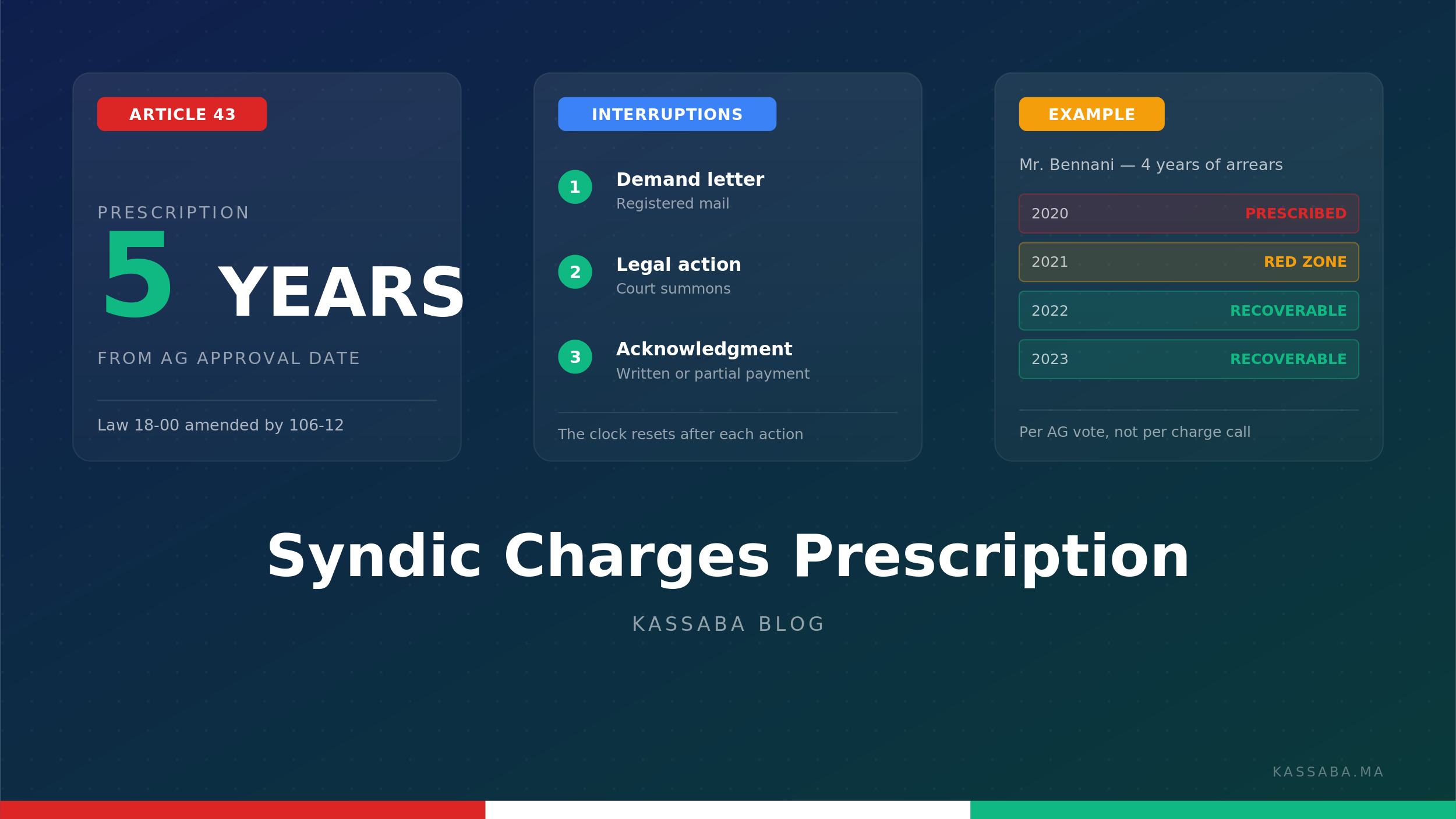
The syndic is responsible for collecting charges from all co-owners. Unpaid charges have a 5-year statute of limitations (Article 43). After that, the syndic can no longer legally claim them.
Watch the starting point: the 5 years run from the date the general assembly approved those charges, not from the charge call's due date. If the AG of March 10, 2020 approved the 2020 budget and you haven't taken any action by March 10, 2025, the debt is prescribed. We break down the calculation and how to interrupt the clock in our guide to the prescription of syndic charges.
Convening the general assembly
The syndic must convene the general assembly (AG) at least once per year, within 30 days of the end of the fiscal year (Article 16ter). The notice must be sent at least 15 days before the assembly date (Article 16quinquies), by registered mail or legal notification.
Presenting accounts
The syndic must present management accounts at each annual assembly (Article 24). Accounting must follow the accrual method. Décret 2.23.700 specifies the exact format for the required financial documents.
Maintenance and preservation
The syndic handles maintenance of common areas and preservation of the building. They must also keep the co-ownership's archives and hand them over to their successor.
The general assembly: rules and majorities
The general assembly is the decision-making body of the co-ownership. Here's how it works according to the law.
Quorum
For the assembly to deliberate validly, half of the co-owners (as people) or their representatives must be present (Article 18).
This is crucial: quorum is counted by number of people, not by tantièmes. If your co-ownership has 20 co-owners, you need 10 present or represented to reach quorum. It doesn't matter whether those 10 people hold 20% or 80% of the tantièmes.
Proxies
An absent co-owner can give a proxy to another co-owner. But Article 16decies sets two cumulative limits:
- A proxy holder can represent no more than 3 co-owners
- The combined tantièmes of the proxy holder and their mandators cannot exceed 10% of total votes
Both conditions apply simultaneously. A co-owner who already holds 8% of tantièmes can only accept one proxy from a co-owner holding at most 2%.
The three majority levels
Law 18-00 provides exactly three majority levels. Not two, not four. Three.
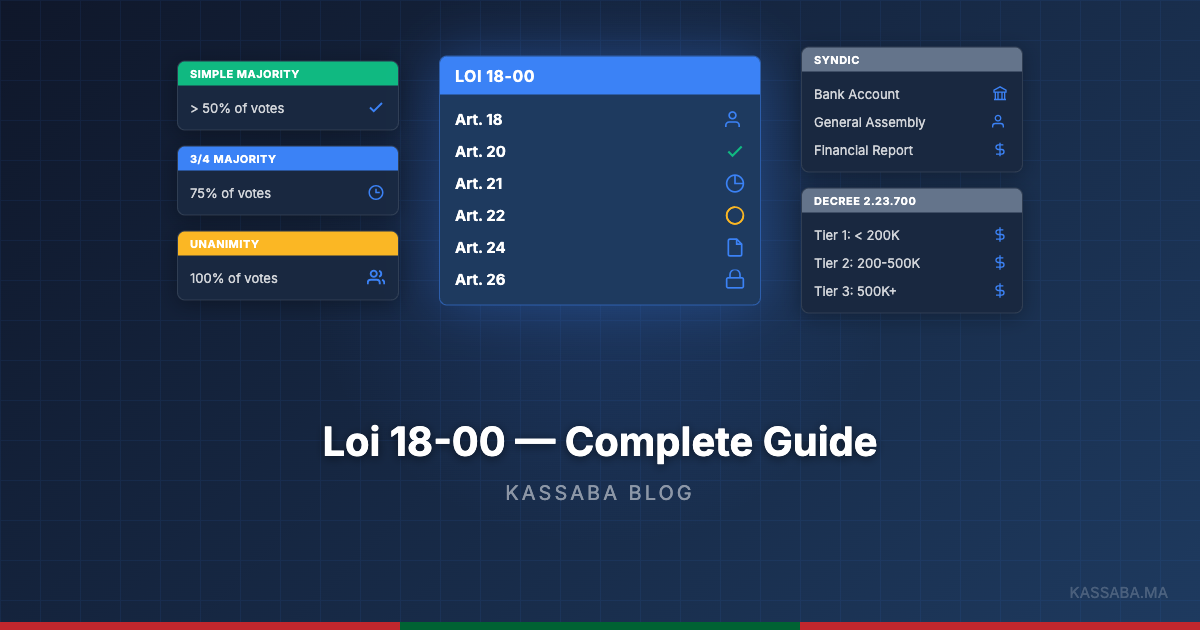
Simple majority (Article 20). Majority of the votes of co-owners present or represented. Applies to routine decisions: ordinary maintenance, hiring the concierge, minor works.
3/4 majority (Article 21). 3/4 of votes of all co-owners (not just those present). Applies to major decisions: budget vote, syndic election or dismissal, building insurance, major works, amendments to the co-ownership bylaws.
Unanimity (Article 22). Unanimous vote of all co-owners. Required for the most significant decisions: new construction on common areas, selling common areas, building extensions.
There is no two-thirds majority in Moroccan law. If someone mentions a "two-thirds majority," they're confusing it with a different jurisdiction.
Second consultation
If quorum isn't reached at the first meeting, a second assembly can be convened. The quorum requirements are relaxed for the second consultation, but the voting majorities remain the same.
The syndic's term
Election
The syndic is elected with a 3/4 majority of all co-owner votes (Article 19). The term is exactly 2 years. Not "one or two years," not "as the assembly decides." Two years, full stop.
Dismissal
The syndic can be dismissed by the assembly with a 3/4 majority (Article 21). The dismissal doesn't need to be justified, but it must be on the assembly's agenda.
Resignation
If the syndic resigns, they must convene an assembly within 30 days to elect their successor (Article 26ter). Until the new syndic is elected, the deputy syndic handles interim duties.
Handover
The outgoing syndic (whether they resigned or were dismissed) must hand over all documents and funds to the new syndic within 15 days of the election (Article 28). Two different deadlines, two different articles: 30 days to convene the assembly (Art. 26ter), 15 days for the handover (Art. 28).
Décret 2.23.700: the accounting complement
Décret 2.23.700, published in the Official Bulletin no. 7391 on March 31, 2025, supplements Law 18-00 on accounting matters. It imposes a standardized framework based on three tiers:
| Tier | Charges called | Required annexes |
|---|---|---|
| Small | ≤ 200,000 MAD | 10, 13-1, 13-2 |
| Medium | 200,000 to 500,000 MAD | 10, 11, 12 |
| Large | 500,000 MAD and above | 3, 4, 5, 6, 7, 8, 9, 10 |
Above 1,000,000 MAD in annual charges called, the decree also requires an audit by a licensed accountant.
This decree doesn't replace Law 18-00. It supplements it by specifying the "how" of the accounting obligation in Article 24.
Real-world cases: Law 18-00 in practice
The law on paper is one thing. The law inside a 24-unit building in Casablanca with an overwhelmed volunteer syndic is another. Here are four real situations and what the text actually says.
Case 1: a co-owner owes 4 years of charges
Mr. Benali hasn't paid his charges since January 2022. It's December 2025. The syndic never sent a formal demand, just a few WhatsApp messages. Amount owed: 36,000 MAD (roughly €3,300).
What the law says: Article 43 sets a 5-year statute of limitations, running from the date the AG approved the charges in question. Say the AG of March 15, 2022 approved the 2022 budget: every charge under that budget prescribes on March 15, 2027. The syndic still has time to act, but every passing month brings the deadline closer.
What to do: send a registered letter with acknowledgment of receipt immediately, detailing the amount owed per year. This letter interrupts the prescription. If Mr. Benali doesn't respond within 30 days, consult a lawyer for a formal demand. WhatsApp messages are worth nothing before a judge as proof of formal notice.
Case 2: quorum isn't reached at the assembly
Your co-ownership has 30 co-owners. On assembly day, 12 people are present (8 in person, 4 by proxy). You're short 3 people to reach the half-quorum of 15.
What the law says: Article 18 is clear. You need half of co-owners by headcount, not by tantièmes. Even if the 12 present hold 70% of tantièmes, the assembly can't validly deliberate.
What to do: note the absence of quorum in the minutes. Convene a second assembly within 30 days. At this second consultation, quorum requirements are relaxed, but voting majorities stay the same. Common mistake: some syndics hold the assembly anyway, thinking "nobody will check." A disgruntled co-owner can challenge every decision made without quorum. It happens, and courts systematically annul them.
Case 3: the outgoing syndic refuses to hand over documents
You've just been elected syndic. The previous syndic, Mr. Tahiri, refuses to give you the archives, technical room keys, and bank statements. He says he "doesn't have anything" or that "everything's at his place, he's looking."
What the law says: Article 28 requires handing over all documents and funds within 15 days of the new syndic's election. This isn't a suggestion.
What to do: send a registered letter citing Article 28 and setting a 15-day deadline. Keep the receipt. If Mr. Tahiri doesn't cooperate, you can go to court. In practice, the summary judge can order the handover with a daily penalty for non-compliance. The assembly minutes electing you and the registered letter are enough evidence for the court.
Case 4: urgent repairs without an assembly vote
A major water leak floods the underground parking on a Sunday evening. The repair will cost about 15,000 MAD (around €1,400). The next assembly isn't for 4 months. Should you wait for a vote?
What the law says: Article 20 allows the syndic to commit routine maintenance expenses with a majority of votes of co-owners present or represented. But an urgent leak can't wait for an assembly. Article 26 charges the syndic with ensuring building preservation. A leak that risks damaging the structure is a preservation emergency.
What to do: proceed with the repair. Take photos before and after. Keep the invoice. Inform co-owners in writing within 48 hours (a group message works). Present the expense and supporting documents at the next assembly for ratification. If the amount significantly exceeds the approved budget (say, 50,000 MAD to redo all the plumbing), convene a special assembly rather than deciding alone.
Law 18-00 and MRE co-owners
Many buildings in Morocco have co-owners who live abroad. MRE stands for "Marocains Résidant à l'Étranger" (Moroccans Residing Abroad). In Tangier, some residences have 40% MRE co-owners based in the Netherlands and Belgium. In Casablanca, it's more often France and Canada. Law 18-00 makes no distinction between residents and non-residents, but the practical reality is very different.
Notices sent abroad
Article 16quinquies requires sending notices 15 days before the assembly by registered mail. For a co-owner in Amsterdam, registered mail from Morocco can take 10 to 15 days. Result: the notice arrives the day before the assembly, or after it.
In practice, many syndics send notices by email in addition to registered mail. Email has no legal value as an official notice, but it lets the co-owner prepare. Registered mail remains mandatory for legal validity.
For large co-ownerships with many MRE co-owners, plan 25 to 30 days before the assembly for sending notices, not 15.
Proxies and remote voting
An MRE who can't attend the assembly gives a proxy to another co-owner. Article 16decies sets two limits: a proxy holder can represent no more than 3 co-owners, and the combined tantièmes (holder plus mandators) must not exceed 10% of total votes.
In a 20-unit building where 8 co-owners are MRE, finding enough proxy holders becomes a puzzle. Each holder can take only 3 proxies, so you need at least 3 holders among the 12 residents to cover all 8 MRE. And you still need to verify that the 10% tantièmes rule is respected for each one.
Law 18-00 doesn't provide for video conferencing or mail-in voting. It's a legal gap that many syndics fill informally, but decisions made this way can be challenged.
Payments from abroad
Charges are in MAD (Moroccan Dirhams). A co-owner in Paris or Rotterdam has to make an international wire transfer to the co-ownership's bank account in Morocco. Banking fees (€10 to €30 per transfer) discourage monthly payments. Many MRE prefer to pay quarterly or semi-annually to limit fees.
The syndic needs to adapt: plan quarterly charge calls for MRE, accept that payments arrive 5 to 10 days late (international transfer delay), and don't confuse banking delay with bad faith. An MRE who consistently pays 8 days late isn't a delinquent. That's just the normal timeline for an international wire.
The most common violations
Here's what you see most often on the ground:
No separate bank account. The syndic collects charges into their personal account. This directly violates Article 26.
No annual assembly held. The syndic doesn't convene the annual assembly within the required timeframe. This violates Article 16ter.
No accounts presented. The syndic doesn't produce financial documents at the assembly. Violation of Article 24.
Confusing quorum with tantièmes. The syndic checks quorum by tantièmes instead of counting people. Result: decisions made without a valid quorum.
Works voted at the wrong majority. Major works voted by simple majority instead of 3/4. The decision is challengeable.
How Kassaba helps you stay compliant
Kassaba integrates the requirements of Law 18-00 and Décret 2.23.700 directly into the software:
- Quorum is automatically calculated by number of people, not by tantièmes
- Charge calls are generated with the correct tantièmes for each co-owner
- Payment tracking shows who's current and who's late, with the 5-year prescription deadline
- Decree accounting annexes are generated automatically based on your tier
- Assembly notices include the agenda and respect the 15-day notice period
You don't need to memorize every article. The software applies the rules for you.
Manage your co-ownership with Kassaba. Compliant with Law 18-00 and Décret 2.23.700. Accounting, charges, assemblies: everything is automated. Try Kassaba syndic software for free
FAQ
What does Law 18-00 say about the syndic?
Law 18-00 (as amended by Law 106-12) defines the syndic as the legal representative of the co-ownership. The syndic is elected by the general assembly with a 3/4 majority of all co-owner votes (Article 19) for a 2-year renewable term. Their obligations include maintaining a separate bank account, collecting charges, maintaining the building, and convening the annual general assembly.
What are the syndic's obligations in Morocco?
The syndic must: open a bank account in the co-ownership's name (Art. 26), convene the general assembly at least once per year within 30 days of the fiscal year end (Art. 16ter), present management accounts (Art. 24), collect charges, maintain common areas, keep archives, and execute decisions voted at the general assembly.
How does a general assembly work under the law?
The notice must be sent 15 days before the date (Art. 16quinquies) by registered mail or legal notification. Quorum requires the presence of half of co-owners as people (Art. 18), not by ownership shares. Votes use three majority levels depending on the subject: simple majority of ownership shares present (Art. 20), 3/4 majority of all votes (Art. 21), or unanimity (Art. 22).
What are the voting majorities for co-ownership in Morocco?
Law 18-00 provides exactly three levels. Simple majority of ownership shares present (Art. 20) for routine maintenance. 3/4 majority of all co-owner votes (Art. 21) for the budget, syndic election, insurance, and major works. Unanimity (Art. 22) for new construction or selling common areas. There is no two-thirds majority in Moroccan law.
Has Law 18-00 been recently amended?
Law 18-00 was amended by Law 106-12, published in the Official Bulletin no. 6514 on November 3, 2016. More recently, Décret 2.23.700 (OB no. 7391, March 31, 2025) supplemented the law by imposing a standardized accounting framework with mandatory annexes based on the co-ownership's size.
Simplify your property management
Kassaba automates accounting, payment reminders, and resident communication.
Create your free syndic accountFree during beta. No credit card required.
Related articles
Pest Control in Moroccan Co-Ownership: Who Pays, Who Manages
Who pays for pest control in Moroccan co-ownership? Common areas usually fall under the syndic's Article 26 duties; private units need separate proof.
Syndic Charges in Morocco: The 5-Year Prescription Rule (Article 43)
In Morocco 2026, syndic charges expire 5 years after approval by the General Assembly (Art. 43 Law 18-00). How to calculate and interrupt.
New Syndic Law in Morocco: What Changes in 2025-2026
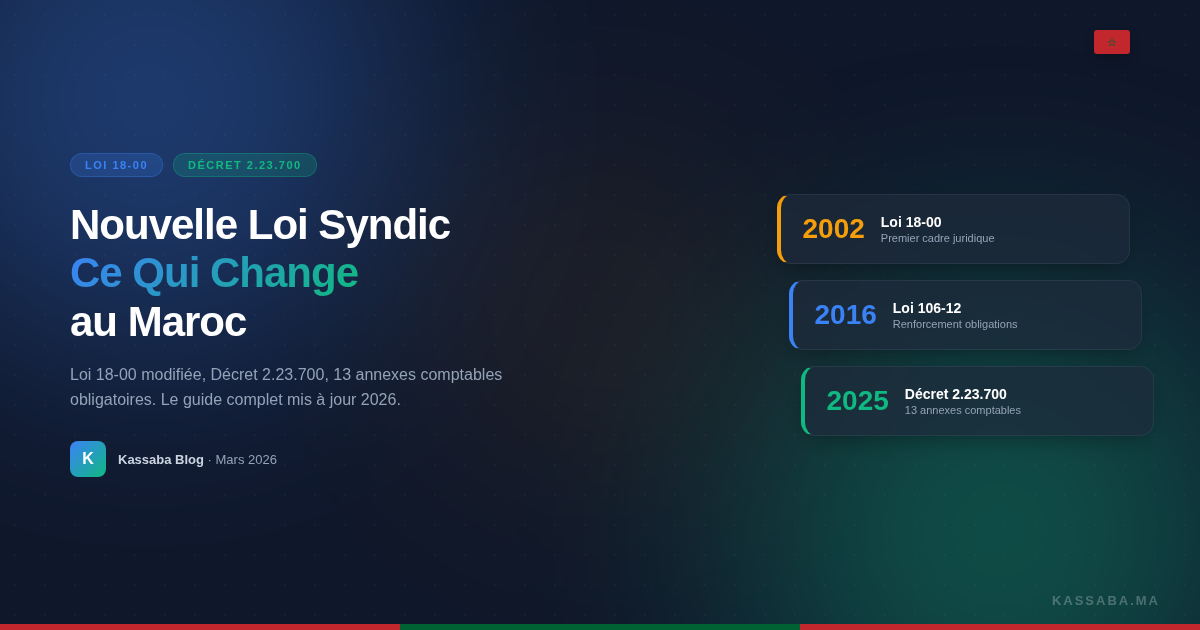
Everything about the new syndic law in Morocco. Law 18-00 amendments, Decree 2.23.700, new accounting obligations and penalties. Updated guide 2026.