
Décret 2.23.700: Everything Moroccan syndics need to know about accounting compliance
Updated on
Since the 2026 fiscal year, every syndic in Morocco must follow new accounting rules. Most still don't know what Décret 2.23.700 actually requires. Here you'll find the 3-tier classification, up to 12 financial annexes, common mistakes, and exactly what you need to do to stay compliant. The rules apply equally to volunteer syndics managing a small building and professionals handling dozens of properties.

About this guide:All information is sourced directly from Décret n° 2.23.700 as published in Bulletin Officiel n° 7391 (March 31, 2025), the official source of Moroccan law. Tier thresholds, annexe requirements, and accounting rules come from the final published decree, not draft versions. Some online sources incorrectly reference "Décret 2.23.733" from earlier projet de décret stages. Kassaba's compliance is built from the law as it was enacted.
What is Décret 2.23.700?
Décret n° 2.23.700 is a Moroccan government decree published on March 31, 2025, inBulletin Officiel n° 7391. Issued in application of Law 18-00(Morocco's co-ownership statute), it defines the accounting requirements and sets specific standards for how syndics must track and report building finances. Compliance is required from the first fiscal year after publication (January 1, 2026 for calendar-year fiscal years).
Before this decree, syndic accounting was a mess. Some syndics kept meticulous records. Many kept a notebook. A few kept nothing at all. Co-owners had no way to compare what their syndic provided against any standard. Money went missing. Trust eroded. Assemblies turned into shouting matches over receipts nobody could find.
The decree fixes this by defining exactly what financial documents a syndic must produce, when, and in what format. It introduces up to 12 specific annexes (depending on building size) and a 3-tier classification system based on annual charges called. The goal is simple: if you manage other people's money, you need to prove where it went.
Key facts:
- • Official name: Décret n° 2.23.700
- • Published: March 31, 2025 in Bulletin Officiel n° 7391
- • Compliance from: first fiscal year after publication (January 1, 2026 for calendar-year fiscal years)
- • Issued in application of: Law 18-00 (accounting provisions)
- • Applies to: ALL syndics (volunteer and professional)
- • Defines: Up to 12 financial annexes depending on building tier
- • Classification: 3-tier system (Small, Medium, Large) based on annual charges called
You can't ignore this. Even if you're managing a 6-unit building for free as a volunteer syndic, the decree applies to you. The requirements are simpler for small buildings (Small tier), but they exist.
What tier classification is my building?
The decree splits buildings into 3 tiers based on total annual charges called. Not collected. Called. That distinction trips people up constantly. If you billed 200,000 MAD but only collected 150,000, your tier is based on the 200,000.
≤ 200,000 MAD/year
Example: 15-unit building, 800 MAD/month = 144,000 MAD/year
Required: Annexes 10, 13-1, 13-2 (very simplified)
Typical: Small to mid-size residential
200K - 500K MAD/year
Example: 30-unit building, 900 MAD/month = 324,000 MAD/year
Required: Annexes 10, 11, 12 (simplified system)
Typical: Mid to large with elevator and security
≥ 500,000 MAD/year
Example: 111-unit complex, 5,750 MAD/unit/year = 638,850 MAD/year
Required: Annexes 3-10 (full accounting)
Typical: Large complex, full amenities, professional management
How to calculate your tier
Add all annual charges called
Include both regular monthly charges and any special charges (one-time repairs, assessments). Use the full amount billed, even if some co-owners haven't paid yet.
Use accrual basis
Charges CALLED, not collected. If you billed 200,000 MAD but only collected 150,000, your tier is based on 200,000.
Fiscal year boundary
January 1 through December 31. No mid-year calculations, no custom fiscal years.
Include all units
Count charges for every unit, including ones that aren't paying. The tier is about what you billed, not what arrived in the bank.
Real example: Al Andalous building, Tétouan
- • 111 units
- • 5,755 MAD average charge per unit per year
- • 111 × 5,755 = 638,850 MAD
- • Classification: Large (≥500K MAD)
- • Required: Annexes 3-10 (full accounting)
One thing to watch: your tier can change year to year. If you had a big renovation that required special assessments, you might jump from Small to Medium for that year. Always recalculate.
Real scenario: the tier miscalculation
A 45-unit building in Fès calculated their tier using collected charges (180,000 MAD) instead of called charges (230,000 MAD). They classified as Small and only prepared Annexes 10, 13-1, and 13-2. At the assembly, a co-owner who worked in accounting caught the error. The building was actually Medium tier, requiring Annexes 10, 11, and 12. The entire accounting package was incomplete. The assembly refused to approve. The syndic spent three extra weeks creating the missing annexes, and the building had to pay for a second assembly. All because of using the wrong number (collected vs. called) for tier classification.
What your tier means in practice
The tier determines which annexes you file. But it also tells you how much work you're signing up for. Here's what to expect at each level.
Small (≤ 200,000 MAD/year): The manageable volunteer
Your building profile:
6-25 units. No elevator (or a simple one). Basic services: cleaning a few times a week, maybe a gardener. Simple structure. Mostly Moroccan residents, some MRE.
Example: Résidence Yasmine, Tétouan
15 units, simple elevator, cleaning three times weekly. Budget: 144,000 MAD (800 MAD/unit/month). Small tier = Annexes 10, 13-1, 13-2 (very simplified).
Time commitment:
- Monthly tracking: 15-30 minutes
- Bank reconciliation: 10 minutes/month
- Year-end closing: 4-6 hours (first time), 2 hours (after)
- Assembly prep: 3-4 hours
- Annual total: ~40 hours/year (less than 1 hour/week)
What trips Small tier syndics up:
- ✗ "We're too small to need proper accounting" (wrong. Law 18-00 applies to ALL buildings)
- ✗ "I'll keep it all in a notebook" (assemblies reject notebook accounts)
- ✗ "Simplified means I can skip things" (you still need Annexes 10, 13-1, and 13-2, properly formatted)
Small tier advantage: You can absolutely do this as a volunteer. Simplified requirements mean less paperwork, and software handles most of it.
Medium (200K-500K MAD/year): Simplified accounting
Your building profile:
20-60 units. Elevator (adds 25-35K MAD/year). Security and cleaning. Mix of residents and MRE. More complex finances with multiple suppliers.
Example: Résidence Les Palmiers, Rabat
30 units, elevator, night security, daily cleaning. Budget: 324,000 MAD (900 MAD/unit/month). Medium tier = Annexes 10, 11, 12 (simplified system).
Time commitment:
- Monthly tracking: 30-90 minutes
- Bank reconciliation: 15-20 minutes/month
- Supplier management: 30-60 minutes/month
- Year-end closing: 1-3 days
- Annual total: ~80-150 hours/year (~2-3 hours/week)
The Medium tier decision:
This is where volunteer syndics start questioning if it's worth it. 80-150 hours/year for free? Some do it. Many burn out. Can you dedicate 2-3 hours/week consistently? Do you have backup when you're unavailable? Is the building willing to pay a stipend? Consider hiring an accountant for year-end review (3,000-8,000 MAD).
Large (≥ 500,000 MAD/year): Professional territory
Your building profile:
60+ units. Full services: elevator, 24/7 security, daily cleaning, gardener, possibly pool/gym. Significant MRE population. Complex operations with multiple staff.
Example: Al Andalous, Tétouan
111 units, elevator + backup, 24/7 security, cleaning, gardener, pool. Budget: 638,850 MAD (5,755 MAD/unit/year). Large tier = Annexes 3-10 (full accounting).
Time commitment:
- Monthly tracking: 2-4 hours
- Supplier management: 1-2 hours/month
- Staff coordination: 2-3 hours/month
- Year-end + bonus annexes: 3-7 days
- Annual total: ~200+ hours/year (~4+ hours/week)
The Large tier reality:
Borderline full-time work. Most Large tier buildings should either pay the syndic (5,000-10,000 MAD/month) or hire a professional syndic company. Full accounting means Annexes 3-10: balance sheet, general management account, budget comparison, and more. Kassaba also generates bonus simplified views (11, 12, 13-1, 13-2) for extra transparency. If annual charges called exceed 1,000,000 MAD, the Decree requires an audit by a certified accountant. Volunteer at this scale: possible but very rare.
Crossing tier boundaries
What if you're Small but approaching Medium? Say 185K MAD this year, might hit 210K next year? Plan ahead: start learning Annexes 11 and 12 requirements (the simplified balance sheet and income statement are a step up from the 4-line format), consider an accountant, and inform co-owners that requirements are increasing.
The jump from Medium to Large is the biggest. If your building crosses 500K MAD, seriously consider professional management. The full accounting system (Annexes 3-10) including balance sheet, general management account, and double-entry journal isn't something most volunteer syndics can handle properly.
What annexes does my building need?
It depends on your tier. Small buildings (≤ 200K MAD) get very simplified requirements: Annexes 10, 13-1, and 13-2. Medium buildings (200K-500K MAD) need simplified accounting: Annexes 10, 11, and 12. Large buildings (500K+ MAD) need full accounting: Annexes 3 through 10. Large tier also gets bonus simplified views (11, 12, 13-1, 13-2).
We'll break down each one in the detailed section below. For now, here's the quick reference:
| Annexe | Name | Small | Medium | Large |
|---|---|---|---|---|
| 3 | Financial Position Statement (État de la situation financière) | - | - | ✓ |
| 4 | General Management Account (Compte de Gestion) | - | - | ✓ |
| 5 | Budget Comparison (Budgets) | - | - | ✓ |
| 6 | Non-Current Works (Travaux Non Courants) | - | - | ✓ |
| 7 | Reserve Fund Tracking (Fonds de Réserve) | - | - | ✓ |
| 8 | Loan Tracking (Emprunts) | - | - | ✓ |
| 9 | Equipment Tracking (Immobilisations) | - | - | ✓ |
| 10 | Co-owner Contributions | ✓ | ✓ | ✓ |
| 11 | Simplified Statements | - | ✓ | ✓ |
| 12 | Simplified Income & Budget | - | ✓ | ✓ |
| 13-1 | Very Simplified Financial Position Statement (4-line) | ✓ | - | ✓ |
| 13-2 | Very Simplified Income & Budget | ✓ | - | ✓ |
✓ = Required for that tier. Small = very simplified (3 documents). Medium = simplified (3 documents). Large = full accounting (8 documents). Large also generates 11, 12, 13-1, 13-2 as bonus simplified views.
What happens if I don't comply?
The honest answer: probably nothing right away. Government enforcement isn't aggressive yet. But co-owners are getting smarter. They're reading about their rights. They're asking questions. And one formal complaint to authorities can trigger an investigation.
Here's what you're risking:
- •Co-owner lawsuits. Any co-owner can take you to court for failing to provide proper accounts. Personal liability for financial losses.
- •Forced removal. The assembly or a judge can remove you as syndic if you repeatedly fail to meet accounting obligations.
- •Can't collect charges. Without approved accounts, you lose legal standing to pursue non-paying co-owners in court.
- •Assembly deadlock. If co-owners reject your accounts, you can't approve a new budget. No budget means no authority to spend. Everything stalls.
Compliance isn't optional. It's the law. The sooner you start, the easier it gets. First year is a learning curve. Second year? Much smoother.
Does Décret 2.23.700 apply to volunteer syndics?
Yes. No exceptions.
Volunteer syndics have the same accounting obligations as professionals. Law 18-00 makes no distinction between someone doing this for a living and someone doing it after work because nobody else in the building would step up.
The good news: most volunteer-managed buildings fall in the Small or Medium tier, which means the requirements are simpler. Small tier buildings only need Annexes 10, 13-1, and 13-2, and with proper software, generating those takes minutes. You don't need an accountant. You don't need a finance degree. You need consistent tracking throughout the year. Before committing to a tool, our framework for evaluating whether a software actually supports Décret 2.23.700 lays out what to ask in a vendor demo.
If you're a volunteer syndic feeling overwhelmed by this, check our volunteer syndic guide for practical tips on managing the workload.
Real scenario: the Medium tier volunteer who burned out
Rachid volunteered to manage a 65-unit building in Casablanca after the previous syndic quit. "How hard can it be?" First year: 200+ hours of accounting, supplier management, and chasing payments. He was doing Medium tier work (budget: 420,000 MAD) as a volunteer, nights and weekends, while working full-time as an engineer. By November, he was three months behind on bank reconciliation, hadn't started year-end closing, and the assembly was in six weeks. He resigned mid-December. The building went three months without a syndic. Co-owners eventually voted to hire a professional at 6,000 MAD/month. They could have done that from the start and saved everyone the trouble.
The financial annexes: detailed breakdown
This is the core of Décret 2.23.700. Each annexe serves a specific purpose, and together they paint a complete picture of a building's finances. Here's what each one is, why it matters, and what trips syndics up.
Quick note on numbering
The decree numbers its annexes starting at 3. But two foundational concepts underpin the entire system: charges called and charges collected. Kassaba tracks these as core accounting records because every other annexe depends on them. We cover them first below, then walk through the official decree annexes (3 through 13-2).
Charges Called (État des Charges Appelées)
Every charge you billed to co-owners during the year: regular monthly charges and special one-time assessments. It's your billing record.
Co-owners check this to verify they were charged the correct amount. If Ahmed from Unit 12 was billed 650 MAD/month plus a 1,500 MAD elevator repair in April, that's 9,300 MAD for the year.
Real scenario: the missing elevator charge
Nadia, syndic of a 15-unit building in Rabat, prepared her charges called report perfectly for monthly charges. Every unit, every month, 650 MAD. At the assembly, a co-owner pulled out his bank statement: "I paid 2,150 MAD in April. Your report only shows 650." Nadia had forgotten to include the 1,500 MAD special assessment for the elevator cable replacement. Her charges called total showed 117,000 MAD. The real total was 139,500 MAD. Every co-owner's individual total was wrong. The assembly rejected the accounts. She spent two weeks recalculating and called a second assembly.
Common pitfalls with charges called:
- • Only listing monthly charges, forgetting special assessments
- • Recording charges when paid, not when called (charge date = the day you issued it)
- • Missing charges for non-paying units (they still get billed, even if they never pay)
- • Inconsistent amounts without explanation (if Unit 3 went from 650 to 750, document why)
How to track charges called from scratch
List all units with their monthly charge amount
Open your building's rules (règlement de copropriété) or last assembly minutes. Find each unit's approved monthly charge. If everyone pays the same (say 650 MAD), one column. If charges vary by tantièmes, you need each unit's exact amount.
Add 12 rows per unit (one per month)
Unit 1: Jan 650, Feb 650, Mar 650... through December. Every month gets an entry, whether or not they paid. You're recording what you CALLED, not what you received.
Add special assessments in the month they were called
Assembly voted a 1,500 MAD elevator repair in April? Add a separate line: "Unit 1: Apr - Special assessment (elevator) - 1,500 MAD." Do this for every unit that was charged. The total for Unit 1 in April is now 650 + 1,500 = 2,150 MAD.
Total per unit, then grand total
Unit 1: 12 x 650 + 1,500 = 9,300 MAD. Do this for all units. Grand total should match your approved budget plus any special assessments voted during the year. If the numbers don't match, something's missing.
Charges Collected (État des Charges Encaissées)
What was actually paid. Not what you billed (that's charges called), but what landed in your bank account. The gap between charges called and charges collected tells you how much is unpaid.
If you billed Ahmed 9,300 MAD but he only paid 7,800 MAD, the 1,500 MAD difference shows up here, revealing who's behind on payments.
Pro tip: if charges collected is significantly lower than charges called, you have a collection problem. That gap is your unpaid balance, and it should trigger follow-up actions before the next assembly.
Common pitfalls with charges collected:
- • Mixing payment years (a January 2 deposit might be for December charges)
- • Not matching payments to specific charges (Unit 12 paid 5,000 MAD, but for which months?)
- • Recording cash payments without receipts (if there's no trail, it didn't happen)
- • Double-counting payments that bounced or were reversed
How to track charges collected from scratch
Start from your bank statements
Not your notebook. Not your memory. Your bank statements are the source of truth. Go through January to December and list every incoming deposit from co-owners. For cash payments, use your signed receipts.
Match each payment to a unit and charge period
Unit 12 transferred 1,300 MAD on March 10. That covers January and February (650 x 2). Label it: "Unit 12, Jan + Feb charges, bank transfer." If someone pays a lump sum, break it down by which charges it covers. Don't leave 5,000 MAD unallocated.
Handle year-crossing payments carefully
Payment date is when it clears the bank. Unit 5 paid December 28, cleared January 2? That's 2025 income, not 2024. It feels wrong, but this is correct accounting. The December charge stays "unpaid" in 2024, and the payment appears in January 2025.
Compare with charges called to find unpaid balances
Charges called total for Unit 12: 9,300 MAD. Charges collected for Unit 12: 7,800 MAD. Unpaid: 1,500 MAD. Do this for every unit. The total difference between called and collected is your building's total outstanding balance. If that number is large (say 20%+ of budget), you have a collection problem.
Annexe 3: الحصيلة / État de la situation financière (Financial Position Statement) Large tier only
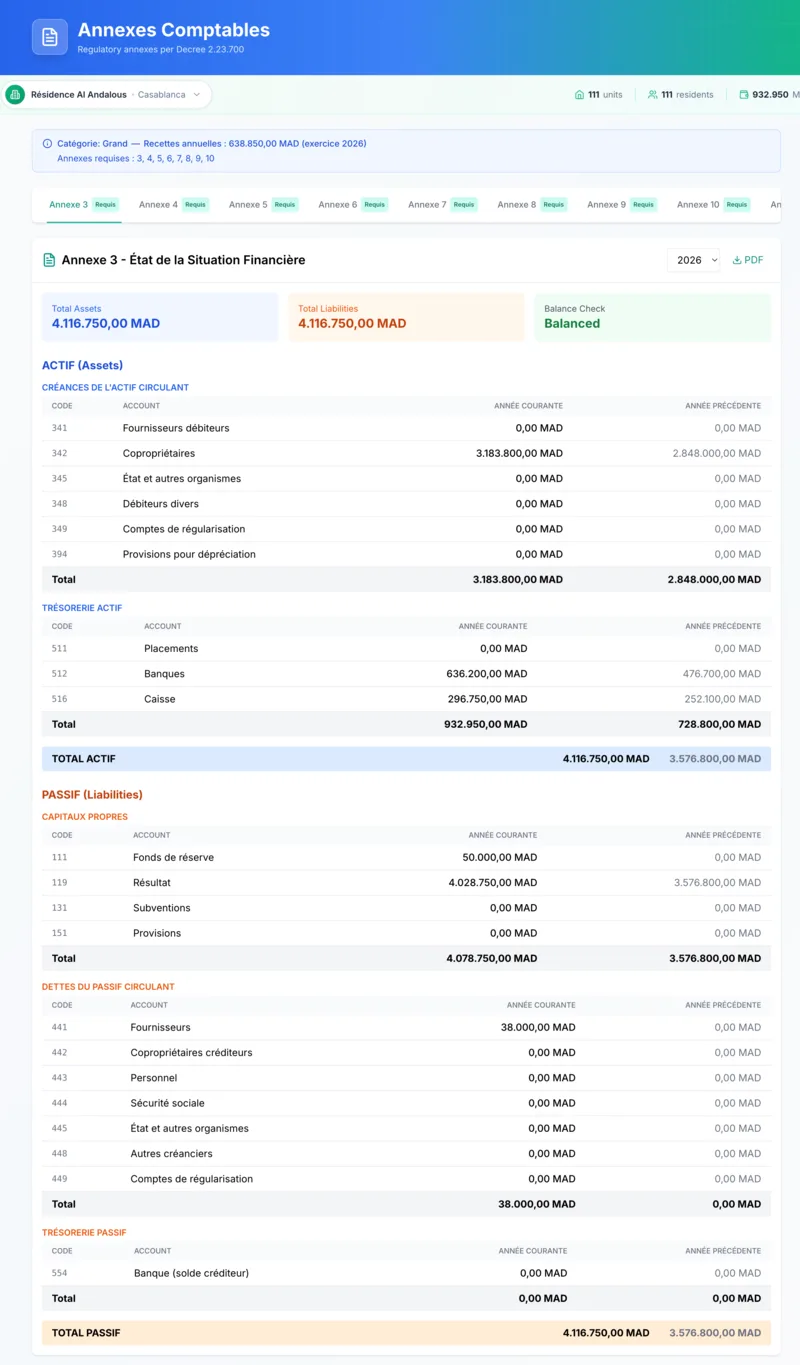
Your building's financial snapshot on December 31. What the building owns (assets) versus what it owes (liabilities). Total assets must equal total liabilities. If they don't, something is wrong.
Assets include co-owner receivables (who owes money), bank balance, and cash on hand. Liabilities include the reserve fund, supplier debts, staff obligations, and any provisions for future work. It shows two columns: current year (N) and previous approved year (N-1) so co-owners can see how the financial position changed.
Common pitfalls with Annexe 3:
- • Assets and liabilities don't balance (every dirham must be accounted for on both sides)
- • Forgetting co-owner receivables as an asset (unpaid charges are money owed TO the building)
- • Not carrying over the reserve fund balance correctly from previous year
Annexe 4: حساب التسيير العام / Compte de Gestion Général (General Management Account) Large tier only
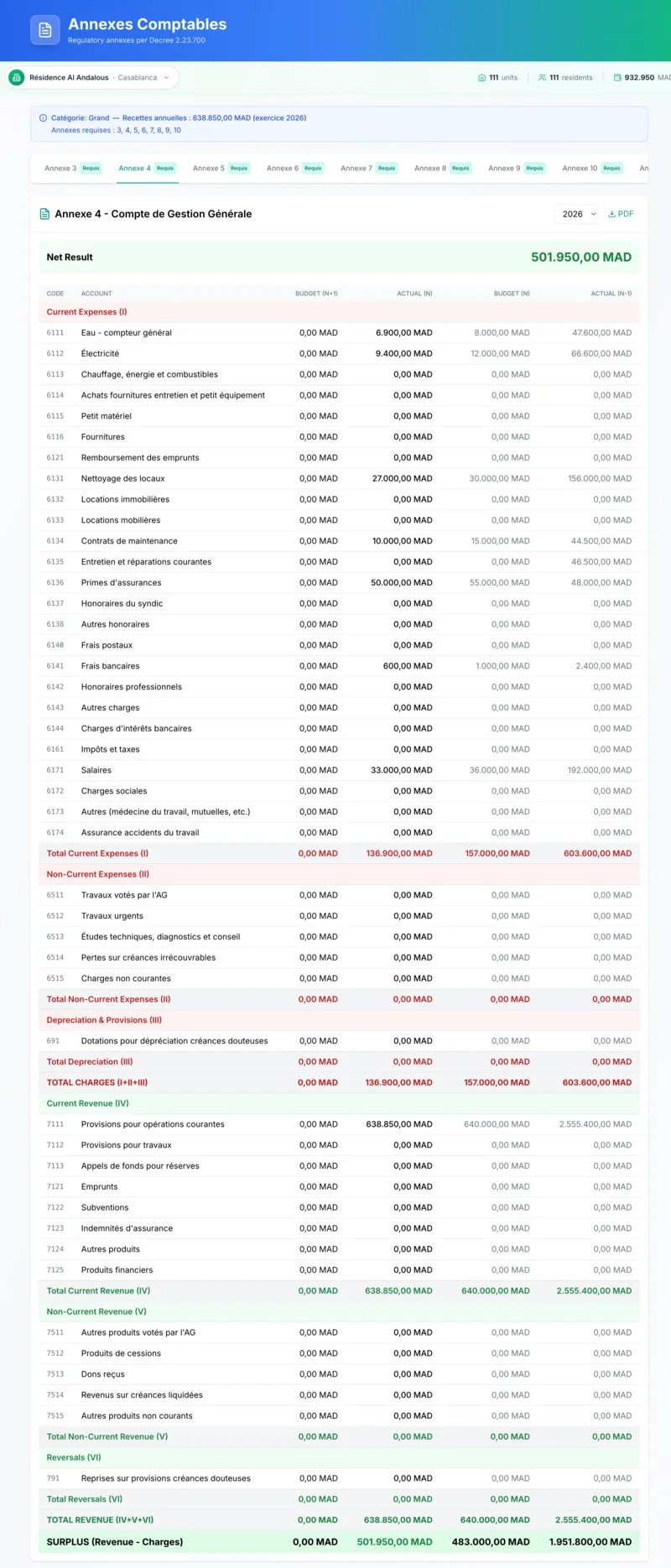
The full general management account. All revenue (regular contributions, works contributions, reserve fund, late fees) on one side, all expenses (water, electricity, maintenance supplies, cleaning, external services, taxes, staff costs, depreciation) on the other. Uses the full chart of accounts with account codes (Class 6 expenses, Class 7 revenue).
Shows two columns: current year actual (N) and the budget for approval (N+1). Co-owners see the result: surplus means you collected more than you spent, deficit means you went over budget. Either way, you need an explanation.
Annexe 4 Example: Al Andalous, Tétouan (111 units) - 2025
| Category | Actual (N) | Budget (N+1) |
|---|---|---|
| Revenue | ||
| Regular contributions | 600,000 | 638,850 |
| Late fees | 12,500 | 10,000 |
| Expenses | ||
| Security (6121) | 120,000 | 120,000 |
| Cleaning (6122) | 48,000 | 50,000 |
| Elevator (6125) | 51,000 | 36,000 |
| Electricity (6112) | 38,500 | 42,000 |
Common pitfalls with Annexe 4:
- • Not explaining variances (for any difference over 10%, write an explanation)
- • Using wrong account codes (elevator maintenance is 6125, not 6111)
- • Not splitting emergency expenses from regular costs (co-owners need to see what was normal vs exceptional)
Annexe 5: الميزانيات / Budgets (Budget Comparison) Large tier only
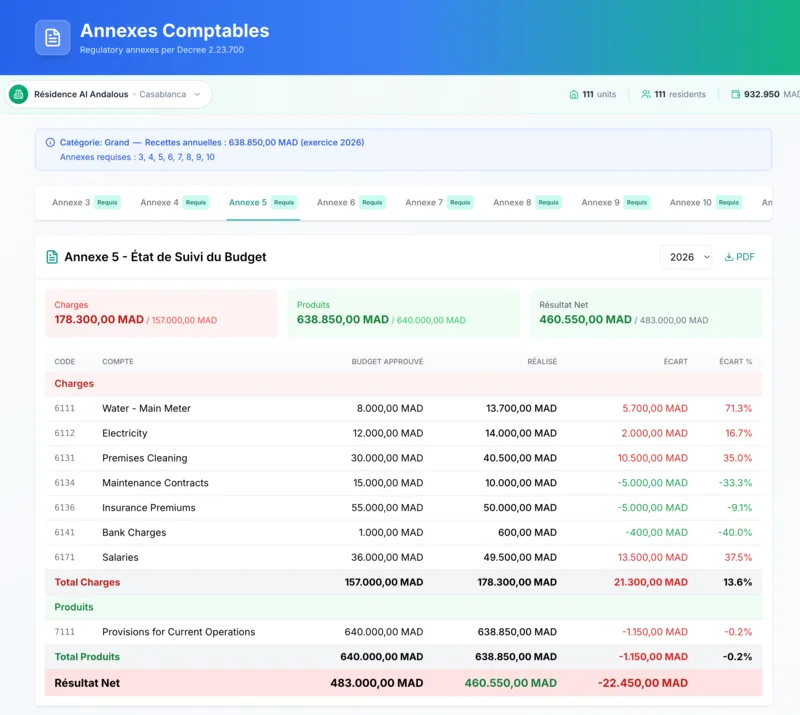
The 4-column comparison that co-owners care about most. Same expense/revenue line items as Annexe 4, but with columns for: previous approved year (N-1), voted budget for current year (N), actual achieved (N) for approval, and provisional budget for next year (N+1) for vote.
This is where the assembly can see: did the syndic stick to the budget? Was last year's estimate close to reality? Is next year's forecast realistic given history? The elevator budget was 36,000 MAD but you spent 51,000? Annexe 5 shows that 15,000 MAD variance, and you better have an explanation ready.
Real scenario: the rejected budget
Omar, syndic of Résidence Les Oliviers in Marrakech, walked into the assembly and dropped a 20% charge increase on the co-owners with zero warning. "Security costs went up. Elevator contract increased. We need more." No breakdown. No comparison to last year. No advance notice. The assembly erupted. Owners accused him of padding expenses. The budget was rejected 18 to 4. Omar had to schedule a second assembly, this time with a detailed breakdown showing exactly where every dirham went. The budget passed the second time, but three co-owners still don't trust him. The lesson: never surprise people with their money.
How to prepare Annexe 5 from scratch
Gather last year's actual expenses
Don't guess. Check the "Actual" column from last year. If planned security was 110,000 MAD but you actually spent 115,000 (added weekend coverage), start from 115,000 for next year's estimate.
List every expense category
Personnel (security, cleaning, gardener), maintenance (elevator, plumbing, electrical), utilities (electricity, water), insurance, administration (bank fees, postage, supplies). Don't forget small items: hallway light bulbs (500 MAD/year), cleaning supplies (1,200 MAD/year). They add up.
Add the reserve fund
A reserve fund can be created by a 3/4 majority vote at the assembly (Article 37bis of Law 18-00). 10% of budget is typical. Base expenses: 341,000 MAD. Reserve fund (10%): 34,100 MAD. Total: 375,000 MAD. Without a reserve, emergencies trigger special assessments. Co-owners hate that.
Send draft at least 15 days before assembly
Include: full budget breakdown, comparison to last year, explanation of increases, proposed new monthly charges. Give co-owners time to read and ask questions BEFORE the meeting. Surprises at the assembly lead to rejection.
Annexe 6: أشغال وعمليات غير جارية / Travaux Non Courants (Non-Current Works) Large tier only
Tracks works and operations outside the regular budget: facade renovations, roof replacement, major plumbing overhauls, legal cases with dedicated funds. For each project: voted amount (with date), paid amount, completed amount, balance pending execution, and completed but unpaid amounts.
Example: the assembly voted a 250,000 MAD facade renovation. Contractor invoiced 180,000 MAD. Paid so far: 150,000 MAD. Remaining to execute: 70,000 MAD. Completed but unpaid: 30,000 MAD. This keeps big project money separate from the regular operating budget so nobody confuses the two at the assembly.
Common pitfall with Annexe 6:
Mixing regular maintenance (elevator annual contract) with non-current works (elevator full replacement). If it was voted as a separate project at the assembly, it goes in Annexe 6. Regular contract expenses stay in Annexe 4.
Annexe 7: تتبع الأشغال في الحساب الاحتياطي / Suivi du Fonds de Réserve (Reserve Fund Tracking) Large tier only
Tracks operations funded from the reserve account per Article 37bis of Law 18-00. Same column structure as Annexe 6 but specifically for reserve-funded work. Shows voted amount, paid amount, completed amount, and balance pending execution.
If the elevator broke and you used 15,000 MAD from the reserve fund to cover emergency repairs, this tracks it. Co-owners can see exactly how the reserve was used and how much remains for future emergencies.
Annexe 8: تتبع الاقتراضات / Suivi des Emprunts (Loan Tracking) Large tier only
Tracks building loans: loan date, lender name, amount borrowed, amounts paid during the fiscal year, and remaining balance. Most buildings have no loans, so this annexe is often empty. If your building took a bank loan for a renovation or major project, every payment and the outstanding balance gets tracked here.
Annexe 9: تتبع المعدات / Inventaire des Immobilisations (Equipment Tracking) Large tier only
Registry of equipment placed at the disposal of the co-ownership. For each item: type/nature, provider, date placed, value, and notes. Elevator (Otis Gen2, installed 2018, value 350,000 MAD). Security cameras (8 units, Hikvision, 2022, 24,000 MAD). Fire safety equipment (extinguishers + alarm, 2023, 15,000 MAD).
This isn't about daily tracking. It's an inventory of what the building has, who supplied it, and what it was worth. Update it when equipment is added or replaced.
Best practice: monthly bank reconciliation
Bank reconciliation isn't a separate decree annexe, but it's the single most important accounting habit. Reconcile your records with the bank statement every month. 10 minutes prevents the kind of trust-destroying disaster described below.
Hassan, volunteer syndic of Résidence Les Palmiers in Rabat, stood nervously at the assembly. His accounting showed 145,000 MAD in the bank. The bank statement showed 130,000 MAD. "Where's the missing 15,000?" The money wasn't missing: 8,000 MAD in uncashed checks, 5,000 MAD in a December deposit that crossed into January, 2,000 MAD in a duplicate bank fee. But three hours explaining this during the assembly destroyed trust. 10 minutes monthly would have prevented it all.
Annexe 10: تتبع إسهامات المالك المشتركين / Suivi des Contributions des Copropriétaires (Co-owner Contributions) All tiers
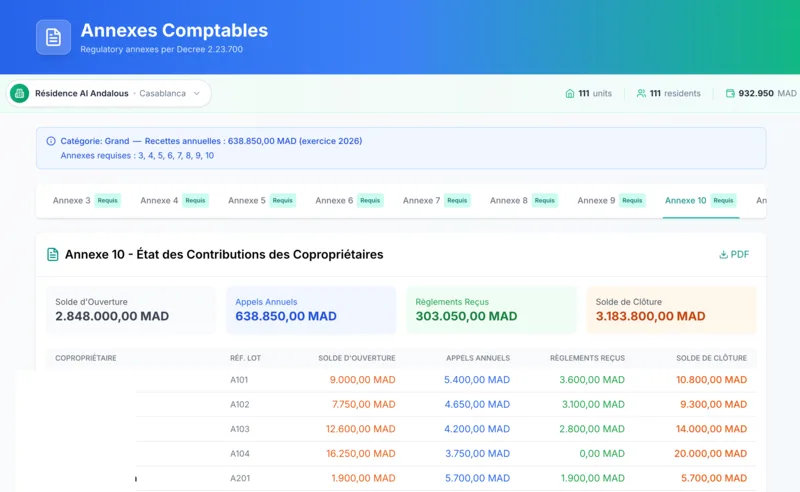
The most important document. The official format is a summary table: one row per co-owner showing property reference (lot), name, annual contribution amount, opening balance (01/01/N), contributions due, payments received, and closing balance (31/12/N). Kassaba enhances this with a detailed ledger showing every charge and payment chronologically, which is what co-owners actually want to see.
Annexe 10 Example: Unit 12 (Ahmed Alami) - 2025
| Date | Description | Charge | Payment | Balance |
|---|---|---|---|---|
| Jan 1 | Opening balance | 0 | ||
| Jan 1 | Regular charge Jan | 650 | 650 | |
| Jan 15 | Bank transfer | 650 | 0 | |
| Feb 1 | Regular charge Feb | 650 | 650 | |
| Feb 20 | Bank transfer | 650 | 0 | |
| Apr 1 | Elevator repair (special) | 1,500 | 1,500 | |
| Year-end balance (Dec 31) | 9,300 | 7,800 | 1,500 | |
When Ahmed gets this document, the conversation changes from "I don't owe anything!" to "Oh, right, the elevator repair. I forgot about that." Numbers on paper end arguments. That's why Annexe 10 is the most important annexe for building trust.
Common pitfalls with Annexe 10:
- • Not including opening balance from previous year (if Ahmed owed 500 MAD from 2024, that carries over)
- • Missing payment method details (bank transfer, check, cash with receipt number)
- • Not cross-checking totals with the balance sheet (the sum of all Annexe 10 closing balances must match total receivables in Annexe 3 or 11)
How to create Annexe 10 for each co-owner
Start with last year's closing balance
Ahmed owed 500 MAD from 2024. That's his opening balance for 2025. This must match last year's Annexe 10 closing balance exactly. If it doesn't, you have a data error from last year that needs fixing first.
Add every charge chronologically (from your charges called record)
Jan 1: Monthly charge 650 MAD. Feb 1: Monthly charge 650 MAD. Apr 1: Special assessment (elevator) 1,500 MAD. Each charge increases the balance. Don't skip months. Even if Ahmed paid on time, the charge still appears as a line.
Add every payment chronologically (from your charges collected record)
Jan 15: Bank transfer 650 MAD (covers January charge). Mar 10: Bank transfer 1,300 MAD (covers Feb + Mar). Include the payment method and which charges it covers. Each payment reduces the balance. The running balance after each line should be correct.
Verify closing balance against the totals row
Ahmed's closing balance: 1,500 MAD owed (the elevator repair he forgot about). The sum of all co-owner closing balances in Annexe 10 must match the total receivables in your balance sheet (Annexe 3 for Large tier, Annexe 11 for Medium). If the numbers don't match, find the error now, not during the assembly.
Print individual statements for the assembly
Give each co-owner their personal Annexe 10 at the assembly (or email it a week before). They'll check it against their own records. If everything matches, trust is built. If there's a discrepancy, you resolve it one-on-one instead of having 30 people arguing during the assembly.
Annexe 11: القوائم المبسطة / Simplified Statements Medium tier + Large bonus
Contains simplified versions of the balance sheet and management account in condensed format. Two columns: current period (N) and previous approved period (N-1).
For Medium tierbuildings, this IS your financial statement. You don't need the full Annexe 3 (balance sheet) or Annexe 4 (general management account). Annexe 11 gives you the condensed version that covers what the assembly needs to see: what the building owns, what it owes, what came in, and what went out.
For Large tierbuildings, Kassaba generates this as a bonus simplified view alongside the full annexes. It's useful as an executive summary for co-owners who don't want to read through 8 full annexes.
Annexe 12: الإيرادات والميزانية المبسطة / Simplified Income & Budget Medium tier + Large bonus
Simplified income and budget WITH comparison. Three columns: current year actual (N), previous approved year (N-1), and voted budget (N). Shows revenue, expenses, and the resulting surplus or deficit.
For Medium tierbuildings, this IS your budget comparison. You don't need the full 4-column Annexe 5. Annexe 12 shows co-owners: here's what we budgeted, here's what happened, here's the result. Revenue: 324,000 MAD. Expenses: 310,000 MAD. Surplus: 14,000 MAD. Clean and clear.
For Large tier, it's a simplified summary view alongside the full budget comparison in Annexe 5.
Common pitfalls with Annexe 12:
- ✗ Forgetting to include bank interest or late payment fees as revenue
- ✗ Not matching the totals with Annexe 11 (they must reconcile)
- ✗ Reporting cash basis instead of accrual basis (use charges at exigibility date)
Annexe 13-1: بيان الوضعية المالية نموذج جد مبسط / Very Simplified Balance Small tier + Large bonus
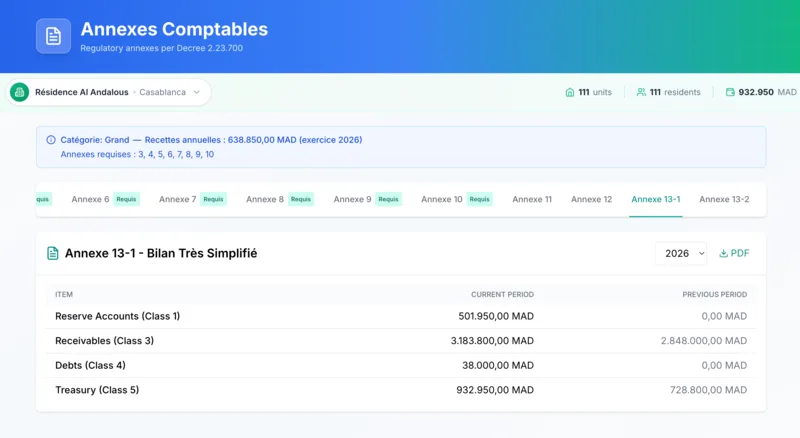
An ultra-simplified 4-line balance sheet. That's it. Four lines:
- Reserve accounts situation (Class 1)
- Receivables situation (Class 3): who owes the building money
- Debts situation (Class 4): who the building owes money to
- Treasury situation (Class 5): bank balance + cash
Columns: current period (N), allocation (+), usage (-), previous period (N-1), and notes.
For Small tierbuildings, this replaces the full balance sheet. Your 6-unit building doesn't need a full Annexe 3. Four lines tell the whole story: "Reserve: 15,000 MAD. Co-owners owe us: 4,200 MAD. We owe suppliers: 2,000 MAD. Bank: 22,400 MAD." Done.
Annexe 13-2: حساب العائدات والتكاليف والميزانية نموذج جد مبسط / Very Simplified Income & Budget Small tier + Large bonus
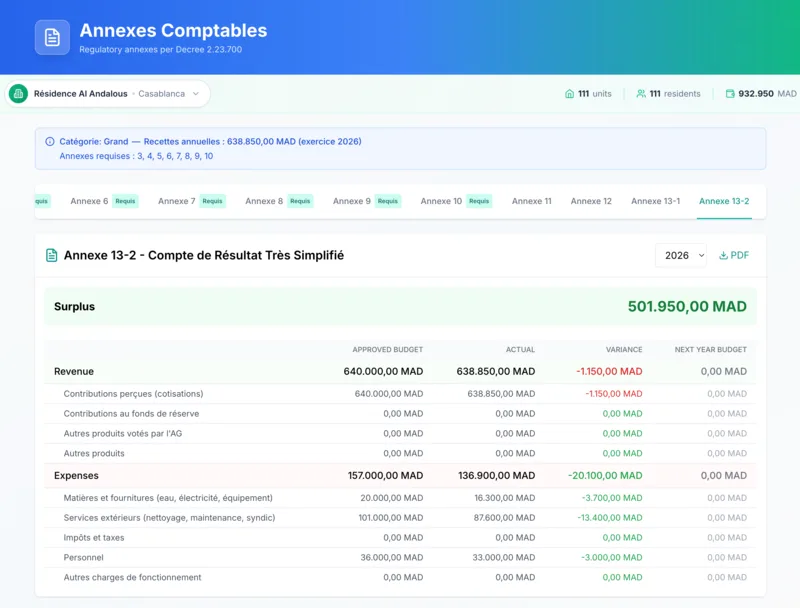
Very simplified income and budget with comparison. Revenue broken into: contributions received, works contributions, reserve fund, other. Expenses broken into: supplies, external services, taxes, staff, other.
Five columns: approved budget (A), actual achieved (B), variance value (A-B), variance %, and next year budget (N+1).
For Small tierbuildings, this IS your income and budget document. It shows the assembly: here's what we budgeted, here's what happened, and here's our proposal for next year. Simple enough for any volunteer syndic to prepare.
When you need an external audit
If your building's annual charges called exceed 1,000,000 MAD, the Decree requires an audit by a certified accountant (commissaire aux comptes). They review your records, verify bank statements match, check supplier invoices exist for every expense, and confirm co-owner balances are correct. A 150-unit complex in Casablanca with a 2.25M MAD budget discovered this the hard way when the auditor found 180,000 MAD in "miscellaneous expenses" with no supporting invoices. The management company lost the contract. At that scale, every dirham needs a paper trail.
Generating annexes manually?
Kassaba tracks your charges and payments all year, then generates all required annexes in minutes. Free to get started.
Your annual compliance process
Compliance isn't a December project. It's a year-round habit. If you track consistently, year-end takes a day. If you wait until December to start, you'll spend 2-3 weeks reconstructing the year from scattered receipts and WhatsApp messages.
January through November: ongoing tracking
- • Issue charges to all units (week 1 of each month)
- • Record payments as they arrive
- • Follow up on late payments by day 10
- • Reconcile bank statement at month-end
- • Record all supplier invoices with receipt numbers
December: year-end closing
- • Week 1-2: Issue final December charges, chase remaining payments
- • Week 3: Generate all required annexes for your tier, review for errors, cross-check totals
- • Week 4: Prepare assembly presentation, print annexes, write explanatory notes for variances
January (next year): assembly preparation
- • Send convocation with annexes attached (at least 15 days before assembly, Art. 16quinquies)
- • Give co-owners time to review and ask questions in advance
- • Prepare next year's draft budget for the assembly vote
Assembly day
- • Present each annexe briefly (summaries, not line by line)
- • Explain major variances
- • Answer questions
- • Get the approval vote
After assembly
- • Archive all approved documents
- • Send copies to absent co-owners (especially MRE owners living abroad)
- • File everything for at least 5 years (Decree requirement, Article 11), ideally 10 years
- • Start tracking for the new fiscal year
The real difference:
Syndics who track monthly spend about 15 minutes per day on accounting. Their December takes 1-2 days. Syndics who wait until December spend 2-3 weeks reconstructing the entire year. Same work, distributed differently. One approach is sustainable. The other leads to burnout.
Real scenario: the 5-hour assembly
Samir, syndic of a 40-unit building in Agadir, waited until December 20 to start preparing for the January 10 assembly. He spent the holidays reconstructing 12 months of transactions from bank statements and WhatsApp messages. His annexes had errors. Totals didn't match. He couldn't explain a 23,000 MAD variance in maintenance costs. The assembly turned hostile. Co-owners cross-examined every line for five hours. Accounts were rejected. Samir had to redo everything and call a second assembly in March, which cost the building 2,500 MAD in mailing and venue fees. If he had tracked monthly, the first assembly would have lasted 90 minutes and everything would have passed.
Common mistakes syndics make (and how to avoid them)
These are the errors we see over and over. Every single one is avoidable.
Wrong tier classification
Using collected amounts instead of called amounts to determine tier.
Fix: Always use charges called (what you billed), never collected (what you received).
Missing bank reconciliation
Never reconciling with bank statements, just trusting your own numbers.
Fix: Reconcile monthly. 10 minutes/month vs 3 hours in December.
No receipts for cash payments
Paid the gardener 500 MAD cash, no receipt, can't prove it at assembly.
Fix: Never pay cash without a written receipt. Avoid cash entirely if possible.
Confusing fiscal years
Mixing January 2025 charges with December 2024 payments.
Fix: Strict fiscal year: Jan 1 to Dec 31. Payment date determines the year.
Late preparation
Started preparing annexes 3 days before the assembly, rushed, made errors.
Fix: Block weeks 3-4 of December for year-end closing. Non-negotiable.
No variance explanations
Budget said 36K for elevator, spent 51K, no explanation prepared.
Fix: For any variance over 10%, write an explanation before the assembly.
Handwritten annexes
Tried to create everything by hand in a notebook. Took 2 weeks and was full of errors.
Fix: Use Excel at minimum, software if you can. Don't torture yourself.
The expensive mistakes (real stories)
Using cash for everything
Karim, syndic of a 12-unit building in Marrakech, paid everything in cash for "convenience." Gardener: 500 MAD cash monthly. Plumber repair: 1,200 MAD cash. Electrician: 800 MAD cash. Year-end total: 45,000 MAD in undocumented cash payments.
At the assembly: "Where are the receipts?" Karim: "I didn't always get them. I trusted the workers." Result: co-owners accused him of stealing. He wasn't. The money was legitimately spent. But he couldn't prove it. Assembly rejected the accounts. Three co-owners demanded his resignation.
Fix: Open a dedicated bank account (mandatory anyway). Pay by check or transfer for everything. If you MUST pay cash (emergency weekend repair), get a signed receipt immediately and photograph it.
Mixing fiscal years
December 28, 2024: Unit 5 pays 650 MAD. Syndic records it as "December 2024 charge, PAID." But the payment cleared the bank January 2, 2025. Now 2024 shows a payment the bank doesn't have. 2025 shows a bank deposit nobody recorded. Assembly: "Your totals don't match the bank!"
Fix: Strict rule: payment date = the date it clears the bank. December 28 payment that clears January 2 = 2025 income. The December charge stays "unpaid" in 2024 accounts. That's correct accounting.
Not labeling payments
March 15: Unit 12 transfers 5,000 MAD. But the syndic doesn't note what it's for. Was it 3 months of regular charges (650 x 3 = 1,950)? Plus elevator repair (1,500)? Plus advance for next month (650)? Plus extra toward the balance? By June, nobody remembers. Chaos.
Fix: Every payment gets labeled the day it arrives. "Unit 12, March 15: Regular Jan 650 + Regular Feb 650 + Regular Mar 650 + Elevator special 1,500 + Advance Apr 650 = 4,100 MAD." Remaining 900 MAD applied to balance. Memory fails after 48 hours. Record it today.
Lost receipts = lost money
A syndic spent 28,000 MAD on repairs throughout the year. Kept paper receipts in a desk drawer. What happened: dog ate two, coffee spilled on three, kid used one for an art project, four more just vanished. Only 15,000 MAD documented. Assembly: "Show us proof of 28,000." Syndic: "I have receipts for 15,000. The rest are gone." Co-owners: "So 13,000 MAD has no proof?"
Fix: Digital backup for every receipt. Get the paper, photograph it immediately (same day!), email it to yourself. Name files clearly: "2026-03-15-Plumber-Leak-1200MAD.jpg." Time cost: 30 seconds per receipt. Risk cost of not doing it: thousands in disputed expenses.
Inconsistent charges without documentation
January-June: Unit 5 paid 650 MAD/month. July-December: 750 MAD/month. Assembly: "Why did Ahmed's charge increase?" Syndic: "Uh... I think there was a vote?" Co-owners: "We don't remember voting on this." Without documentation, the syndic can't prove the increase was approved.
Fix: Every charge change needs documentation. Assembly PV from June: "Resolution #5: Increase monthly charges by 100 MAD starting July 1 to cover security upgrade. Vote: 15 for, 2 against, 1 abstention. APPROVED." Then when Unit 5 asks, you point to Resolution #5. No documentation = no proof.
Do you need an accountant?
Short answer: it depends on your tier and how comfortable you are with numbers.
Small/Medium tier: Probably not
- • Software handles the calculations
- • Hire accountant for year-end review only: 3,000-5,000 MAD
- • Monthly tracking: handle yourself
Large tier: Consider it
- • Annexes 3-10 require full double-entry accounting
- • Monthly accountant: 2,000-5,000 MAD/month
- • Year-end only: 8,000-15,000 MAD
If you're a volunteer syndic, start with software and only bring in an accountant if you're truly stuck. You're doing this for free already. Don't spend your evenings on spreadsheets when software can handle it.
The middle ground that works well: use software year-round for daily tracking. Hire an accountant for 2-3 days in December to review, verify, and put their stamp on your documents. Best of both worlds.
How Kassaba handles Décret 2.23.700 compliance
We built Kassabaspecifically for Moroccan co-ownerships, so compliance with Décret 2.23.700 is built into how the software works. You don't think about compliance separately. It happens as you track your building's finances throughout the year.
Without software (December panic)
- • 2-3 weeks gathering receipts and records
- • Manual Excel calculations, formula errors
- • Tier classification done by guesswork
- • Annexes formatted differently each year
- • Bank reconciliation done once (or never)
- • Stress, errors, late assembly documents
With Kassaba (30-minute year-end)
- • Data tracked all year (5 min/day)
- • Automatic calculations, no formula errors
- • Tier calculated automatically from annual charges called
- • Professional PDF format for all annexes
- • Bank reconciliation built into monthly flow
- • Click "Generate": all annexes ready
Kassaba is free to get started. If you're managing a building in Morocco and want to see how it works, create an account and look around. No commitment, no credit card.
What happens if you don't comply
Law 18-00 plus Décret 2.23.700 makes compliance mandatory. The consequences come in three flavors, and they get progressively worse.
Legal consequences
Co-owners can sue for lack of transparency. They can demand your removal as syndic. They can claim damages for financial losses they attribute to your mismanagement. A judge can order you to produce the missing documents and fine you for the delay.
Practical consequences
Without approved accounts, you can't approve a new budget. Without a budget, you can't legally collect charges. Without collected charges, you can't pay the security company, the elevator maintenance, the insurance. Everything cascades.
And if a co-owner doesn't pay and you take them to court, the first thing the judge asks is: "Are your accounts in order?" If they're not, your case is significantly weaker.
Relationship consequences
Co-owners lose trust. Assemblies become hostile. Every expense gets questioned. People stop paying because "the syndic can't even show us where the money goes." The pressure to resign builds.
Illustrative scenario: late payment follow-up that recovered 52,000 MAD
A 30-unit building in Kenitra had 8 co-owners who hadn't paid in over a year. Total owed: 62,400 MAD. The syndic had proper Annexe 10 statements for each one showing exactly what was owed. She sent formal letters with the detailed accounts attached. Seven of the eight paid within a month (52,000 MAD recovered). The eighth went to court, where the judge reviewed the syndic's Annexe 10 and ruled in her favor within two hearings. Without those detailed records, she'd have had no legal standing. The court explicitly noted that her documentation met Décret 2.23.700 standards.
Reality check:
Most syndics won't get fined by the government right away. Enforcement is still catching up. But co-owners are increasingly aware of their rights. One complaint to authorities can trigger an investigation. And in court, a syndic without proper records has almost no defense. It's not worth the risk.
Templates and resources
If you're doing this manually in Excel, you'll need templates for each annexe. The basic structure for the core annexes follows the format described above: columns for dates, descriptions, amounts, and running balances.
You can build your own in a spreadsheet, or use software that generates them automatically. If you want to try Kassaba, it generates all required annexes from the data you track throughout the year. No manual formatting needed.
For questions about templates or compliance, reach out at [email protected]. We're happy to help.
Frequently asked questions
When did Décret 2.23.700 take effect?
Décret 2.23.700 was published in Bulletin Officiel n° 7391 on March 31, 2025. Compliance is required from the first fiscal year after publication, which means January 1, 2026 for co-ownerships whose fiscal year follows the calendar year. If you haven't started preparing, now is the time.
What if my building is only 6 units?
It still applies. You'll likely be in the Small tier (≤ 200K MAD, very simplified requirements: Annexes 10, 13-1, and 13-2). No building is too small for Décret 2.23.700.
Can I use Excel instead of software?
Legally, yes. Practically? It works for Small tier buildings maybe. Once you're at Medium tier with 20+ units, Excel becomes a nightmare of broken formulas and version conflicts. Most syndics who try Excel for a full year switch to software the next year.
How do I calculate my building's tier?
Multiply the number of units by the average annual charge per unit. A 30-unit building at 500 MAD/month: 30 x 6,000 = 180,000 MAD/year = Small tier. Use charges called (what you billed), not what you collected.
What if my annual charges fall between two tiers?
Use the tier you're in. 199,000 MAD = Small. 201,000 MAD = Medium. 499,000 MAD = Medium. 501,000 MAD = Large. There's no rounding or grace zone.
Do I present all annexes at the assembly?
Yes, but don't read every line. Summarize the key points, provide printed copies, and let co-owners review the details. Focus on the budget annexe (Annexe 5 for Large, 12 for Medium, 13-2 for Small) and Annexe 10 (co-owner contributions) since those generate the most questions.
How long does it take to prepare annexes manually?
First time: 2 to 3 weeks if you're doing everything from scratch. With experience: 3 to 5 days. With software like Kassaba: about 30 minutes, because the data is already tracked throughout the year.
What if I made mistakes in previous years?
You can't change the past. Start complying properly now and be transparent about improving your processes. Co-owners generally appreciate honesty about past issues more than discovering hidden errors later.
Can co-owners reject the annexes?
Yes. If the numbers don't add up, documentation is missing, or they suspect irregularities, they can refuse to approve the accounts at the assembly.
What happens if the assembly rejects the accounts?
You must fix the issues and reconvene. The building can't move forward (no new budget, no new projects) without approved accounts. It's a deadlock that hurts everyone.
Do I need receipts for every expense?
Yes. Every single one, no matter how small. Paid 50 MAD for hallway light bulbs? Get a receipt. No receipt means the expense can be challenged at the assembly, and you might end up paying from your own pocket.
Can I just show bank statements instead of annexes?
No. Bank statements show transactions but they're not the same as structured accounting annexes. You need both: bank statements for monthly reconciliation and the formal annexes for the assembly.
What's the penalty for non-compliance?
Fines from authorities vary and aren't consistently enforced yet. The bigger risk: co-owners can sue you, demand your removal, and claim damages. That's where it gets personal and expensive.
Is there a grace period?
The decree says compliance starts from the first fiscal year after publication (March 31, 2025). That means January 1, 2026 for co-ownerships whose fiscal year follows the calendar year. The built-in transition period is effectively your grace period. Use 2025 to prepare your systems and processes.
What if I don't understand accounting?
Three options: learn the basics (this guide is a good start), use software that handles the calculations for you, or hire an accountant. For Small and Medium tier buildings, software alone is usually enough.
How long do I keep these documents?
The Decree (Article 11) requires a minimum retention of 5 years for co-ownership accounting documents. In practice, keeping all annexes, receipts, bank statements, and assembly minutes for at least 10 years is recommended. Digital backups are strongly recommended.
What if co-owners want more detail than the annexes provide?
The annexes are the minimum. You can always provide more transparency. If a co-owner wants a breakdown of every elevator repair invoice, you should be able to provide it. More transparency is always better.
Can I charge co-owners for accountant fees?
Yes, if it's voted in the budget prévisionnel. Include it as an 'Administration' or 'Accounting' line item. The assembly approves the budget, including professional fees.
What's the most important annexe?
Annexe 10 (co-owner contributions). This is what every co-owner checks first: what they were charged, what they paid, and what they still owe. If Annexe 10 is wrong, everything else falls apart.
Do I present to co-owners or to the government?
Co-owners, at the annual assembly. The government only gets involved if there's an audit or a formal complaint. Your primary audience is always the people who live in the building.
Can software replace an accountant?
For Small and Medium tier buildings, yes. The calculations aren't complex, and software handles them accurately. For Large tier buildings (500K+ MAD), use software for daily tracking but have an accountant review the year-end documents.
What if I discover errors after the assembly?
Correct them going forward. For minor errors, note them in next year's report. For major errors that affect co-owner balances, call an extraordinary assembly to present the corrections and get approval.
Is Kassaba compliant with Décret 2.23.700?
Yes. Kassaba was designed for Moroccan co-ownerships and generates all required annexes automatically based on the data you track throughout the year.
Can I backdate compliance?
There's nothing to backdate. The decree only requires compliance from 2026 onward, so previous years didn't require these annexes. When you start with software like Kassaba, you enter your current balances as opening balances, and the system generates compliant documents going forward. The N-1 (previous year) columns will show zeros in your first year. That's completely normal and expected.
My building has never had a syndic. Does this still apply?
If there's a co-ownership (multiple owners sharing common areas), someone is legally responsible for management. Even informal arrangements need to comply once a syndic is properly elected.
Resources and next steps
Official documentation
- →Bulletin Officiel n° 7391(official government site)
- →Law 18-00 full text(co-ownership statute)
Related guides
- →Syndic Management in Morocco: Complete Guide (Law 18-00)
- →Volunteer Syndic Guide Morocco
- →MRE Property Management in Morocco
- →Syndic Accounting in Morocco: Practical Guide
- →Syndic Management App for Morocco
- →Syndic Bylaws Template for Morocco
Get help
- →Try Kassaba free(auto-generates all annexes)
- →WhatsApp(quick questions about compliance)
- →[email protected](detailed questions about compliance)
Compliance doesn't have to take weeks.
Kassaba tracks your building's finances all year and generates every required annexe at year-end. Built for Moroccan syndics, free to get started.
Questions? [email protected]
This guide is written by the Kassaba team based on our understanding of Décret 2.23.700 and Moroccan co-ownership law. It is not legal advice. For anything that could end up in front of a judge, consult a lawyer or certified accountant.