
Pest Control in Moroccan Co-Ownership: Who Pays, Who Manages
If you live in a Moroccan apartment building, the summer reality is familiar. The temperature climbs, the cockroaches appear in the stairwell, the mosquitoes settle in the courtyard, and a neighbor sends a WhatsApp to the building group asking what the syndic is going to do about it.
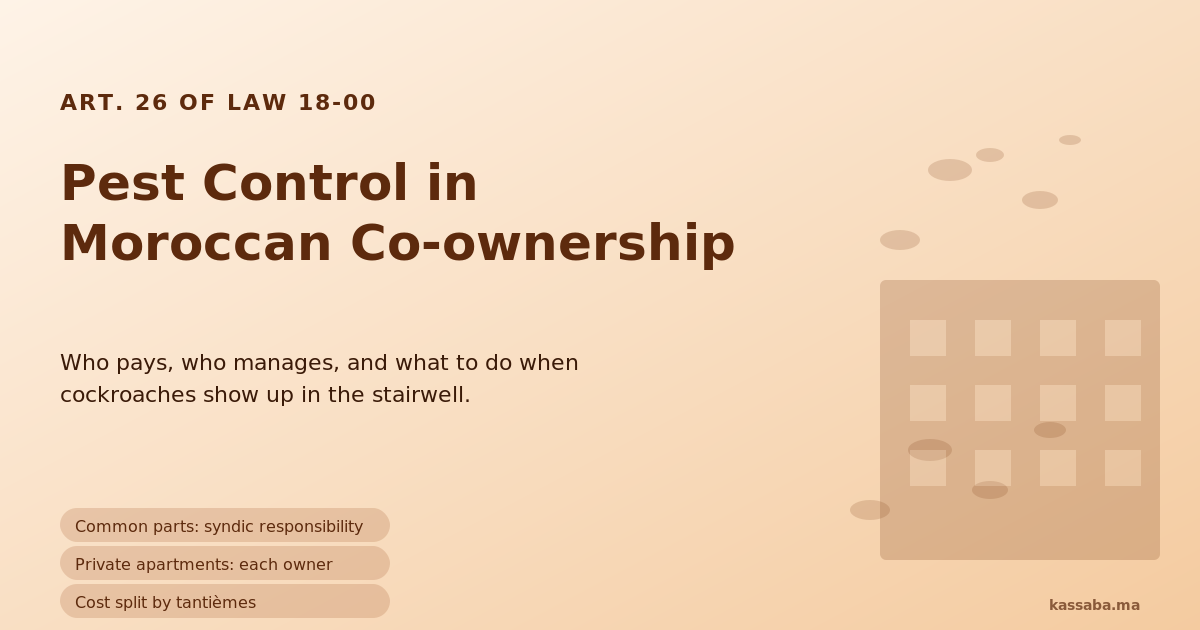
The answer to the WhatsApp question starts with Article 26 of Loi 18-00. Pest control in common areas generally falls under the syndic's maintenance responsibility when pests affect cleanliness, safety, or normal use of shared spaces. The building budget usually pays for it. Each co-owner contributes their share by tantièmes. If the syndic refuses to act, the escalation path starts with written documentation and, if needed, an AG request under the building's règlement de copropriété and applicable provisions of Loi 18-00.
This article walks through what Article 26 actually supports, where the cost lands, what happens at the boundary between common areas and private apartments, and how to handle a non-responsive syndic.
This article is an informational guide, not legal advice. If the infestation involves health risks, tenant disputes, refusal of access, damage claims, or a contested charge allocation, ask a Moroccan lawyer, commune service, or qualified property professional to review the facts before taking formal action.
What Article 26 of Loi 18-00 actually says
Article 26 of Loi 18-00 (as modified by Loi 106-12) sets out the syndic's general duties. Among those duties is the upkeep of the building's common areas: the syndic is responsible for keeping the building habitable, which in standard Moroccan copropriété practice includes pest treatment when infestations threaten common-area cleanliness or safety. The Arabic source text uses terms such as "صيانة" (maintenance) and "حفظ" (conservation/upkeep) to describe this duty set.
The law does not enumerate specific pests or specific treatments. It does not say "the syndic must treat for cockroaches every June." What it says is that the syndic is responsible for the common areas, and pest control is part of how upkeep gets done in practice. When an inspection or a co-owner report establishes that pests are present in common areas, the argument for action flows from Article 26's general duty framework.
Quick decision table
| Situation | Usual payer | Syndic action | Evidence to keep |
|---|---|---|---|
| Pests in stairwell, garbage room, basement, roof, or shared utility space | Building budget, split by tantièmes | Quote, treatment, invoice, follow-up | Dated photos, treatment report, invoice |
| Pests inside one private apartment only | That co-owner or occupant | Written notice if it creates nuisance | Photos, complaint log, access/refusal record |
| Infestation crossing several units and common risers or ducts | Usually AG-approved collective treatment | Diagnose source, propose collective plan | Contractor diagnostic, règlement clause, AG vote |
| Emergency health or safety risk in common areas | Building budget first, later allocation if needed | Immediate containment and documented decision | Written request, quote, report, commune contact |
| Exceptional termite or structural treatment | Usually special assessment after AG vote | Put scope and funding on AG agenda | Technical report, quotes, PV, payment proof |
Common areas vs private apartments: where the cost lands
The split is procedural, not biological. The pest itself does not change category. What changes is the location and the source.
Common areas usually handled at the building's expense:
- Stairwells, landings, hallways, elevator shafts
- Basements, parking garages, storage cellars
- Courtyards, gardens, rooftop terraces (if accessible to all co-owners)
- Garbage rooms and trash chutes
- Shared utility spaces (boiler rooms, electrical rooms, water meter rooms)
- Building exterior walls and façades (when pests like termites threaten structural integrity)
Private apartments where each co-owner pays for their own treatment:
- Inside individual apartments (kitchens, bathrooms, bedrooms)
- Private balconies (in most règlement frameworks)
- Storage cellars assigned to a specific apartment
- Parking spaces assigned to a specific apartment
Borderline cases that depend on the building's règlement de copropriété:
- Party walls between apartments (cockroaches or termites traveling through shared walls)
- Plumbing risers connecting multiple apartments
- Vents and ducts shared by adjacent units
For the borderline cases, the règlement de copropriété is the controlling document. If your règlement is silent, the syndic should document the source and typically convene an AG to decide on collective treatment for any infestation that crosses multiple apartments or shared technical spaces.
How costs get allocated
When the syndic schedules a common-area treatment, the cost goes into the building's ordinary maintenance budget. Each co-owner pays their share according to their tantièmes, the same ratio used for any other common-area expense.
A typical example: a building has 30 apartments. Annual common-area pest control contract costs 18,000 MAD. An apartment with 350 tantièmes out of 10,000 total pays approximately 630 MAD per year. The amount appears on the regular charge call alongside concierge, water, lighting, and other common-area expenses.
For exceptional treatments above the routine budget (a termite infestation requiring structural treatment, a rat eradication campaign, a major preventive intervention), the syndic typically calls an extraordinary AG and asks for a vote on a special assessment. The vote follows Article 20 for ordinary decisions (majority of co-owners present or represented) or Article 21 for larger works where the 3/4 majority is required.
The syndic cannot unilaterally bill co-owners for exceptional pest control above the approved annual budget. That distinction matters: routine pest control is part of normal maintenance and does not need a special vote; exceptional pest control does.
What if one apartment is the source
Sometimes the infestation can be traced to a specific apartment. A bedbug outbreak that started in one unit. A cockroach colony in a kitchen the syndic can document is feeding from one apartment's waste.
In that case the general principle in Moroccan co-ownership law applies: the use of private parts must not cause nuisance or harm to other co-owners. The syndic can issue a formal request to the source apartment, with a deadline and a documented basis. If the source apartment treats, the problem is contained.
If the source apartment refuses, the syndic has a procedural choice. They can either escalate the source-apartment liability through a tribunal (slow, expensive, often disproportionate to the issue), or they can protect the common areas and ask the AG to approve the collective response and any proposed recovery from the source apartment. A separate bill to one apartment is much easier to defend when the source, scope, cost, and decision trail are documented in writing.
When summer brings public-health concerns
Mosquito populations explode in Moroccan summers, particularly in coastal cities and inland areas with standing water. In recent years, public health authorities in Morocco have increased attention on arboviruses (dengue, chikungunya, West Nile) carried by certain mosquito species.
If the situation in your building reaches the threshold of a public-health concern, two additional paths open up. First, the syndic can request guidance or support from the local commune or préfecture, especially where standing water, rodents, or mosquitoes affect common spaces. Second, if the infestation creates a documented health risk, the co-owners can request immediate containment from the syndic regardless of the AG schedule, citing Article 26's duty to maintain security of common areas.
Public-health-grade interventions are different from cosmetic pest control. A reputable treatment company will identify the species, source, and risk profile before quoting. Avoid contractors who quote without inspection.
What if the syndic refuses to act
Three practical escalation paths exist.
Path 1: Written request and documentation. Send the syndic a formal written request (email is sufficient for initial documentation, registered mail if a paper trail is needed later). Describe the problem, request action with a reasonable deadline (15 to 30 days for non-emergency, immediate for health risk), and request a written response. Keep copies of everything.
Path 2: Extraordinary general assembly. An extraordinary general assembly can be convened by the syndic or requested by co-owners under the building's règlement de copropriété and applicable provisions of Loi 18-00. In multi-building complexes where a conseil syndical legally exists, it may also have a role. The agenda can include instructions to the syndic to act on pest control, a vote on an exceptional treatment budget, or in serious cases a vote on syndic replacement. For more on the syndic's general obligations and dismissal procedures, our pillar walks through the role and how it can be ended.
Path 3: Civil liability review. If the syndic's inaction causes documented damage (worsening infestation, health incident, damage to common areas, or avoidable extra costs), ask a Moroccan lawyer to assess whether syndic civil liability can be invoked. This is rarely the first move, but it matters when inaction is repeated and documented.
A practical 5-step playbook for syndics
If you are a syndic facing a pest issue in your building, here is the workflow that typically resolves it quickly and defensibly.
Step 1: Identify the source. Inspect the common areas thoroughly. Where are the pests entering, breeding, and moving? Document with photos.
Step 2: Get 2 or 3 quotes. Contact qualified pest control companies. Ask for a written diagnostic before they quote. Compare not just price but the proposed treatment scope, chemical products used, safety precautions, warranty or follow-up, and whether residents must avoid treated areas for a period.
Step 3: Decide on the funding path. If the annual budget covers it, proceed directly. If it requires an exceptional spend, call an AG (regular or extraordinary depending on urgency) and put the treatment on the agenda for vote.
Step 4: Document the treatment. Keep the diagnostic, the quote, the contract, the proof of payment, and the after-treatment report. These become annexes to your year-end accounts under Décret 2.23.700.
Step 5: Schedule follow-up. A single treatment rarely eliminates a serious infestation. Plan inspection at 30 days, 60 days, and 6 months. Include the follow-up cost in your annual planning.
Documents to request from the treatment company
Before the syndic approves a contractor, request a minimum paper trail:
- Written diagnostic identifying the pest, source, affected areas, and proposed treatment.
- Quote with the exact common areas covered, number of visits, products used, and safety instructions for residents, children, pets, and food storage.
- Proof of company identity and invoice details so the expense can be booked cleanly in the syndicate accounts.
- After-treatment report with date, areas treated, products used, technician notes, and follow-up recommendation.
- Warranty or retreatment condition, especially for recurring cockroach, rat, or termite problems.
For serious infestations, notify residents before treatment. A short written notice should state the date, areas treated, access restrictions, cleaning instructions, and contact person for questions.
Three things to do this week
Whether you are a syndic or a co-owner, three actions matter before the heat peaks.
1. Walk the common areas. Inspect stairs, basements, garbage rooms, courtyards. Note any visible signs of pests. Take dated photos.
2. Check the building's last treatment record. When was the last common-area pest treatment? If it was more than 12 months ago, the building may be overdue, depending on the site, season, and pest history.
3. Confirm what your règlement says. Pull your building's règlement de copropriété and re-read the section on common-area maintenance. If you are unsure how it interacts with Article 26 of Loi 18-00, our syndic management pillar for Morocco covers the framework.
Legal references used
This guide is anchored on:
- Loi 18-00, as modified by Loi 106-12: Article 20 (ordinary decisions), Article 21 (3/4 majority for larger decisions and works), Article 24 (management reporting), Article 26 (syndic duties and common-area maintenance framework), and Article 43 (5-year charge prescription).
- Décret n° 2.23.700, published in Bulletin Officiel n° 7391 on March 31, 2025: accounting treatment and year-end documentation for building expenses, invoices, and supporting records.
- The building's règlement de copropriété, which remains the first document to check for private/common-area boundaries, tantièmes, and internal maintenance rules.
For the official-document path and the broader statutory framework, see the Décret 2.23.700 guide and the syndic management guide for Morocco.
Pest control is not the most dramatic syndic responsibility, but it is one of the most visible to residents. A building where the syndic handles infestations promptly is a building where residents trust the management. A building where pests are tolerated is a building where the syndic's authority erodes long before any formal dispute reaches the AG.
For the broader context of syndic responsibilities under Loi 18-00 and Décret 2.23.700, Kassaba's pillar guides cover the full framework, with article citations and practical examples.
FAQ
Is the syndic legally required to handle pest control in a Moroccan co-ownership?
Usually yes for the common areas of the building. Article 26 of Loi 18-00 makes the syndic responsible for conservation, maintenance, and security of common areas. Pest control in stairwells, basements, courtyards, garbage rooms, roofs, and shared utility spaces generally falls under that maintenance duty when pests affect cleanliness, safety, or normal use. Pest control inside private apartments is normally each co-owner's responsibility.
Who pays for cockroaches in the stairwell?
The building budget pays, allocated to each co-owner by their tantièmes share as defined in the building's règlement de copropriété. The syndic procures the treatment, the co-owners share the cost according to the same ratio used for any other common-area expense. Co-owners who paid their charges cannot be billed extra for pest control unless the AG votes a special assessment.
What if the pests are coming from one neighbor's apartment?
If the source is documented in a specific apartment, the syndic can issue a formal request asking that co-owner to treat the private part and stop the nuisance. If the source apartment refuses and the infestation spreads, the syndic should document the evidence, protect the common areas, and seek an AG decision, settlement, or court-backed recovery before charging the targeted cost to that co-owner.
Can the syndic enter a private apartment for pest control?
Not casually. The syndic can request access when a private apartment appears to be the source of a nuisance affecting common areas or other co-owners, but access should be consented, documented, and limited to the problem. If the occupant refuses and damage continues, the syndic should preserve evidence and seek an AG decision, settlement, or legal route before forcing the issue.
Who pays if one apartment caused the infestation?
If the source is clearly documented in one apartment, that co-owner or occupant may ultimately bear the targeted private-part cost. The syndic should still separate common-area containment from private-apartment responsibility and avoid unilateral reallocation without evidence, AG support, settlement, or court-backed recovery.
Can a co-owner refuse to pay their share of common-area pest control?
Not if the expense was properly approved or included in the voted annual budget. Common-area pest control is normally part of ordinary building maintenance. Article 20 of Loi 18-00 governs ordinary decisions by the majority of co-owners present or represented. Once the relevant charges are approved, refusal to pay can trigger the unpaid-charge recovery path, with the Article 43 prescription period running from AG approval of the charges concerned.
What if the syndic refuses to act on a pest problem?
Three escalation paths exist. First, co-owners can request a written response from the syndic and document the refusal. Second, they can request an extraordinary general assembly under the building's règlement de copropriété and applicable provisions of Loi 18-00. Third, if inaction causes documented damage, co-owners can ask a Moroccan lawyer to assess whether syndic civil liability may be invoked under the duties entrusted to the syndic.
Do summer pest treatments need to be voted at the annual general assembly?
Routine pest control (monthly or quarterly maintenance contracts) does not require a separate vote if it is part of the annual budget approved at AG. Exceptional treatments above what the budget covers, or one-off large interventions like termite eradication, typically require an AG vote. Article 20 covers ordinary decisions by the majority of co-owners present or represented; Article 21 may apply to larger works depending on cost, scope, and how the project affects the building.
Simplify your property management
Kassaba automates accounting, payment reminders, and resident communication.
Create your free syndic accountFree during beta. No credit card required.
Related articles
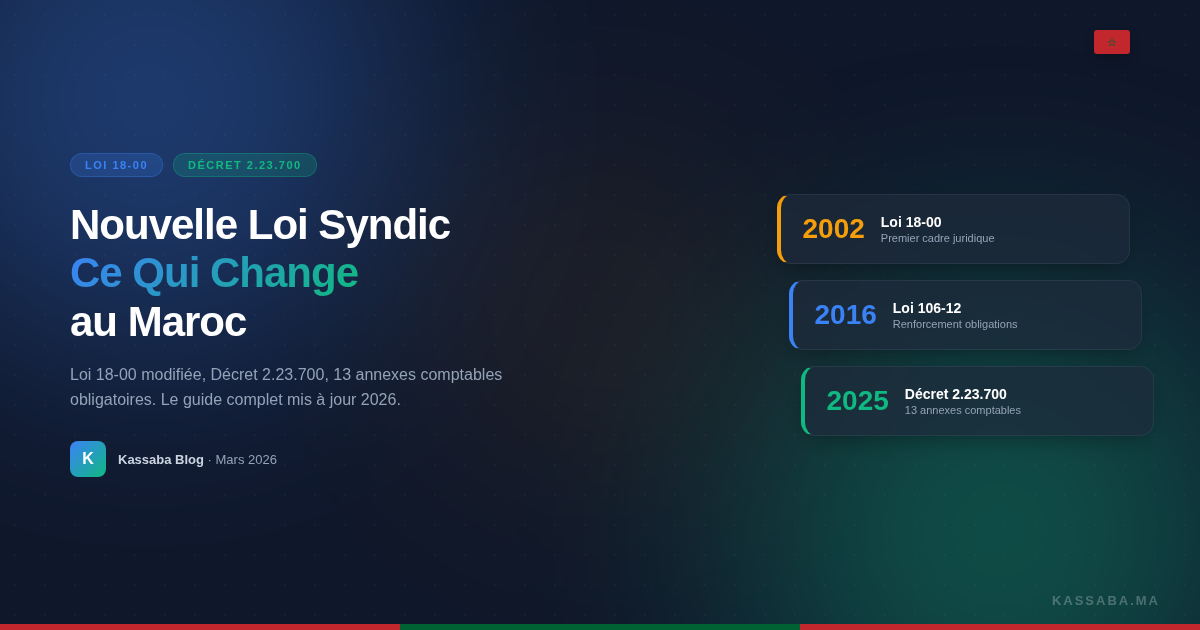
New Syndic Law in Morocco: What Changes in 2025-2026
Everything about the new syndic law in Morocco. Law 18-00 amendments, Decree 2.23.700, new accounting obligations and penalties. Updated guide 2026.
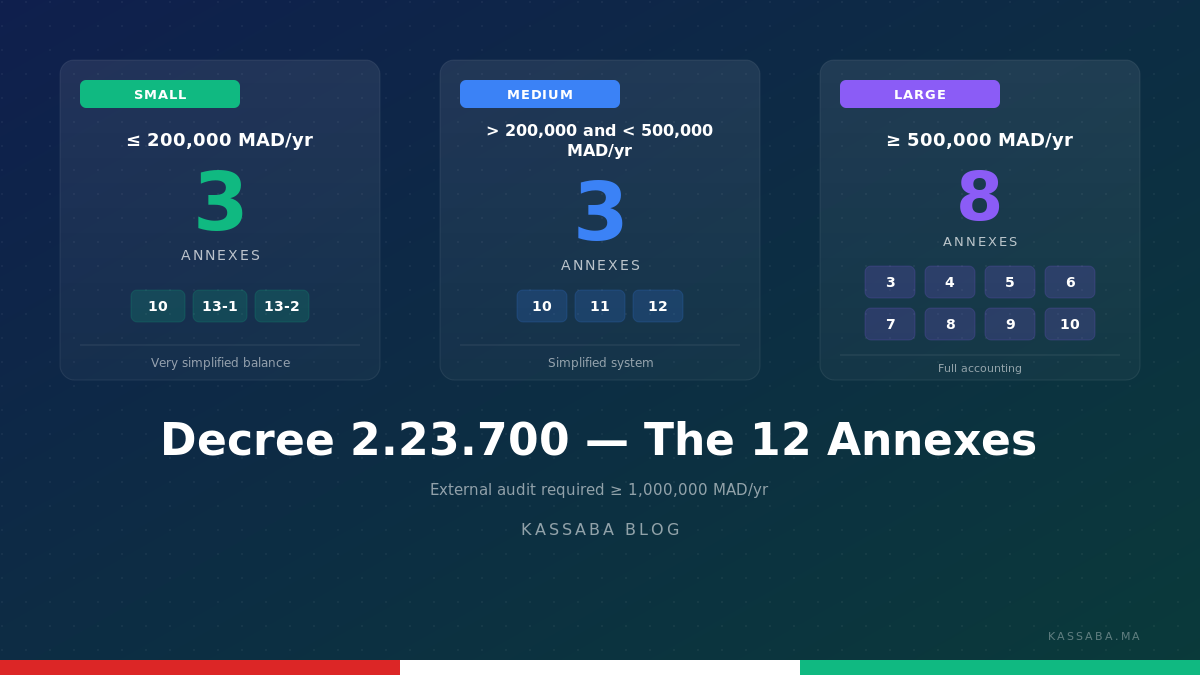
Décret 2.23.700: All 12 Accounting Annexes Explained
The 12 accounting annexes of Décret 2.23.700 broken down one by one: what each contains, which tier it applies to, and practical tips for Moroccan syndics.
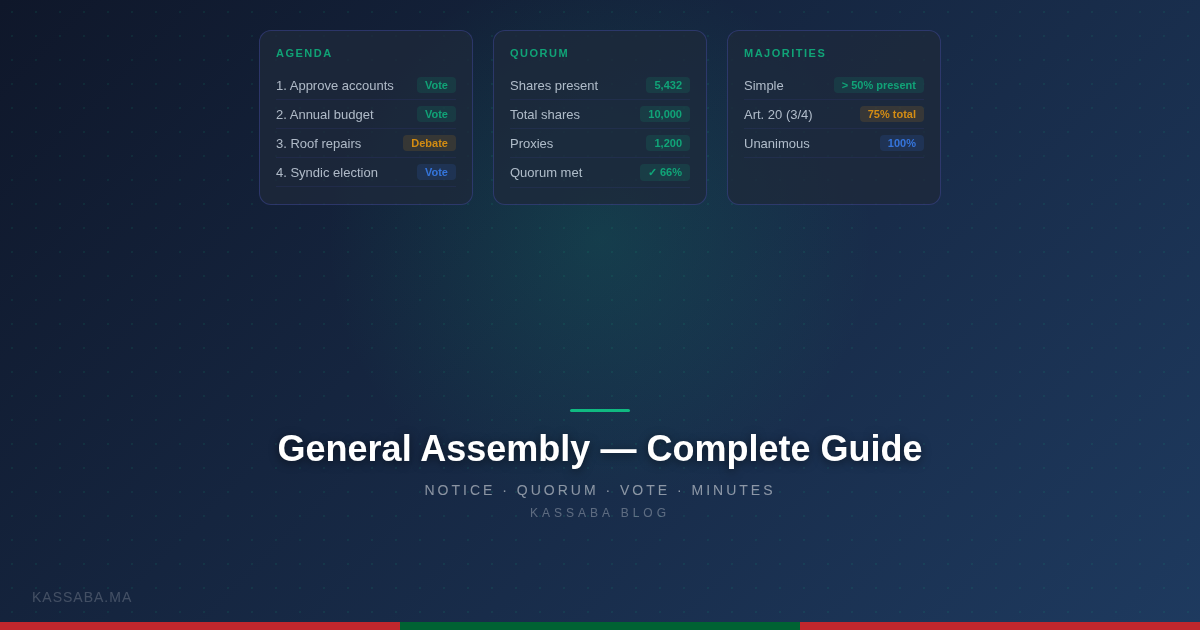
General Assembly for Co-Ownership in Morocco: A Complete Guide
How to organize a general assembly for co-ownership in Morocco: notices, quorum, voting majorities, minutes. A practical guide for syndics and co-owners.