
Décret 2.23.700: All 12 Accounting Annexes Explained
Why this article exists
You've probably heard of Décret 2.23.700 by now. Published in Official Bulletin (B.O.) 7391 on March 31, 2025, it sets the accounting rules every syndic (property manager) in Morocco must follow. Our full Décret 2.23.700 guide covers the entire text.
But when you get to the accounting annexes, things get confusing fast. 12 annexes, 3 tiers, Arabic names from the Official Bulletin... It's not obvious which ones apply to you, what they contain, or how to fill them in.
That's exactly what we'll do here. Annexe by annexe, we'll break down the content, the tier that needs it, and the pitfalls to watch out for.
The 3 tiers: which group are you in?
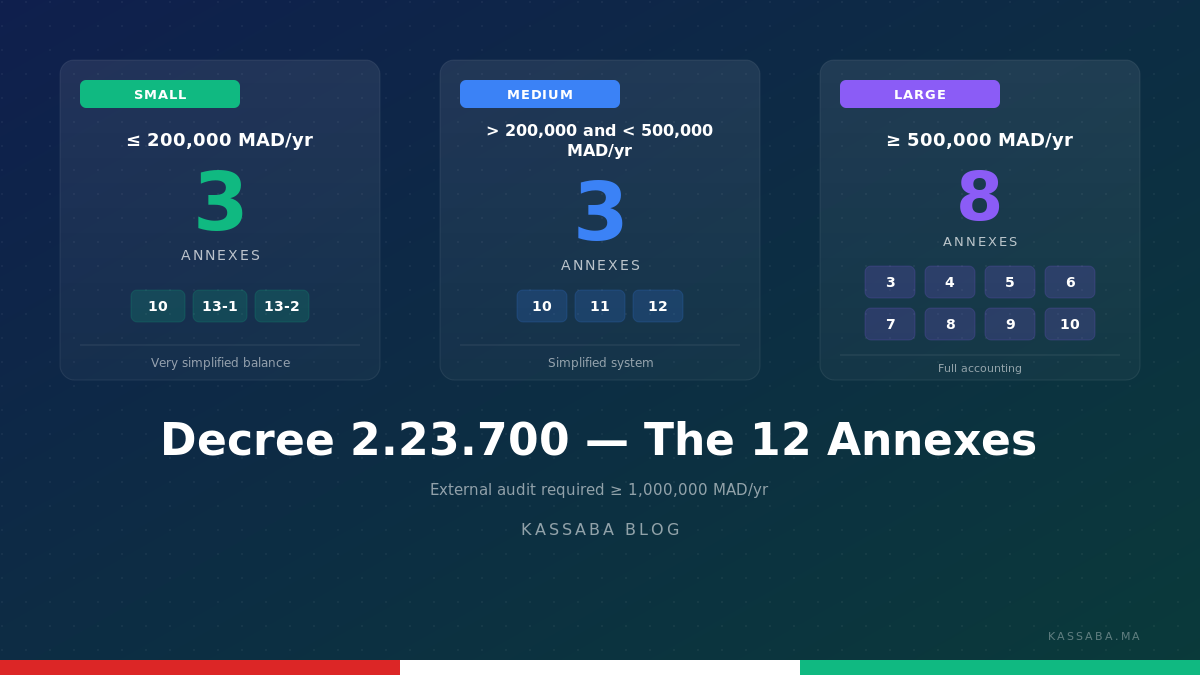
Before talking about annexes, you need to know your tier. Décret 2.23.700 classifies co-ownerships into three categories based on total charges called per year (not the forecast budget, but the charges actually billed to co-owners).
Small tier: charges called up to 200,000 MAD per year. A small building with 12 units and annual charges of 72,000 MAD falls here. You produce Annexes 10, 13-1, and 13-2.
Medium tier: charges called between 200,000 and 500,000 MAD per year. A residence with 40 units and 320,000 MAD in annual charges, for example. You produce Annexes 10, 11, and 12.
Large tier: charges called of 500,000 MAD or more per year. A large residence with 80 units, elevators, a pool, and round-the-clock security. You produce Annexes 3, 4, 5, 6, 7, 8, 9, and 10.
One thing all three have in common: Annexe 10 is required for everyone. Tracking co-owner contributions applies to every co-ownership, regardless of size.
To understand how these annexes fit into your overall syndic accounting in Morocco, check our dedicated guide.
Large tier annexes (500,000 MAD or more)
These are the most detailed annexes. If your co-ownership calls 500,000 MAD or more in charges per year, you must produce all of them, from Annexe 3 through Annexe 10.
Annexe 3: Balance Sheet (الحصيلة)
The balance sheet gives a snapshot of the co-ownership's financial position at the end of the fiscal year. On one side, what the co-ownership owns (assets): bank balance, charges receivable from co-owners in arrears, any investments. On the other, what it owes (liabilities): unpaid supplier invoices, advance payments from co-owners, reserve fund balance.
In concrete terms, if your co-ownership has 180,000 MAD in the bank on December 31, 45,000 MAD in unpaid co-owner charges, and 22,000 MAD in outstanding supplier invoices, all of that appears in Annexe 3.
Common mistake: forgetting receivables. A co-owner who owes 8,000 MAD on December 31 but pays in January, that's still a receivable on December 31. It must appear in the balance sheet assets.
Annexe 4: General Management Account (حساب التسيير العام)
The general management account details all income and all expenses for the fiscal year. Income: charges called, financial income, insurance reimbursements. Expenses: security, electricity, water, maintenance, insurance, bank fees, professional fees.
This is the document co-owners look at first during the general assembly. They want to know where the money went. The result (income minus expenses) shows whether the year ended in surplus or deficit.
An example. Charges called: 620,000 MAD. Security: 180,000 MAD. Electricity: 85,000 MAD. Water: 32,000 MAD. Routine maintenance: 95,000 MAD. Insurance: 28,000 MAD. Miscellaneous: 40,000 MAD. Total expenses: 460,000 MAD. Result: +160,000 MAD. This surplus can feed the reserve fund or carry over to the next fiscal year, depending on the AG's decision.
Annexe 5: Budget Comparison (مقارنة الميزانية)
Annexe 5 puts the forecast budget voted at the AG side by side with actual expenses. Item by item, you compare what was planned versus what happened.
Budgeted security costs: 170,000 MAD. Actual: 180,000 MAD. Variance: +10,000 MAD (5.9% overspend). Maybe a temporary replacement concierge during holidays cost more than expected.
Why does this matter? Co-owners immediately see which line items went over budget and which came in under. You can justify each variance. A syndic who presents this comparison gains credibility.
Annexe 6: Non-Current Works (الأشغال غير الجارية)
Annexe 6 lists works that go beyond routine maintenance. Facade renovation, elevator replacement, terrace waterproofing. These are exceptional expenses, often voted with a special majority at the AG.
For each project, you indicate: the nature, the amount voted, the amount committed, the amount paid, and the remaining balance. If the co-ownership voted 250,000 MAD for waterproofing and the contractor was paid in two installments (150,000 MAD then 80,000 MAD), the annexe shows 20,000 MAD still owed.
Annexe 7: Reserve Fund Tracking (صندوق الاحتياط)
Law 18-00 provides that a reserve fund can be created by AG vote (Article 37bis). Annexe 7 tracks movements in this fund: opening balance, contributions for the fiscal year (the portion of charges allocated to the fund), uses (works financed from the fund), and closing balance.
If the reserve fund starts the year at 120,000 MAD, receives 60,000 MAD in contributions, and finances 45,000 MAD in waterproofing work, the closing balance is 135,000 MAD.
Important: if your co-ownership doesn't have a reserve fund, Annexe 7 is still required for the large tier. You fill it with zeros and a note indicating no fund exists.
Annexe 8: Loan Tracking (تتبع القروض)
If the co-ownership has taken out a loan (to finance major works, for example), Annexe 8 tracks the outstanding balance. Initial amount, repayments during the year (principal and interest separately), remaining capital.
Most Moroccan co-ownerships don't have loans. In that case, the annexe shows zero amounts. But it's still required.
Annexe 9: Equipment Tracking (تتبع المعدات)
Annexe 9 lists the co-ownership's significant equipment: elevator, backup generator, water pump, automatic gate, security cameras. For each piece of equipment, you note the acquisition date (or date put into service), acquisition value, and current condition.
Why? Because replacing an elevator costs between 200,000 and 400,000 MAD. If the syndic knows the elevator is 18 years old with a 20-year lifespan, they can anticipate the expense and set money aside.
Annexe 10: Co-Owner Contribution Tracking (تتبع إسهامات المالك المشتركين)
Annexe 10 is the most important. It's also the only one required across all three tiers.
For each co-owner, you indicate: the name, unit number, tantièmes, charges called, payments received, and the balance (credit or debit).
A co-owner who owes 15,000 MAD for the year and has paid 10,000 MAD has a debit balance of 5,000 MAD. One who paid 18,000 MAD in advance has a credit balance of 3,000 MAD.
This is the reference document for chasing unpaid charges. It's also the first thing a court asks for in collection proceedings. Clean tracking, unit by unit, is your best protection in a dispute.
If you use a property management app, this annexe fills itself automatically with every payment recorded.
Medium tier annexes (200,000 to 500,000 MAD)
The medium tier produces three annexes: 10, 11, and 12. Annexe 10 is identical to the one described above. Annexes 11 and 12 are condensed versions of Annexes 3 through 9.
Annexe 11: Simplified Statements (القوائم المبسطة)
Annexe 11 merges into a single document what Annexes 3 through 9 cover separately for the large tier. You'll find a simplified balance sheet (assets/liabilities), a summary of income and expenses, and tracking of the reserve fund and works, all in a shorter format.
No need for detailed line-by-line breakdowns. Broad categories are enough: personnel costs, energy costs, maintenance costs, insurance costs, other costs.
For a residence of 35 units calling 280,000 MAD in charges, Annexe 11 fits on one or two pages. Much more manageable than the eight annexes of the large tier.
Annexe 12: Simplified Income and Budget (الإيرادات والميزانية المبسطة)
Annexe 12 combines the budget comparison and income detail in a simplified format. Budget voted versus actual spending, but with fewer line items than Annexe 5 of the large tier.
You'll also find total income collected, split between regular charges and any exceptional revenue.
The appeal of the medium tier is clear: you keep a full picture of financial management without drowning in tables. Three annexes instead of eight, but with enough detail for co-owners to understand the situation.
Small tier annexes (up to 200,000 MAD)
The small tier covers the majority of Moroccan co-ownerships. A building with 8 to 15 units, a concierge, and modest common charges often falls into this category. Three annexes to produce: 10, 13-1, and 13-2.
Annexe 13-1: Very Simplified Balance Sheet (الحصيلة المبسطة جداً)
Annexe 13-1 is the most condensed version of the balance sheet. Assets: how much money is in the bank, how many charges remain to be collected. Liabilities: how many invoices remain to be paid, reserve fund balance (if one exists).
For a small building with 42,000 MAD in the bank and 8,500 MAD in unpaid charges, Annexe 13-1 fits in a few lines. No breakdown by type of receivable or category of debt. Just the bare minimum to give an accurate picture of the situation.
Annexe 13-2: Very Simplified Income and Budget (الإيرادات والميزانية المبسطة جداً)
Annexe 13-2 summarizes income and expenses for the year and compares actual results to the voted budget. Ultra-compact format.
Total charges called: 96,000 MAD. Total expenses: 88,000 MAD. Result: +8,000 MAD. Budget voted: 95,000 MAD. Overall variance: -7,000 MAD (savings).
Four or five lines that tell the whole story. Co-owners in a small building don't need a 15-page report. They want to know if the money was managed well. Annexe 13-2 answers that question.
Summary table: who produces what?
| Annexe | Official Name (B.O. 7391) | Small (up to 200k MAD) | Medium (200k-500k MAD) | Large (500k+ MAD) |
|---|---|---|---|---|
| 3 | Balance Sheet | Yes | ||
| 4 | General Management Account | Yes | ||
| 5 | Budget Comparison | Yes | ||
| 6 | Non-Current Works | Yes | ||
| 7 | Reserve Fund Tracking | Yes | ||
| 8 | Loan Tracking | Yes | ||
| 9 | Equipment Tracking | Yes | ||
| 10 | Co-Owner Contribution Tracking | Yes | Yes | Yes |
| 11 | Simplified Statements | Yes | ||
| 12 | Simplified Income and Budget | Yes | ||
| 13-1 | Very Simplified Balance Sheet | Yes | ||
| 13-2 | Very Simplified Income and Budget | Yes |
Common mistakes to avoid
Confusing the forecast budget with charges called. The tier is determined by the charges actually billed to co-owners, not the budget voted at the AG. If you voted a budget of 210,000 MAD but only called 195,000 MAD, you're in the small tier.
Forgetting Annexe 10. It's the only annexe common to all three tiers. Without it, you can't prove who paid what. In a dispute, it's the first document a judge will request.
Filling in the wrong tier's annexes. A medium-tier syndic who produces Annexes 13-1 and 13-2 instead of Annexes 11 and 12 is not compliant with Décret 2.23.700. Check your charges called amount before you start.
Ignoring zero-value annexes. Your co-ownership has no loans? Annexe 8 is still required for the large tier. Same for the reserve fund (Annexe 7). A document with zero amounts is perfectly valid. A missing document is non-compliance.
Not following the official format. B.O. 7391 publishes a template for each annexe. The headers, columns, and structure must match. A homemade Excel spreadsheet with the right data but the wrong format can cause problems during an inspection.
How to actually fill in the annexes
You have three options.
Option 1: by hand. Download the templates from B.O. 7391, print them, and fill them in with a pen. Doable for a very small building with simple cash flows. But one mistake means starting over.
Option 2: spreadsheet. Recreate the templates in Excel or Google Sheets. Better, because you can make corrections without redoing everything. But you need to make sure your layout matches the official format, your formulas are correct, and the totals across annexes are consistent. One bad copy-paste and your balance sheet no longer matches your management account.
Option 3: dedicated software. A tool like Kassaba automatically detects your tier based on charges called, fills in the data from your accounting entries, and generates the annexes in the correct format. You get built-in consistency checks: if the total contributions in Annexe 10 don't match the income in Annexe 4, the software flags it.
For large-tier co-ownerships (eight annexes to produce), the third option saves hours of work and drastically reduces the risk of errors.
The link with the general assembly
Article 24 of Law 18-00 requires the syndic to report on their management at the annual general assembly. The Décret 2.23.700 annexes are the supporting documents for that report.
In practice, you distribute (or send) the annexes to co-owners along with the AG notice, at least 15 days before the meeting (Article 16quinquies). During the AG, you present the headlines: the year's result, budget variances, the state of unpaid charges.
Co-owners then vote to approve the accounts by a 3/4 majority of all co-owners' votes (Article 21). If the accounts are rejected, the syndic will need to rework them and convene a new AG.
Clear, compliant annexes make approval easier. A syndic who shows up to the AG with incomplete documents or the wrong format can expect questions, challenges, and sometimes outright rejection.
For a broader understanding of co-ownership management in Morocco, our guide covers all syndic obligations.
Our practical syndic accounting guide walks through the full accounting process, from day-to-day entries through to presentation at the AG.
Generate your annexes in a few clicks. Kassaba automatically detects your tier and produces the right annexes. Try Kassaba syndic software for free
FAQ
Which annexes from Décret 2.23.700 does my building need to produce?
It depends on the total charges called per year. Small co-ownership (up to 200,000 MAD): Annexes 10, 13-1, and 13-2. Medium (200,000 to 500,000 MAD): Annexes 10, 11, and 12. Large (500,000 MAD or more): Annexes 3 through 10. Annexe 10 is required for all tiers.
What's the difference between simplified and full annexes?
The full annexes (3 through 9) detail each accounting category separately: balance sheet, management account, budget comparison, works, reserve fund, loans, and equipment. The simplified annexes (11, 12, 13-1, 13-2) consolidate this information into one or two condensed documents. The level of detail required goes up with the amount of charges called.
Is Annexe 10 really mandatory for every co-ownership?
Yes. Regardless of the amount of charges called, the co-owner contribution tracking document (Annexe 10) is required. It is the only annexe common to all three tiers of Décret 2.23.700.
Can I fill in the Décret 2.23.700 annexes using Excel?
Technically yes, but it's risky. You need to match the exact format from Official Bulletin 7391, manually recalculate every total, and verify consistency across annexes. Software like Kassaba automatically generates the correct annexes for your tier, which eliminates format and calculation errors.
Simplify your property management
Kassaba automates accounting, payment reminders, and resident communication.
Create your free syndic accountFree during beta. No credit card required.
Related articles
Pest Control in Moroccan Co-Ownership: Who Pays, Who Manages
Who pays for pest control in Moroccan co-ownership? Common areas usually fall under the syndic's Article 26 duties; private units need separate proof.
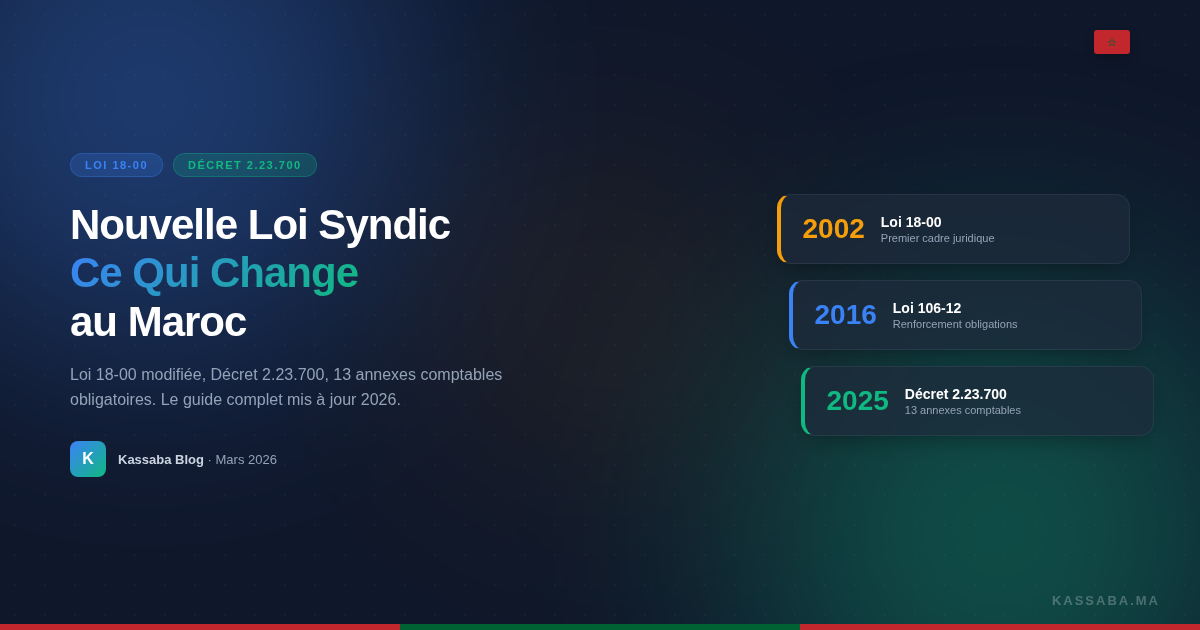
New Syndic Law in Morocco: What Changes in 2025-2026
Everything about the new syndic law in Morocco. Law 18-00 amendments, Decree 2.23.700, new accounting obligations and penalties. Updated guide 2026.
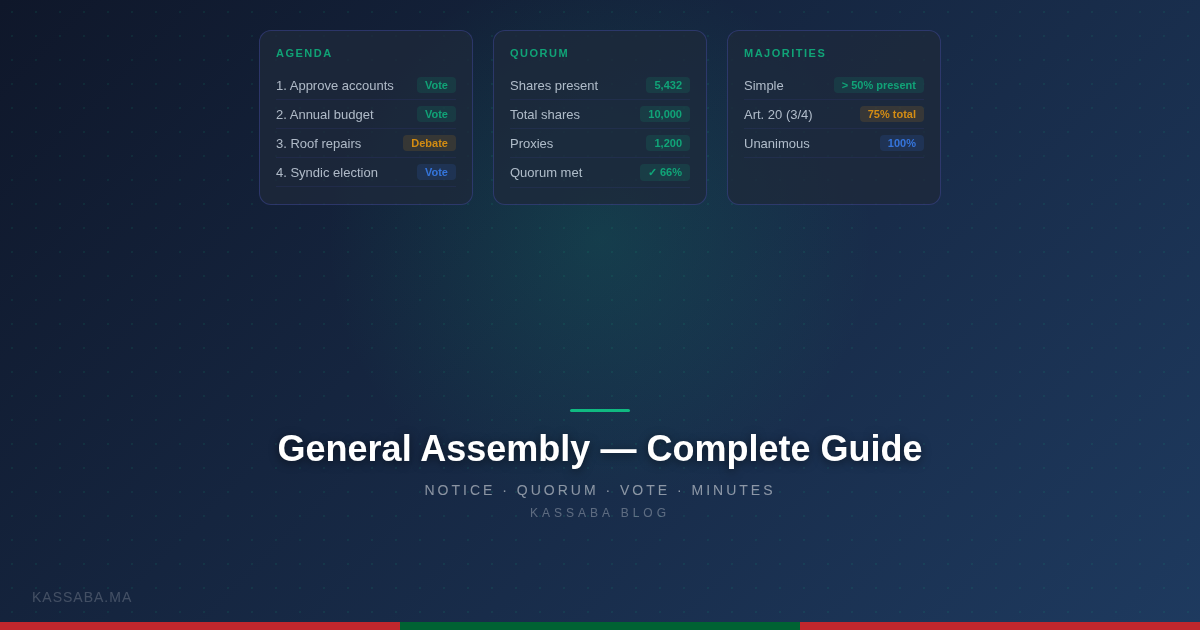
General Assembly for Co-Ownership in Morocco: A Complete Guide
How to organize a general assembly for co-ownership in Morocco: notices, quorum, voting majorities, minutes. A practical guide for syndics and co-owners.