
Property Manager Accounting in Morocco: A Practical Guide
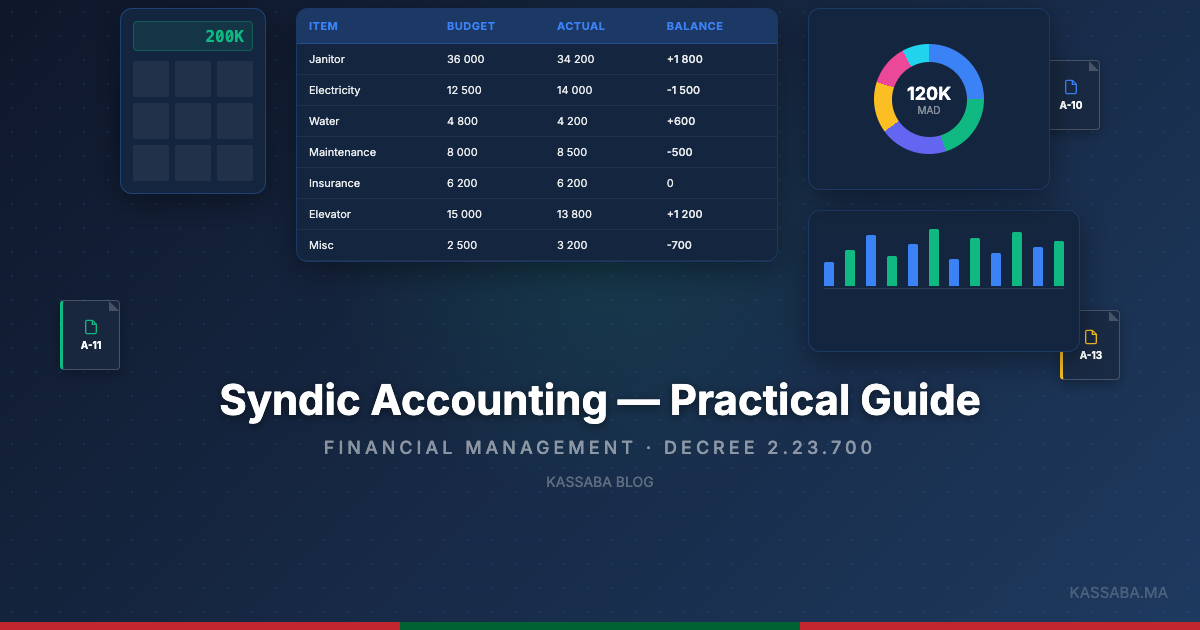
Syndic accounting isn't business accounting
A syndic (property manager in Morocco) isn't a merchant. They don't sell anything, don't invoice, don't file VAT returns. Their accounting is simpler than corporate accounting, but it has its own rules.
Law 18-00 (Article 24) requires the syndic to maintain accrual-based accounting and to present management accounts every year at the general assembly (AG). Décret 2.23.700 specifies exactly what documents to produce.
This guide shows you how to do it, step by step.
What you need to record
Syndic accounting boils down to two categories: what comes in and what goes out.
Income
A co-ownership's income comes primarily from charges called to co-owners. Each co-owner pays their share proportionally to their tantièmes (ownership shares).
An annual charge call of 120,000 MAD (about €11,000) for a 20-unit building works out to an average of 6,000 MAD per unit. But in reality, a 100 m² apartment doesn't pay the same as a 40 m² studio. The tantièmes make the difference.
Other possible income: bank account interest, insurance reimbursements, rental income from common areas (a telecom antenna on the roof, for example).
Expenses
The typical expenses for a Moroccan co-ownership:
- Security guard/concierge: often the largest expense (salary, social security contributions, paid leave)
- Common area electricity: hallway lighting, elevator, water pump
- Water: cleaning common areas, irrigation
- Maintenance: painting, repairs, plumbing
- Insurance: building multi-risk policy
- Bank fees: co-ownership account maintenance
Every expense must be backed by a supporting document (invoice, receipt, payslip). No document, no recorded expense.
The forecast budget
Each year, the syndic prepares a forecast budget for the following fiscal year. This budget is voted at the general assembly with a 3/4 majority (Article 21).
How to build it
Take the current year's actual expenses as your baseline. Adjust based on what you know:
- Is the concierge's salary going up? Add the difference
- Are renovations planned? Get quotes and add a 10-15% margin
- Is the elevator 15 years old? Budget for higher maintenance costs
A realistic budget is one you can explain line by line at the assembly. If you can't justify a figure, don't include it.
The reserve fund
Law 18-00 (Article 37bis) provides the option to create a reserve fund for major works. This fund is financed by a separate contribution from the regular charges.
The reserve fund isn't mandatory in all cases, but it's good practice. Replacing an elevator costs 150,000 to 300,000 MAD (€14,000 to €28,000). Without a reserve fund, you'll need an exceptional call that some co-owners simply won't be able to pay in one go.
Managing contributions day to day
Charge calls
The charge call is the document telling each co-owner how much they owe. It's based on the budget voted at the AG and each unit's tantièmes.
Send your charge calls at the start of each quarter or month, depending on what the AG voted. Clearly state the amount, the period covered, and the payment deadline.
Payment tracking
For every payment received, note: the amount, the date, the co-owner, and the payment method (cash, wire transfer, check).
If a co-owner pays in cash, give them a receipt. Always. It's your proof and theirs.
Unpaid charges
Unpaid charges are every syndic's headache. Here's an approach that works:
Week 1 after the deadline: send a friendly reminder by SMS or WhatsApp. "Hello, your March contribution hasn't been received yet. Please arrange payment."
Week 3: second reminder, more formal. Mention the total amount owed and consequences of non-payment.
Month 2: registered letter. Keep a copy and the delivery receipt.
Month 3 and beyond: if the amount justifies it, consult a lawyer for a formal demand or legal action.
Don't forget: unpaid charges are prescribed after 5 years (Article 43). If you don't follow up, you lose your right to collect.
The accounting annexes of Décret 2.23.700
Décret 2.23.700 put an end to "everyone does it their own way." Every syndic must now produce financial documents in a specific format, based on the total charges called.
Small tier (≤ 200,000 MAD)
You need to produce three annexes:
- Annexe 10: co-owner contribution tracking (who's paid, who still owes)
- Annexe 13-1: very simplified financial statement
- Annexe 13-2: very simplified income and budget statement
This is the lightest regime. Three documents, but they must exist and be presented at the AG.
Medium tier (200,000 to 500,000 MAD)
Three annexes, with a bit more detail:
- Annexe 10: contribution tracking
- Annexe 11: simplified financial statements
- Annexe 12: simplified income and budget
Large tier (500,000 MAD and above)
Eight annexes, the full regime:
- Annexe 3: financial position statement (الحصيلة)
- Annexe 4: general management account (حساب التسيير العام)
- Annexe 5: budget comparison (مقارنة الميزانية)
- Annexe 6: non-current works (الأشغال غير الجارية)
- Annexe 7: reserve fund tracking (صندوق الاحتياط)
- Annexe 8: loan tracking (تتبع القروض)
- Annexe 9: equipment tracking (تتبع المعدات)
- Annexe 10: contribution tracking
If your annual charges called exceed 1,000,000 MAD, an audit by a licensed accountant is also required.
Full example: accounting for a 24-unit building
Let's look at a concrete case. Résidence Al Firdaws, 24 apartments in Casablanca. Annual budget voted at the AG: 180,000 MAD (about €16,500). That puts it in the small tier (≤ 200,000 MAD), so the required annexes are: 10, 13-1, and 13-2.
The detailed budget
Here's how the 180,000 MAD breaks down over the year:
- Concierge (salary + social security): 54,000 MAD (3,000 MAD net + contributions, 12 months)
- Common area electricity: 18,000 MAD (1,500 MAD/month average, including elevator)
- Common area water: 6,000 MAD (500 MAD/month)
- Elevator maintenance (contract): 12,000 MAD (1,000 MAD/month)
- Building multi-risk insurance: 8,000 MAD/year
- Cleaning supplies: 4,800 MAD (400 MAD/month)
- Bank fees: 1,200 MAD (100 MAD/month)
- Minor repairs (plumbing, electrical): 12,000 MAD (provision)
- Reserve fund: 24,000 MAD (2,000 MAD/month)
- Contingency: 40,000 MAD
Total: 180,000 MAD.
Distribution per co-owner
The 24 units have different tantièmes. A 90 m² apartment on the 3rd floor has 55 tantièmes out of 1,000, while a 45 m² studio on the ground floor has 28.
Annual contribution for the large apartment: 180,000 × 55/1000 = 9,900 MAD, or 825 MAD/month. Annual contribution for the studio: 180,000 × 28/1000 = 5,040 MAD, or 420 MAD/month.
These amounts are fixed for the year. If actual expenses exceed the voted budget, the syndic can't raise charges mid-year. You either dip into the reserve fund or convene a special assembly to vote an exceptional call.
What happens at year-end
On December 31, the syndic takes stock. Of the 180,000 MAD called, 162,000 MAD was collected (90%). Three co-owners still owe a total of 18,000 MAD. On the expense side, 165,000 MAD was actually spent.
Result: the bank account shows a balance of 162,000 - 165,000 = -3,000 MAD. But the reserve fund was allocated 24,000 MAD, so the real available balance is positive. The 18,000 MAD in unpaid charges appear as receivables in annexe 13-1.
This is exactly the kind of situation the Décret 2.23.700 annexes are designed to make transparent. A co-owner reading annexe 10 can immediately see who's current and who isn't.
The syndic's accounting calendar
Syndic accounting isn't a year-end task. It's continuous work with specific deadlines. Here's what you need to do month by month.
January
The busiest month if your fiscal year ends December 31. You need to close the prior year's accounts: verify that all December expenses are recorded, reconcile the bank balance with your register, list unpaid amounts per co-owner, and prepare the accounting file for the AG.
The AG must be held within 30 days after the end of the fiscal year (Article 16ter), so before January 30. In practice, many syndics miss this deadline. It's not legal, but it's common.
February to March
If the AG took place in January, you implement the decisions voted: new budget, any works approved, charge adjustments. Send the first charge calls of the year with updated amounts if the budget changed.
This is also the time to renew annual contracts (insurance, elevator maintenance) if they expire in Q1.
April to June
Cruising period. Record payments as they come in, pay recurring invoices (concierge, electricity, water). Review unpaid amounts: co-owners who didn't pay Q1 need to be reminded before the arrears pile up.
If works were approved at the AG, this is typically when you request quotes and start projects (the weather helps).
July to September
Verify the concierge's social security declarations are current. Prepare for the concierge's vacation (they're entitled to it, like any employee) and arrange cleaning coverage during their absence.
Good time for a mid-year check: compare actual expenses to the voted budget. If you've already spent 60% of the budget in 6 months, there might be a problem to anticipate.
October to December
Prepare for closing. Send final reminders to late-paying co-owners before year-end. Request invoices for ongoing works so you can record them in the right fiscal year. Start drafting the management report for the AG.
In December, reconcile the bank balance with your register. Every dirham should be traceable. If the gap exceeds 100 MAD, find the error before closing.
How to read the Decree annexes
The Décret 2.23.700 annexes are technical documents, but a co-owner doesn't need to be an accountant to understand them. Here's how to read the three small-tier annexes, the ones most Moroccan co-ownerships will need to produce.
Annexe 10: contribution tracking
This is the most important and most readable document. Annexe 10 (تتبع إسهامات المالك المشتركين) lists each co-owner with: their unit, their tantièmes, the amount called, the amount paid, and the remaining balance.
If you see your name with a zero balance, you're current. If the balance is positive, you owe money. If it's negative, the co-ownership owes you (overpayment or credit from a prior year).
Annexe 10 is required for all three tiers. It's the only annexe common to all co-ownerships regardless of size.
Annexe 13-1: very simplified financial statement
Annexe 13-1 (الحصيلة المبسطة جداً) is a financial statement in ultra-simplified form. It shows two columns: what the co-ownership owns (cash, receivables from co-owners) and what it owes (supplier debts, provisions).
For our Résidence Al Firdaws, annexe 13-1 would show:
"Owns" side: bank balance of 21,000 MAD + receivables (unpaid) of 18,000 MAD = 39,000 MAD. "Owes" side: unpaid electrician invoice of 3,000 MAD + reserve fund of 24,000 MAD = 27,000 MAD.
The difference (39,000 - 27,000 = 12,000 MAD) represents the co-ownership's net position. If this number is positive, the co-ownership is financially healthy. If it's negative, there's a problem.
Annexe 13-2: very simplified income and budget
Annexe 13-2 (الإيرادات والميزانية المبسطة جداً) compares the voted budget with what actually happened. Two columns: "forecast" and "actual."
For each expense item (concierge, electricity, water, maintenance), you see how much was budgeted and how much was spent. If the "maintenance" item budgeted 12,000 MAD and you spent 18,000 MAD, the 6,000 MAD gap jumps off the page. The syndic will have to explain it at the AG.
This document is what makes accounts truly transparent. With Excel, you can present numbers however you want. With annexe 13-2, the format is imposed and every co-owner sees the same thing.
Excel vs. dedicated software: an honest comparison
Many syndics still manage their accounting in Excel. Here's how that plays out in practice.
What Excel does well
Excel is flexible. You can create your own tables, add columns, sort however you want. For a small 8-unit building with predictable expenses, it can hold up.
The cost is zero if you already have Office. And you don't need an internet connection.
What Excel doesn't do
Excel doesn't generate the Décret 2.23.700 annexes. You'll have to redo them by hand in the right format. For annexe 10 with 30 co-owners, count on a solid half-day of work.
Excel doesn't catch errors. A broken formula in one cell can throw off your entire balance without you noticing. A co-owner counted twice, a payment entered in the wrong column: nothing will warn you.
Excel doesn't send reminders. You have to manually check who's late, then send messages one by one.
Excel has no reliable audit trail. Who changed that amount? When? You'll never know.
When to switch to software
If you check at least two of these boxes, it's time:
- Your co-ownership has more than 15 units
- You spend more than an hour per week on your Excel file
- You have MRE co-owners who need remote access to accounts
- You need to produce the Décret 2.23.700 annexes
- You've already made an accounting error that caused trouble at an AG
If you're a volunteer syndic, software will save you considerable time on the accounting side.
The most common accounting mistakes
Mixing fiscal years
A December charge paid in January is a December charge, not a January one. Accrual-based accounting (required by Article 24) assigns transactions to the fiscal year they originated in, not the one where money moved.
Forgetting supporting documents
Every expense needs its proof. Every payment received needs its receipt. If the concierge buys a cleaning product for 50 MAD and doesn't bring back a receipt, the expense can't be justified.
Not provisioning for major expenses
Facade renovation costs serious money. So does elevator replacement. If you don't set aside a minimum each year, the exceptional call when the work happens is going to hurt.
Ignoring unpaid charges too long
A 3-month late payment is an oversight. A 3-year late payment is a structural problem that puts the co-ownership in difficulty. Follow up quickly and follow up consistently.
What a non-compliant syndic risks
Law 18-00 (amended by Law 106-12) requires the syndic to present management accounts at the annual general assembly (Article 24). A syndic who doesn't present accounts can be dismissed by the assembly with a 3/4 majority (Article 21).
With Décret 2.23.700, the obligations became more precise. Accounting annexes must follow a standardized format. A syndic who presents accounts "their own way" without following the required annexes isn't meeting their legal obligation, even if the numbers are correct.
In a dispute with a co-owner, the absence of compliant financial documents works against the syndic. A judge will ask for the Decree annexes, not a homemade Excel file.
How Kassaba simplifies all of this
Kassaba records your income and expenses as they happen. The software automatically generates charge calls based on tantièmes, tracks payments in real time, and flags unpaid amounts.
The Décret 2.23.700 annexes are generated in one click. Kassaba automatically detects your tier and only produces the required documents. You don't need to figure out whether you're small, medium, or large: the software calculates it for you.
Reminders go out automatically by SMS or WhatsApp. You set the timing, Kassaba handles the rest.
For the AG, you export a complete PDF package: fiscal year accounts, forecast budget, unpaid charges list, Decree annexes. Everything is ready in 5 minutes instead of 5 hours.
Manage your co-ownership with Kassaba. Automated accounting, Décret 2.23.700 annexes, SMS reminders. Try Kassaba syndic software for free
FAQ
How do you handle accounting for a syndic?
Syndic accounting involves recording all income (co-owner charges) and all expenses (maintenance, security, water, electricity), assigning them to the correct fiscal year, and producing the annexes required by Décret 2.23.700. The simplest approach is using software like Kassaba that automates recording and generates the mandatory documents.
What accounting documents must a syndic maintain?
Décret 2.23.700 requires specific annexes based on the co-ownership's size. Small co-ownerships (≤ 200,000 MAD in charges) must produce annexes 10, 13-1, and 13-2. Medium ones (200,000 to 500,000 MAD) produce annexes 10, 11, and 12. Large ones (500,000 MAD and above) produce annexes 3 through 10.
Does a volunteer syndic need to keep accounts?
Yes, absolutely. Law 18-00 (Article 24) requires every syndic, whether volunteer or professional, to present management accounts at the annual general assembly. Décret 2.23.700 applies equally. Being a volunteer doesn't exempt you from any accounting obligation.
Is an Excel spreadsheet enough for syndic accounting?
Excel can work as a temporary solution for a very small building, but it won't generate annexes in the Décret 2.23.700 format and offers no automatic error checking. Once the co-ownership exceeds 15-20 units, dedicated software becomes essential to avoid mistakes and save time.
How do you handle co-owners who don't pay their charges?
Start with friendly reminders (SMS, WhatsApp, letter). Note each reminder with the date. If the co-owner doesn't respond after several reminders, you can initiate legal proceedings. Warning: unpaid charges are prescribed after 5 years (Article 43 of Law 18-00). Past that deadline, you can no longer collect them.
Simplify your property management
Kassaba automates accounting, payment reminders, and resident communication.
Create your free syndic accountFree during beta. No credit card required.
Related articles
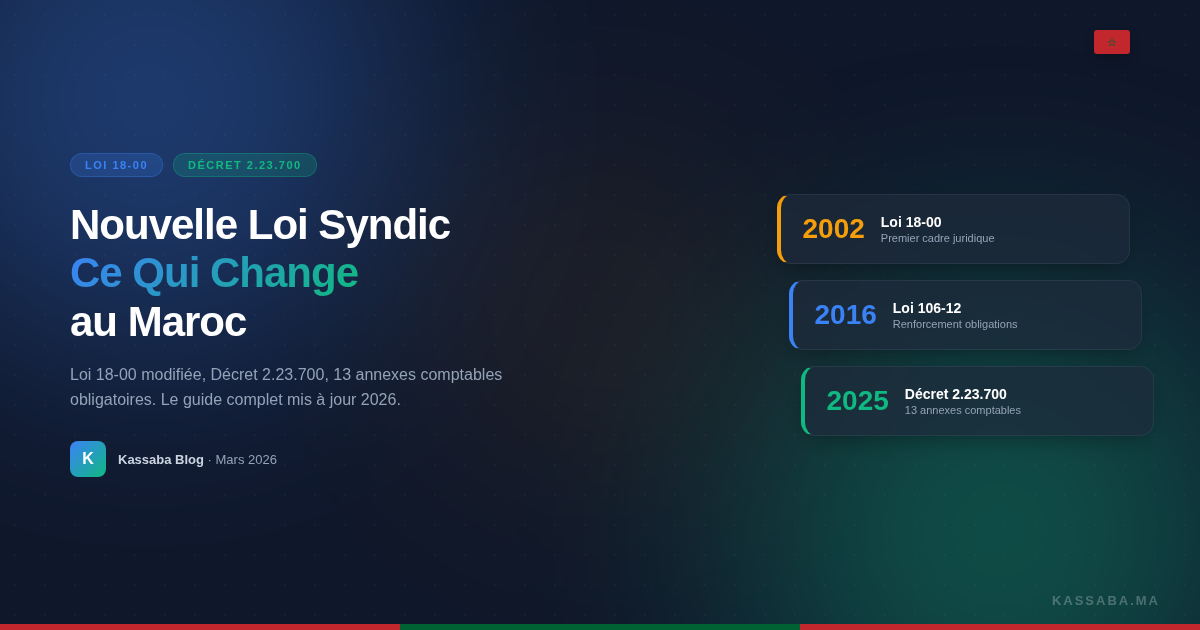
New Syndic Law in Morocco: What Changes in 2025-2026
Everything about the new syndic law in Morocco. Law 18-00 amendments, Decree 2.23.700, new accounting obligations and penalties. Updated guide 2026.
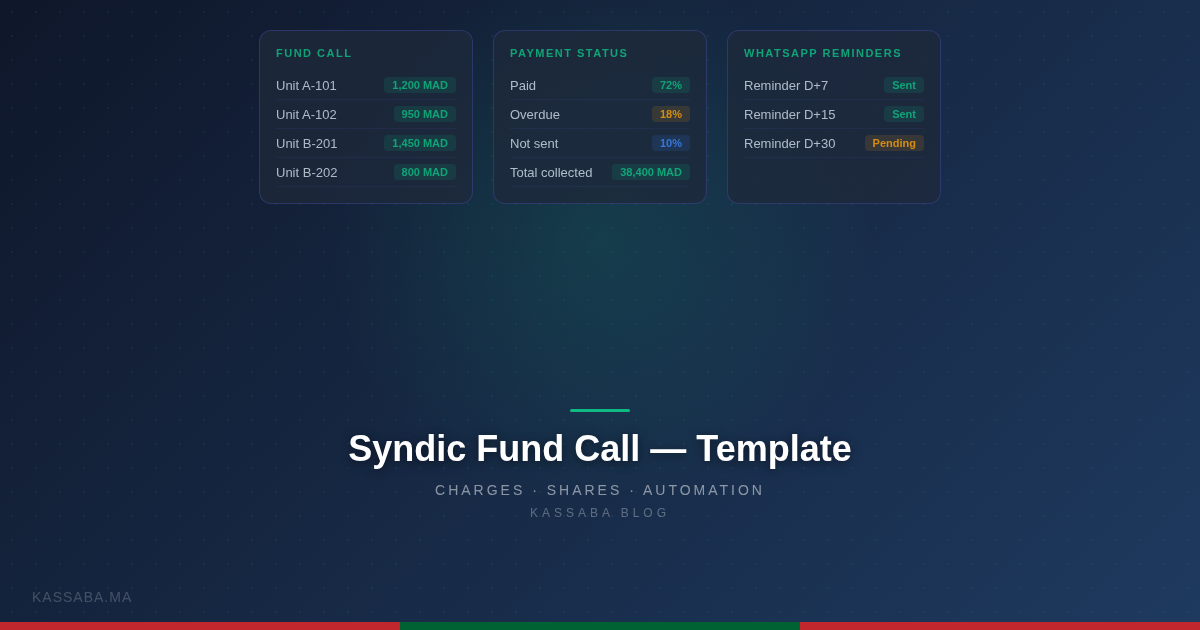
Charge Calls for Syndics in Morocco: Templates and Automation
How to draft a charge call as a syndic in Morocco, calculate tantièmes, and follow up on unpaid charges. Concrete template and practical tips.
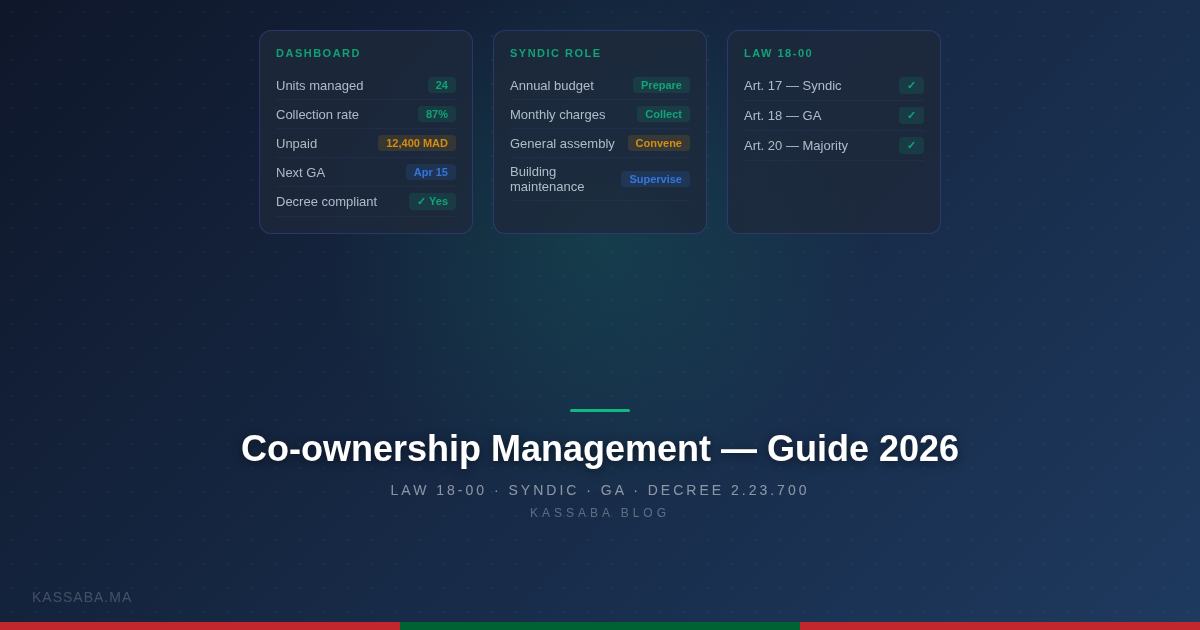
Co-Ownership Management in Morocco: A Complete Guide for 2026
How co-ownership management works in Morocco: the syndic's role, general assemblies, charges, Décret 2.23.700 accounting. A practical, up-to-date guide for property managers.