
Volunteer Property Manager in Morocco: A Complete Starter Guide
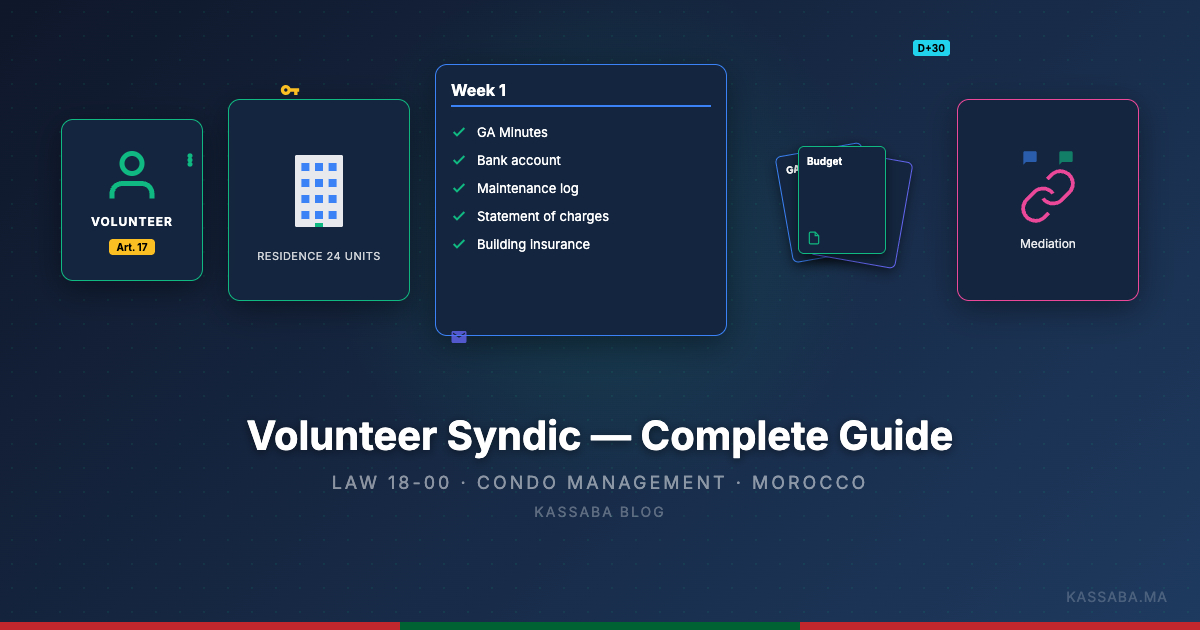
You've been elected volunteer syndic. Now what?
You own an apartment in a building in Morocco. At the last general assembly, nobody wanted to be syndic (property manager). So you raised your hand. Or maybe they talked you into it because "you're the most organized one." Either way, you're now a volunteer syndic.
Don't panic. Thousands of Moroccans manage their buildings on a volunteer basis. It's doable, as long as you know what's expected of you and get organized from the start.
This guide walks you through it.
What a volunteer syndic does (and doesn't do)
Your role
You're the legal representative of the co-ownership. In concrete terms, you:
- Collect charges from co-owners
- Pay common expenses (concierge, electricity, water, maintenance)
- Maintain the common areas
- Convene and hold the annual general assembly
- Keep the accounts and present them
- Execute decisions voted at the AG
What you're not
You're not a referee for neighbor disputes. You're not responsible for what happens inside apartments. And you don't have to do everything yourself: you can delegate tasks (one co-owner handles the garden, another supervises the concierge).
The first things to do
1. Open a bank account
This is the very first step, and it's a legal obligation (Article 26 of Law 18-00). The account must be in the co-ownership's name, not your personal name.
Go to the bank with:
- The assembly minutes showing your election
- The co-ownership bylaws
- Your national ID (CIN)
- The co-ownership's statutes (if they exist)
Some banks are familiar with co-ownership accounts and will guide you. Others less so. Don't hesitate to visit several.
2. Retrieve documents from the previous syndic
If someone held the role before you, they must hand over all documents within 15 days of your election (Article 28). If they refuse, our syndic handover guide walks through the formal notice, the référé and the astreinte. Request:
- Prior year accounts
- Previous assembly minutes
- The co-ownership bylaws
- Current contracts (concierge, elevator, insurance)
- Bank account balance and statements
- Keys to technical rooms
If the previous syndic doesn't cooperate, send them a registered letter reminding them of their legal obligation. Keep a copy.
3. Assess the building
Before diving into daily management, do a thorough walkthrough. Note what works and what doesn't:
- Do the common area lights work?
- Is the elevator in good shape? Is the maintenance contract current?
- Are there leaks, cracks, or damage?
- Is the roof in good condition?
- Are the common area water and electricity meters identified?
This walkthrough gives you a sense of the budget you'll need and the urgent issues to tackle.
4. Build your co-owner list
Prepare a table with: each co-owner's name, their unit (number, floor), their tantièmes (ownership shares), phone number, and email. If some co-owners live abroad (MRE, or Moroccans Residing Abroad), note their country of residence.
This table is your foundation. You'll use it for charge calls, reminders, notices, and vote counts.
Managing charges day to day
Setting the charge amount
The annual budget is voted at the AG with a 3/4 majority (Article 21). Once voted, divide it by the number of months or quarters to get each charge call amount.
Each co-owner pays proportionally to their tantièmes. A co-owner with 150 tantièmes out of 1,000 pays 15% of the total budget.
Concrete example: annual budget of 60,000 MAD (about €5,500), co-owner with 150/1000 tantièmes. Annual contribution: 9,000 MAD, or 750 MAD per month, or 2,250 MAD per quarter.
Collecting payments
Common payment methods in Morocco:
- Bank transfer: the cleanest option, it leaves an automatic trail
- Direct deposit at a branch: the co-owner deposits into the co-ownership account
- Cash: common but risky. If you accept cash, always give a signed and dated receipt
Record each payment with: the amount, date, co-owner, and payment method. Software like Kassaba does this automatically. If you're using Excel, create one line per payment, no exceptions.
Following up on late payments
Unpaid charges are part of every syndic's life. Don't take it personally. Some people forget, others procrastinate, others have real financial difficulties.
The key is consistency. Follow up from the first week of delay. A simple WhatsApp message is enough at first: "Hello, your March contribution hasn't been received yet. Please arrange payment." Short, polite, factual.
If the delay stretches past two months, switch to a more formal registered letter reminder. Always keep a written record of your follow-ups.
Important reminder: unpaid charges are prescribed after 5 years (Article 43). After 5 years without action, you lose the right to collect.
Organizing your first general assembly
This is often the most stressful moment for a new syndic. Here's how to prepare.
Before the AG
Set the date. The AG must be held within 30 days of the end of the fiscal year (Article 16ter). If your fiscal year ends December 31, the AG must happen before January 30.
Prepare the agenda. Standard items: approval of fiscal year accounts, syndic discharge, forecast budget vote, syndic election or renewal, planned works.
Send notices. At least 15 days before the date (Article 16quinquies), by registered mail or legal notification. Include the agenda, fiscal year accounts, and forecast budget.
Prepare documents. Detailed accounts (income, expenses, balances), forecast budget, quotes for any planned works, Décret 2.23.700 annexes.
On the day
Check quorum. Half of co-owners (as people) must be present or represented (Article 18). It's the number of people that counts, not tantièmes. 20 co-owners means 10 minimum present.
Check proxies. A proxy holder can represent no more than 3 co-owners, and combined tantièmes must not exceed 10% of the total (Article 16decies).
Appoint a chairperson and secretary. The chairperson runs the discussion. The secretary takes notes and drafts the minutes.
Vote on each item. Majority reminders:
- Routine maintenance, concierge: majority of votes of co-owners present or represented (Article 20)
- Budget, syndic election, major works: 3/4 majority of all co-owners (Article 21)
- New construction, selling common areas: unanimity (Article 22)
Draft the minutes. Must include: the date, co-owners present and represented, quorum achieved, each decision voted with the result. Have the chairperson and secretary sign it.
After the AG
Send the minutes to all co-owners, including those who were absent. Keep the original in the co-ownership's archives.
Managing building maintenance
The concierge
If your building has a concierge, you're their employer (on behalf of the co-ownership). That means: an employment contract, social security registration (CNSS), monthly payslips, and paid leave.
The concierge's salary is often the largest single expense for a co-ownership. Verify that the amount meets the minimum wage and that social contributions are being declared and paid.
Maintenance contracts
Elevator, water pump, automatic gate: every technical system should have a maintenance contract. Check the existing contracts and make sure they're current.
For elevators, maintenance is mandatory. An unmaintained elevator is a direct liability for the syndic in case of an accident.
Emergencies
A water leak at 11 PM, an elevator breakdown on Friday evening: it happens. Be prepared by keeping the numbers of a plumber, electrician, and elevator technician in your phone. Let them know you're a syndic and may call outside business hours.
Your first month: week by week
The first month is the most important. That's when you set the foundations. Here's a realistic plan, not an ideal one.
Week 1: the admin
Head to the bank to open the co-ownership account. Bring the AG minutes, co-ownership bylaws, and your ID. Some banks also ask for a copy of the building's property deed. If the bank drags its feet, push back: opening the account is a legal obligation (Article 26).
In parallel, retrieve documents from the previous syndic (Article 28: they have 15 days to hand everything over). Create a written inventory of what you receive. Sign a handover document with the outgoing syndic, even on plain paper. If documents are missing, note it in writing.
Week 2: the walkthrough
Tour the building with a notebook or your phone. Photograph anything that's not right: burned-out bulbs, cracks, broken mailbox, noisy elevator. Check the contracts in place: does the concierge have an employment contract? Is the elevator maintenance current? Is the building insurance valid?
Identify the emergencies (leaks, broken elevator) versus things that can wait for the next AG (facade renovation, replacing mailboxes).
Week 3: the co-owners
Prepare your complete list: name, unit, tantièmes, phone, email. Send a message to all co-owners introducing yourself officially. Share the new bank account number for payments.
Use this opportunity to identify co-owners with overdue payments. Review the co-ownership's bank statements for the past 3 months and compare with charge calls. Who hasn't paid? Note the amounts.
Week 4: launch
Send out your first charge call. Each co-owner gets a clear document with: the amount owed, the period covered, the account number for payment, and the deadline.
If co-owners have unpaid amounts from prior years, send them a separate reminder detailing their debt. Don't mix current charges with arrears: it's clearer for everyone.
By the end of the month, you have an open bank account, an up-to-date co-owner list, a building assessment, and your first charge collection underway. It's not perfect, but it's solid.
Handling conflicts between co-owners
The syndic isn't a judge. You don't have the power to settle disputes. But you're on the front line when conflict breaks out. Here are the five most common situations and how to handle them.
Noise
Mrs. Alami on the 3rd floor complains that Mr. Rachidi on the 4th makes noise every evening until midnight. She calls you every week about it.
Your role: remind Mr. Rachidi of the bylaws' noise rules. Do it in writing (letter or dated message). If the problem persists after two written reminders, inform both parties that the syndic can't go further and that Mrs. Alami can contact the police or courts. You're not the noise police.
Common areas being occupied
A ground-floor co-owner installed a table and chairs in the lobby. Another placed a giant flower pot in front of the elevator door. A third mounted a satellite dish on the facade.
Your role: common areas belong to everyone. No co-owner has the right to use them privately without an AG vote. Send a letter reminding them of this rule and setting a 15-day deadline to remove the installation. If they refuse, bring the matter to the next AG.
Leaks between apartments
Mr. Fadili's apartment on the 2nd floor leaks into Mrs. Kabbaj's apartment on the 1st. She calls you to fix it.
Your role: if the leak comes from common areas (water column, roof, shared terrace), it's the co-ownership's responsibility. Arrange repairs. If the leak comes from inside Mr. Fadili's apartment (his bathroom, his pipe), it's his personal responsibility. Inform both parties in writing and recommend they bring in a plumber together to identify the source. Don't take sides before you know the cause.
The co-owner who never pays
After multiple reminders, a co-owner refuses to pay. They have arguments: "charges are too high," "the concierge does nothing," "I don't use the elevator."
Your role: charges are voted at the AG. They apply to everyone according to their tantièmes, no exceptions. A co-owner who doesn't use the elevator still pays their elevator share (unless the bylaws specify a different allocation method). Remind them in writing, citing the relevant articles. If friendly reminders fail after 3 months, escalate: registered letter, then formal demand, then legal action.
Unauthorized works
A co-owner knocked down a load-bearing wall to enlarge their living room. Another enclosed their balcony with glass. A third changed the color of their front door.
Your role: any work affecting the building's structure or external appearance requires AG approval (Article 21 for major works, Article 22 if it modifies common areas). Notify the co-owner by registered letter and bring the issue to the AG. If the work endangers the structure (load-bearing wall removed), it's an emergency: get an expert assessment and demand immediate cessation of works.
The 5 documents you should always have on hand
As a volunteer syndic, you don't need 50 binders. But five documents should be accessible at all times, on your phone or in a folder at home.
1. The co-ownership bylaws
This is your building's constitution. It defines common areas, private areas, tantièmes, house rules, and charge allocation methods. Whenever a co-owner challenges a decision, this is the first document you check. If your co-ownership doesn't have bylaws, that's your top priority: get them drafted and voted at the AG.
2. The most recent assembly minutes
The minutes contain all decisions currently in effect: the voted budget, the elected syndic, approved works. When a co-owner says "we never voted for that," you pull out the minutes. When a supplier asks who has signing authority, you show the minutes. Keep older AG minutes too, but the most recent ones are the most important.
3. The tantièmes table
The table showing how tantièmes are distributed across units. This is the basis for everything: charges, votes, majorities. Without it, you can't produce a correct charge call or verify whether a decision was voted at the right majority. Tantièmes are usually defined in the bylaws, but keep a separate table with current owner names (units change hands).
4. The current month's bank statement
The bank statement proves what went in and out of the co-ownership account. If a co-owner claims they paid and you have no record, the statement settles it. If a supplier claims non-payment, the statement settles that too. Check your statement at least once a month. A statement unchecked for 3 months is an undetected error waiting to happen.
5. The list of current contracts
Concierge (employment contract, salary, social security), elevator (maintenance company, visit frequency), insurance (building multi-risk, expiry date), water and electricity (meter numbers, account holders). When a service provider calls, when a contract is about to expire, when a co-owner asks how much the concierge costs: everything's in this list. Update it whenever a contract changes.
The most common first-year mistakes
Not opening a bank account
Some volunteer syndics collect charges into their personal account "to keep things simple." This violates Article 26 and is the fastest way to create confusion between your money and the co-ownership's money.
Not following up on unpaid charges
Out of awkwardness or neglect, you let arrears pile up. After two years, a co-owner owes 24,000 MAD and refuses to pay it all at once. Follow up from the first month of delay.
Doing works without an AG vote
A leaky faucet? Fix it. A 200,000 MAD facade renovation? Get it voted at the AG with a 3/4 majority. The line between routine maintenance and major works isn't always clear, but the basic rule is simple: if the amount exceeds the voted budget, go through the AG.
Not keeping accounts
"I keep it all in my head" doesn't work. Even for a 6-unit building, maintain a written record of all income and expenses. Check our syndic accounting guide to know exactly what to record. Your annual AG will thank you.
Doing everything alone
You don't have to carry the whole load. Ask other co-owners to help: one can supervise the concierge, another can handle the garden. Delegating isn't a sign of weakness. It's common sense.
The tools you need
At minimum:
- A bank account dedicated to the co-ownership
- A co-owner table (tantièmes, contacts)
- An income and expense register
- A binder for supporting documents
- Emergency contact numbers (plumber, electrician, elevator technician)
To go further, a property management app like Kassaba replaces the Excel spreadsheet, the binders, and the notebook. You enter payments from the web interface, reminders go out automatically, and co-owners track their balance right from the mobile app. For a volunteer syndic managing a building after work in the evening, it makes a real difference.
Manage your co-ownership with Kassaba. The property management app built for volunteers: simple, mobile, compliant with Décret 2.23.700. Try Kassaba syndic software for free
FAQ
What is a volunteer syndic?
A volunteer syndic is a co-owner elected by the general assembly to manage the building without compensation. They have exactly the same legal obligations as a professional syndic under Law 18-00: keeping accounts, convening the annual general assembly, collecting charges, maintaining common areas, and opening a bank account in the co-ownership's name.
What are a volunteer syndic's responsibilities?
The volunteer syndic must: open a separate bank account in the co-ownership's name (Art. 26), collect monthly or quarterly charges, pay common expenses (concierge, electricity, water, maintenance), convene and hold the annual AG within 30 days of the fiscal year end (Art. 16ter), present management accounts (Art. 24), and produce the accounting annexes required by Décret 2.23.700.
How do you organize your first general assembly?
Send notices by registered mail at least 15 days before the date (Art. 16quinquies). Include the agenda, fiscal year accounts, and forecast budget. On the day, verify quorum (half of co-owners as people, Art. 18). Appoint a chairperson and secretary. Vote on each agenda item following the correct majorities. Draft the minutes and send them to all co-owners.
Can a volunteer syndic be compensated?
By definition, a volunteer syndic isn't paid for the role. However, the AG can vote to reimburse actual expenses incurred in performing their duties (travel, phone, supplies). These reimbursements must be backed by receipts and approved by the assembly.
How long is a volunteer syndic's term?
The syndic's term is exactly 2 years (Article 19 of Law 18-00), whether volunteer or professional. It is renewable by vote of the general assembly with a 3/4 majority.
Simplify your property management
Kassaba automates accounting, payment reminders, and resident communication.
Create your free syndic accountFree during beta. No credit card required.
Related articles
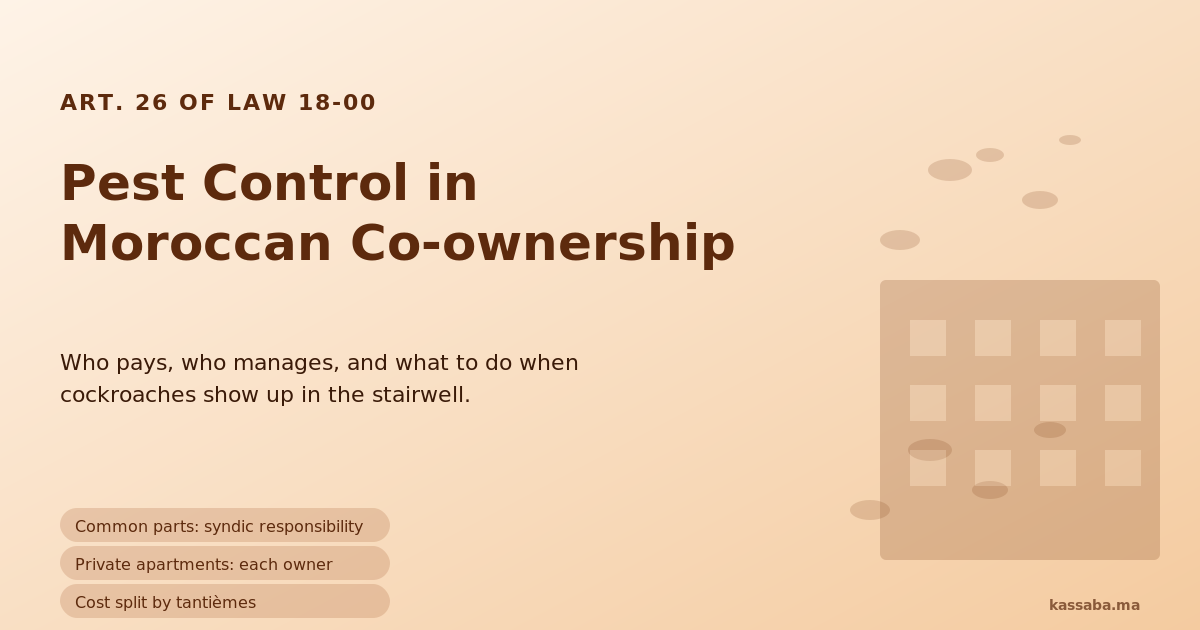
Pest Control in Moroccan Co-Ownership: Who Pays, Who Manages
Who pays for pest control in Moroccan co-ownership? Common areas usually fall under the syndic's Article 26 duties; private units need separate proof.
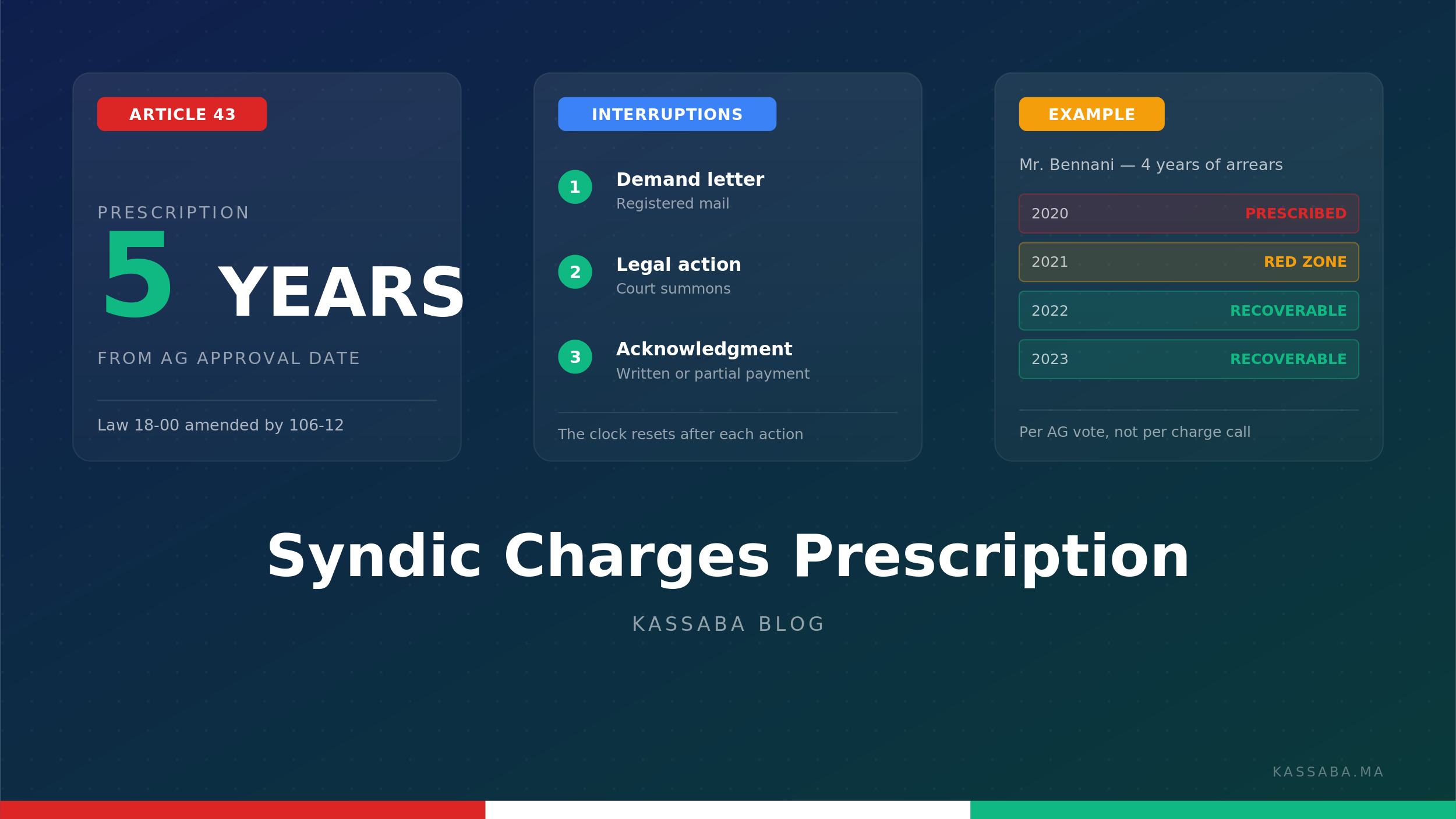
Syndic Charges in Morocco: The 5-Year Prescription Rule (Article 43)
In Morocco 2026, syndic charges expire 5 years after approval by the General Assembly (Art. 43 Law 18-00). How to calculate and interrupt.
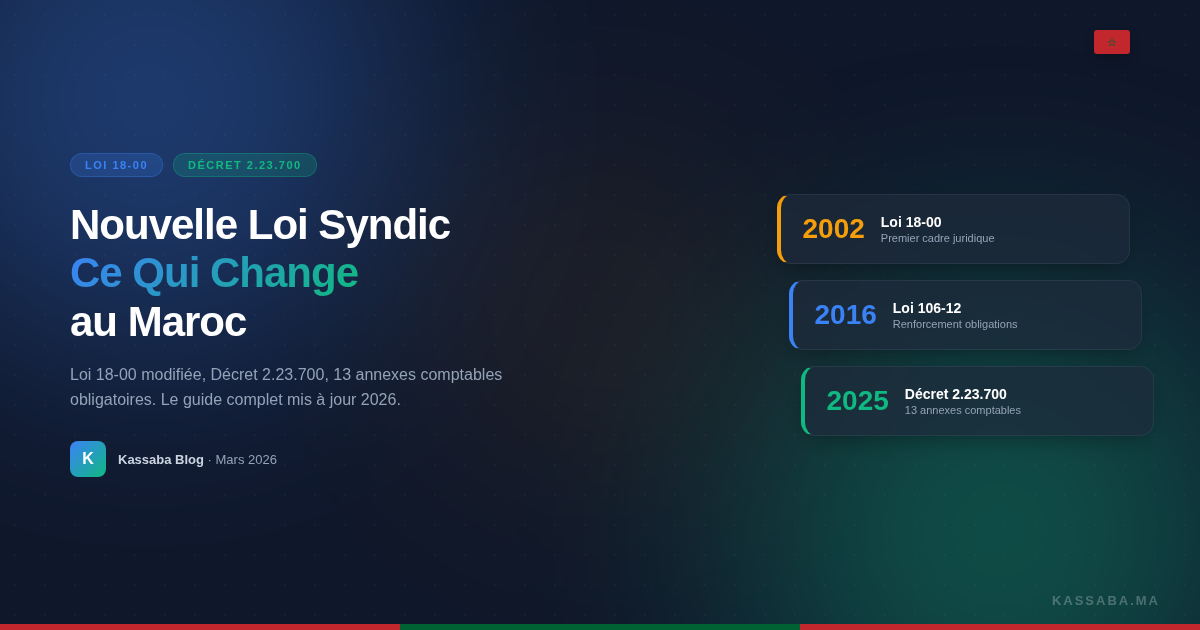
New Syndic Law in Morocco: What Changes in 2025-2026
Everything about the new syndic law in Morocco. Law 18-00 amendments, Decree 2.23.700, new accounting obligations and penalties. Updated guide 2026.