Syndic Fees in Morocco: How Much to Pay and How to Calculate Charges (2026)
You just got the charge notice. You look at the amount. And you're wondering: is that normal?
How much should you actually pay for co-ownership charges in Morocco? Is there a standard rate? How do you check that the syndic is billing you fairly?
If you're a property owner, you have the right to know. If you're a property manager, you need to be able to justify every dirham you ask from co-owners.
This guide explains where charges come from, how they're calculated, and what Moroccan law says about them. With real examples in MAD.
What you're actually paying when you pay syndic fees
Syndic fees aren't some mysterious tax. It's just your share of what it takes to keep the building running.
Here's what it covers, typically.
1. The porter's salary (usually the biggest line item)
The porter (also called concierge) is often the largest budget expense. That makes sense: it's a person on-site 24/7 who has social security costs (CNSS), paid leave, and holidays.
In an average Moroccan co-ownership, the porter takes 30 to 50 percent of the total budget. For a 20-unit building, that might be 2,000 to 3,000 MAD per month on its own.
2. Electricity for common areas
Lighting in hallways, stairwells, the lobby, emergency exits. All of it uses electricity. In summer, if the building has an elevator, the bill skyrockets.
Figure on 1,000 to 2,000 MAD per month, depending on building size and season.
3. Water for common areas
Watering shared landscaping, water for cleaning stairs, toilets in common areas. Less than electricity, but it adds up.
Between 500 and 1,500 MAD per month.
4. Cleaning and routine maintenance
Housekeeping staff, cleaning supplies, small repairs (blown fuse, squeaky door). This usually runs 500 to 1,000 MAD per month.
5. Elevator maintenance
If your building has an elevator, you need a maintenance contract with a specialized company. It's mandatory for safety. Budget 1,500 to 3,000 MAD per month for a small building, more for a larger one with multiple elevators.
6. Building insurance
Fire, liability, water damage. Insurance subscription requires a 3/4 assembly vote (Article 21). It's strongly recommended. Between 200 and 500 MAD per month depending on the building's value.
7. Reserve fund (if voted)
The reserve fund pays for major future projects: facade work, elevator replacement, roof repairs. It's not mandatory. Law 18-00 (Article 37bis) allows it to be created by a 3/4 assembly vote.
Many co-ownerships set aside 100 to 500 MAD per month per unit for this.
8. Professional syndic fees (if applicable)
If you hire a professional property manager, they take a commission. Usually 5 to 15 percent of the collected budget, depending on the contract. For a 150,000 MAD annual budget, that's 7,500 to 22,500 MAD per year.
9. Bank and administrative fees
Bank account, transfers, postage, photocopies, file storage. It's a small item, but it adds up.
Between 100 and 300 MAD per month.
The key point: every building is different. A small building without an elevator in Fès doesn't have the same charges as a luxury residence in Marrakech with a pool and round-the-clock security.
Realistic charge ranges in Morocco (2026)
Looking for a benchmark? Here's what you're seeing right now:
Small building (4 to 8 units), no elevator, no porter
- Total monthly charges: 5,000 to 10,000 MAD
- Per unit: 100 to 200 MAD per month
- Main items: cleaning, electricity, water
Example: older building in a residential area, no elevator.
Medium building (15 to 25 units), with elevator and porter
- Total monthly charges: 20,000 to 30,000 MAD
- Per unit: 200 to 400 MAD per month
- Main items: porter salary (40-50%), elevator, electricity
Example: modern apartment building in the city center.
Large building or residence (30+ units), with extra services
- Total monthly charges: 40,000 to 60,000 MAD
- Per unit: 500 to 1,500 MAD per month
- Main items: porter, multiple elevators, pool, gym, security
Example: upscale residence with shared amenities.
Important: these are ranges. Yours might be different. What matters is that you can ask the property manager for details and verify that each line item makes sense.
How to calculate your exact share: the formula
Now you know roughly what you're paying for. But how do you figure out exactly what YOU owe?
It's based on ownership shares. That's how the Moroccan system works.
What are ownership shares?
Every unit in a building has a certain number of ownership shares. That number reflects its theoretical share of the building based on surface area, floor level, orientation, and access to common amenities.
Ownership shares are set by the building's architect or surveyor when the property is first registered with the land registry. They're documented in the co-ownership rules (a notarized document at the time of construction or property division).
Important: there is no legal standard formula for calculating ownership shares themselves. Law 18-00 Article 37 says charges must be split according to the shares, but the law doesn't specify how to calculate the shares. The co-ownership rules document is what counts. Those rules were established based on the architect's original assessment when the building was first built or divided.
If you think your shares are unfair compared to your actual unit size or amenities, the only way to change them is to propose a modification to the co-ownership rules at the general assembly. But modifying the rules is difficult (it requires a 3/4 majority vote under Article 21).
Example:
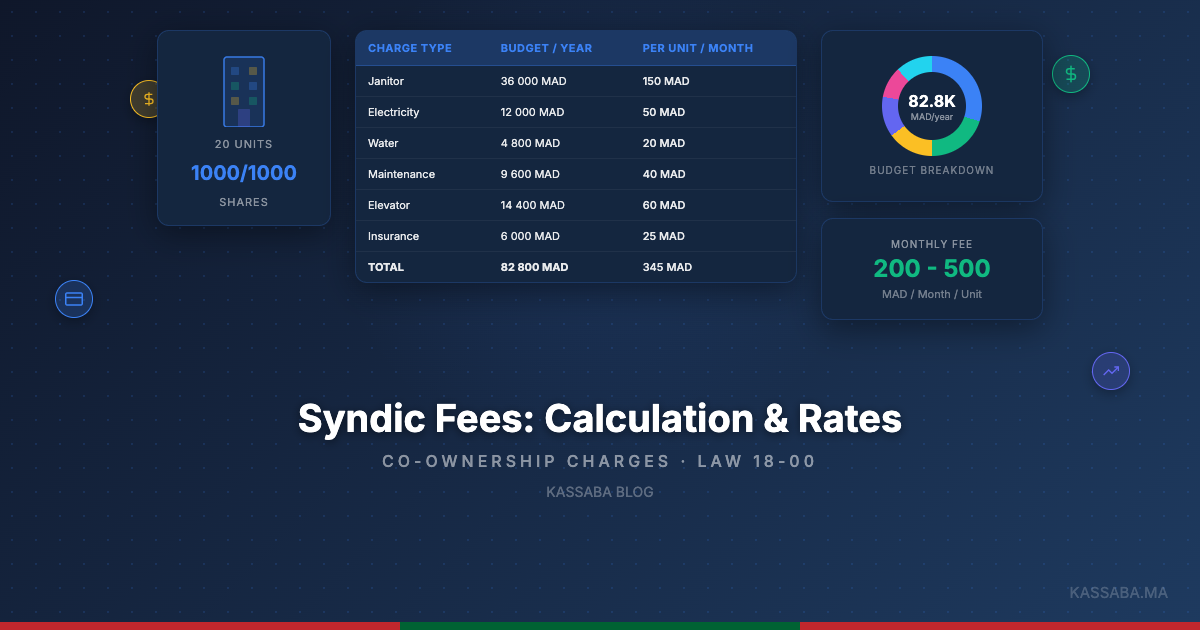
- Total building: 1,000 shares
- Your unit (apartment 8, 3rd floor, 110 m2): 85 shares
- Your share: 85/1,000 = 8.5%
The calculation formula
Your monthly charge = (Annual voted budget ÷ 12) × (Your shares ÷ Total shares)
Concrete example:
Building with 20 units. Annual budget voted at the assembly: 240,000 MAD.
Unit A (small 2-bedroom, ground floor): 60 shares
- Monthly charge = (240,000 ÷ 12) × (60 ÷ 1,000)
- = 20,000 × 0.06
- = 1,200 MAD per month
Unit B (large 4-bedroom, 3rd floor): 100 shares
- Monthly charge = (240,000 ÷ 12) × (100 ÷ 1,000)
- = 20,000 × 0.10
- = 2,000 MAD per month
You see: the more shares your unit has, the more you pay. It's proportional and transparent.
Verify your calculation
- Ask for the minutes from the assembly where the budget was voted
- Find your unit's ownership shares (in your title deed or the co-ownership rules)
- Apply the formula
- Compare with the charge notice you got
If it doesn't match, ask the property manager to explain. They have to be able to justify it.
What about garages, parking spaces, and storage units?
Your building doesn't just have apartments. There are usually parking spots, closed garages, basement storage units (caves/cellars), and sometimes commercial spaces on the ground floor.
Each of these lots has its own ownership shares, typically much lower than an apartment. That makes sense: a 6 m² storage unit doesn't use the same services as a 90 m² three-bedroom apartment.
Real examples:
- A basement storage unit (cave/box): 5 to 15 shares. Typical fee: 10 to 30 MAD/month
- A parking spot: 10 to 25 shares. Typical fee: 20 to 50 MAD/month
- A closed garage: 15 to 40 shares. Typical fee: 30 to 80 MAD/month
- A commercial unit (pharmacy, grocery store): variable shares, sometimes with specific charges defined in the co-ownership rules
Watch for special charges. The co-ownership rules can specify that certain lots don't participate in certain charges. For example: basement parking spots don't pay for the elevator. Ground-floor commercial units don't contribute to cleaning costs for the upper floors. This is set in the rules, not decided by the property manager.
If you own an apartment AND a parking spot or storage unit, you'll get two lines on your charge notice: one for each lot. Each lot has its own shares and its own calculation.
What Moroccan law says about charges
You're a property owner in Morocco. Here are your rights and obligations under Law 18-00.
Article 21: The budget requires a 3/4 majority vote
The property manager prepares the budget. But they don't decide. The general assembly votes. And it takes a 3/4 majority of all co-owners to approve the budget.
That means a minority co-owner can't block charges. But also that 51% isn't enough.
For you: if you disagree with the budget, you can vote against it at the assembly. But once 3/4 of co-owners approve it, you have to pay, even if you voted no.
Article 37: Charges are split by ownership shares
This is the legal foundation for the calculation we did earlier. Ownership shares are the key to dividing charges. Period.
Important: the co-ownership rules can set up a different split for certain items (like an elevator that only serves upper floors). But that's the exception. Usually it's 100% by ownership shares.
Article 26: The syndic must have a bank account
The property manager has to have a bank account in the co-ownership's name. Collected charges go through that account, not the manager's pocket.
Why this matters to you: it means your money isn't just disappearing. There's a bank trail. And if the manager does something wrong, there's proof.
Article 43: Charges expire after 5 years
Unpaid charges don't stay unpaid forever. After 5 years, the property manager can't legally claim them anymore.
But: this doesn't mean you can skip paying for 5 years. It means if the manager hasn't contacted you in 5 years, you're protected legally. But until then, you're accumulating debt every day.
Legal summary: the budget is voted by 3/4 majority. Charges are split by ownership shares. The property manager must collect through a bank account. You have the right to ask for proof of the vote and a detailed breakdown of charges.
You think your charges are too high? Here's what you can do
It's common. "Why am I paying 800 MAD a month? That's too much!"
Before you refuse to pay (warning: it's illegal), try this.
1. Ask for complete details
Demand a detailed charge notice:
- Porter salary: X MAD
- Electricity: Y MAD
- Water: Z MAD
- Elevator: A MAD
- Etc.
And for each line item, ask for justification. An electricity bill. An elevator contract. Proof of the porter's CNSS contributions.
If the property manager can't back it up, that's a red flag.
2. Compare with similar buildings
Do you know anyone in a similar co-ownership? Same size, same amenities, same neighborhood? Compare charges. Not to fight yours, but to see if you're in the normal range.
If everyone else pays 300 MAD and you're paying 600 MAD in an identical building, that's worth asking about.
3. Raise it at the general assembly
At the next assembly, speak up. Ask why charges went up. Ask specific questions. The property manager has to answer in front of the group.
It's your right. The assembly isn't a presentation. It's a forum where you can discuss and challenge.
4. You can't refuse to pay while you contest
This is important: even if you're challenging the charges, you still have to pay. Payment isn't conditional on your agreement.
If you stop paying to "protest," the property manager can sue you. And you'll lose (the law is clear).
If you believe the charges are illegal (budget manipulation, no vote, etc.), you can go to court. But you pay while you wait for judgment.
5. Request a change to the co-ownership rules
If you really think the ownership share system isn't fair, then the co-ownership rules are what need to change. That requires a 3/4 majority vote at the assembly (Article 21).
You'll need to convince three quarters of all your co-owners, not just those present at the assembly. That's a high bar, but it's possible if enough people agree the shares are wrong.
The takeaway: yes, you can challenge charges. No, you can't stop paying while you do. The law protects property managers against this kind of pressure.
Common traps to avoid
Here are mistakes we see often, and how to steer clear.
Trap 1: Accepting a budget with no detail
"Here's the budget: 240,000 MAD per year." That's it.
With no breakdown by item, you don't know where your money goes. Always ask for details. It's your right.
Trap 2: Not tracking arrears
"You owe 800 MAD this month."
But wait, you didn't ask last month. Or the month before. Suddenly there are arrears.
Demand a written record of every charge notice. Every month should be documented.
Trap 3: Mixing routine charges with special projects
The property manager asks you for 800 MAD for "charges and roof work."
Push back. Routine charges and special projects can't be mixed in the same notice. It creates confusion. Legally, special projects need a separate vote.
Trap 4: Paying in cash without a signed receipt
"I give 2,400 MAD to the porter, he says it's fine."
With no signed receipt from the property manager, you've got no proof. Later, the manager might say they never got it.
Always get a written receipt. Or use a bank transfer (best proof, not cash).
Trap 5: Other co-owners who don't pay
If several co-owners aren't paying, the whole building suffers. The electricity in common areas gets cut off. Urgent repairs wait for months.
If that's happening at your building, it means the property manager has no collection system. And you're stuck paying for it. You have the right to ask the assembly to put a serious system in place.
How to automate charge calculation and collection
If you're a property manager, writing 20 charge notices by hand every month, tracking payments, chasing late payers: it's a nightmare.
Especially if you're volunteering.
Here's what property management software can do for you.
Automatic calculation
You enter the voted budget and each unit's ownership shares. The software calculates what each co-owner owes automatically. No math errors. No time wasted.
Generate notices
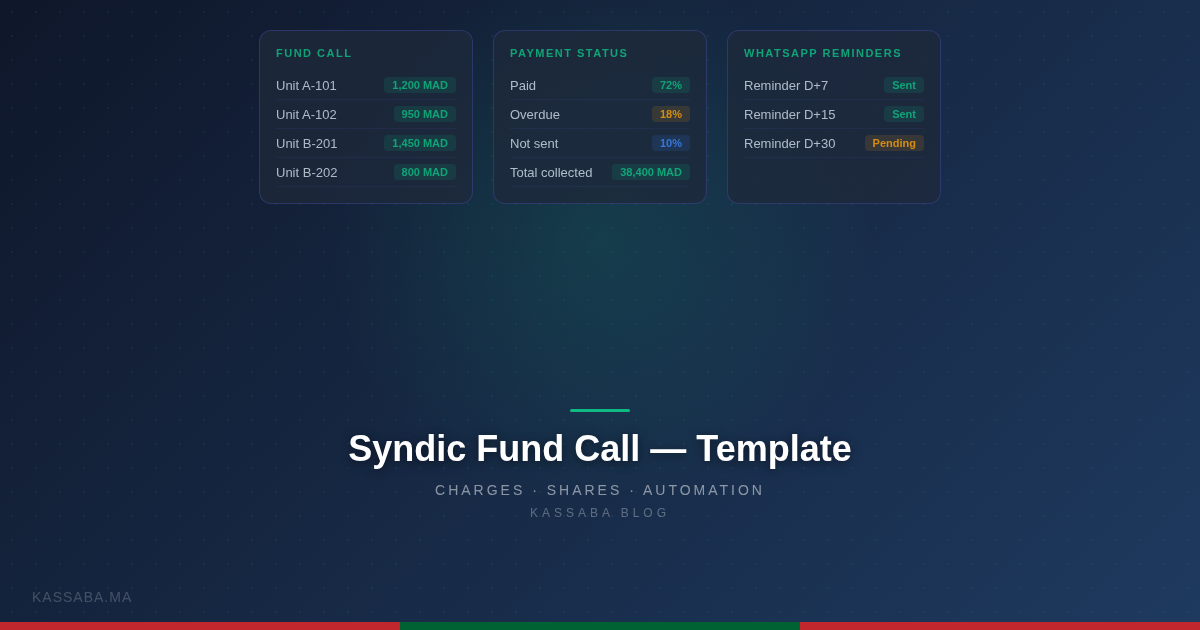
One click generates all the month's notices. Each one is personalized with the owner's name, unit, shares, and amount.
Send straight to the owner's phone
The notice goes out by WhatsApp or SMS. No paper. No risk that the owner "didn't get it."
This is especially helpful for MREs (Moroccans living abroad). They get the notice in France or the Netherlands. They can wire the payment straight to the co-ownership account.
Track payments and send automatic reminders
The software automatically matches incoming transfers to sent notices. And it sends automatic reminders on a schedule you set. 5 days past due, an SMS reminder. 30 days past due, a formal one.
This is exactly what Kassaba does for property managers. It saves 3 to 4 hours per month of manual work.
Generate Schedule 10
Décret 2.23.700 requires Schedule 10 (tracking co-owner contributions). It's the document that shows for each unit how much was billed, how much was paid, and what's still owed.
With software, this document generates itself. By hand, it's a massive job at year-end.
The simple math: if you're a property manager for more than 10 units, software saves you time and cuts errors. Give it a shot.
Summary: what to remember
You got a charge notice. Here's your checklist to make sure everything's in order.
- The budget was voted at the assembly by 3/4 majority (find the minutes)
- You got a detailed breakdown (porter, electricity, water, etc.)
- Your amount is calculated using your ownership shares and the building total
- It's a bank transfer, not cash
- You have a written record of the charge notice
- The amount is in the normal range for your building type
If all that checks out, your property manager is doing things right. If something's missing, ask questions.
Learn more in our complete guides on co-ownership management in Morocco, calculating ownership shares and charge distribution, and Law 18-00 explained.
Are you a property manager? Kassaba calculates ownership shares, generates charge notices, and sends automatic reminders by SMS and WhatsApp. No spreadsheets needed. Start free today
← Back to complete guide: Co-ownership management in Morocco
FAQ
How much do syndic fees cost in Morocco?
Syndic fees vary based on building services. A small building without an elevator or porter costs 100 to 200 MAD per month per unit. A medium building with a porter and elevator ranges from 200 to 400 MAD per month. A residence with a pool and security can exceed 1,000 MAD per month.
How do I calculate my share of co-ownership charges?
Your share is calculated based on ownership shares (tantièmes). Divide the annual budget by the total ownership shares in the building, then multiply by your unit's ownership shares. Example: annual budget of 120,000 MAD, your unit has 80 out of 1,000 total shares = 9,600 MAD per year, or 800 MAD per month.
Can I refuse to pay syndic fees?
No. Even if you disagree, you can't refuse to pay charges that were voted on in the general assembly. You can take legal action to contest them, but you must pay while your case is pending. Unpaid charges expire after 5 years (Article 43).
Who decides the amount of charges?
The budget is voted on in the general assembly by a 3/4 majority of all co-owners (Article 21 of Law 18-00). The syndic (property manager) prepares the budget, but only the assembly can approve it.
Simplify your property management
Kassaba automates accounting, payment reminders, and resident communication.
Create your free syndic accountFree during beta. No credit card required.