
How to Choose Property Management Software in Morocco (2026)
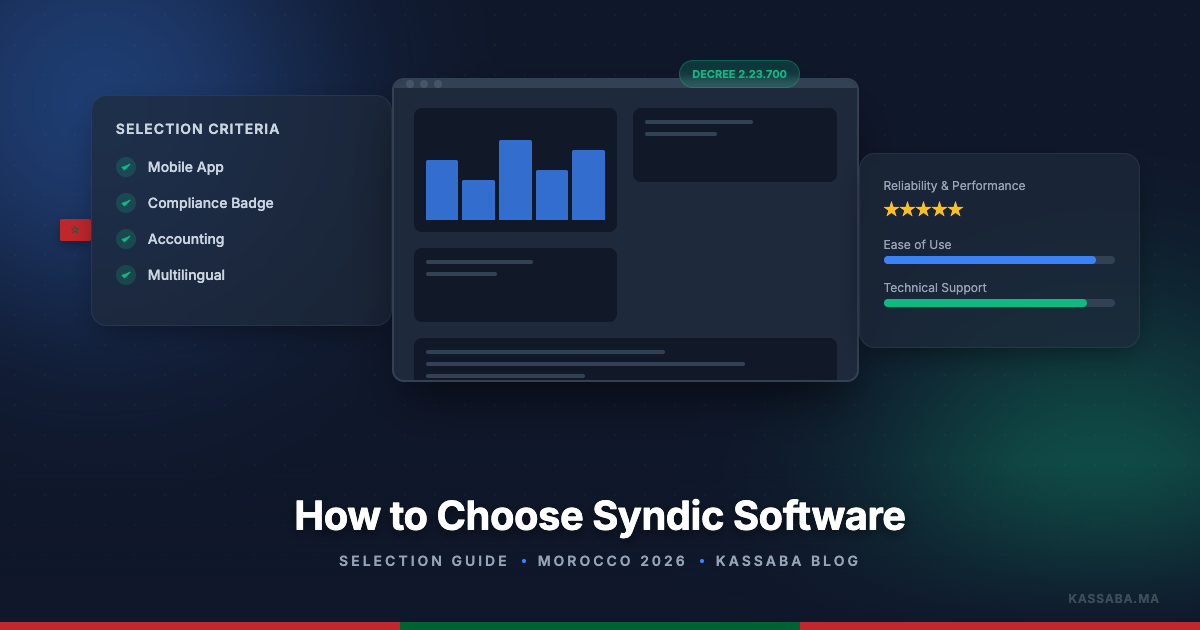
Why choosing property management software matters now
Until late 2024, managing a co-ownership in Morocco with an Excel file and a notebook was possible. Not ideal, but possible. Décret 2.23.700, published in the Official Bulletin no. 7391 on March 31, 2025, changed the rules.
Every syndic (property manager) must now produce standardized accounting annexes. The format is imposed. The data requirements are precise. And the level of detail depends on the total charges called (three tiers: small, medium, large).
Producing these annexes by hand? Technically feasible. But it's also the best way to spend your weekends correcting errors instead of spending them with your family. Property management software is no longer a luxury. It's a working tool.
The problem is that several solutions exist on the Moroccan market, and picking the right one isn't obvious. Some tools come from France and don't know about the Moroccan Decree. Others are local but have no mobile app. Others are free but limited.
This guide gives you concrete criteria to evaluate any property management software, without naming brands. Ask these questions to every vendor, and you'll know which one fits your situation.
Criterion 1: compliance with Décret 2.23.700
This is the non-negotiable criterion. If the software doesn't generate the Décret 2.23.700 annexes, it's useless for a Moroccan syndic in 2026.
The Decree imposes three tiers of accounting documents based on total charges called for the fiscal year:
- Small tier (≤ 200,000 MAD): annexes 10, 13-1, 13-2
- Medium tier (200,000 to 500,000 MAD): annexes 10, 11, 12
- Large tier (500,000 MAD and above): annexes 3, 4, 5, 6, 7, 8, 9, 10
When evaluating software, ask these specific questions:
"Which annexes do you generate?" The answer should list specific numbers. If the vendor says "we generate accounting documents" without mentioning annexe numbers, that's a red flag.
"Is the built-in chart of accounts the Moroccan co-ownership chart of accounts?" French software uses the French chart of accounts. Generic software uses a corporate chart of accounts. Neither works. The Moroccan co-ownership chart of accounts is specific, with its own classes and account numbers.
"Does the tool automatically detect my tier?" Good software calculates your tier from the charges called and generates only the required annexes. You shouldn't have to figure out whether you're small, medium, or large: the tool should know.
Above 1,000,000 MAD in annual charges called, the Decree requires an audit by a licensed accountant. Verify that the software flags this obligation and produces financial statements an auditor can work with.
For more on the detailed accounting requirements, see our syndic accounting guide.
Criterion 2: the mobile app
A volunteer syndic's biggest time drain isn't recording payments. It's answering the same questions over and over. "Have I paid?" "How much do I owe?" "What was that charge for?" A resident-facing mobile app eliminates this. Co-owners check their own status, anytime, from their phone.
This is a point that's often misunderstood: the mobile app isn't for the syndic. It's for the residents. Here's what to look for.
Native app vs. responsive site. Residents need a real app, not a shrunken website. A native app (downloadable from the App Store or Google Play) is fast, works offline, and sends push notifications. A responsive site on a phone screen? Slow, clunky, and nobody remembers to go back to it. The difference is massive.
iOS and Android. In Morocco, roughly 80% of smartphones run Android. But MRE (Moroccans Residing Abroad) co-owners in Europe often use iPhones. If the app only runs on one platform, you're cutting off part of your co-owners from their own information. Both platforms are non-negotiable.
Push notifications. When a charge is called, the co-owner gets notified. When their payment is recorded by the syndic, they see it instantly on their phone. No more "did you get my transfer?" messages. Notifications turn a relationship where the co-owner waits for updates into one where the information comes to them.
The syndic's interface is web-based, by design. Recording payments, managing expenses, generating Décret 2.23.700 annexes, preparing AG reports: these are operations that need a full screen. A keyboard. Room for tables and spreadsheets. The syndic's management interface is built for the web, because that's where you work effectively. The mobile app is for the people who receive the information, not the people who manage it.
Criterion 3: managing MRE co-owners
A building in Casablanca might have 25% of co-owners living in France. In Tangier, it can be 40% in the Netherlands and Belgium. These co-owners are physically far away, but they pay their charges (or should), they vote at the AG (by proxy), and they want to know where their money goes.
Managing MRE co-owners creates specific challenges that property management software should solve.
Multilingual interface. The minimum is French and Arabic. But a Dutch co-owner of Moroccan origin prefers to check their accounts in Dutch. An MRE in Spain prefers Spanish. The more languages the software offers, the more autonomous your co-owners become (and the fewer calls you'll get asking for explanations).
Remote communication. MRE don't always answer a Moroccan phone number. They read their WhatsApp, emails, and app notifications. The software should let you send reminders and notices through these channels, not just by mail.
Online document access. A co-owner in Rotterdam wants to see the latest AG minutes, check their balance, and download their payment receipt. If they have to call the syndic in Morocco for this information, it's a problem for both sides.
Currency and transfer handling. Charges are in MAD (Moroccan Dirhams). Payments sometimes arrive in euros via international wire. The software should handle these payments cleanly, even when the received amount differs slightly from the called amount due to banking fees.
Criterion 4: automated reminders
Unpaid charges are every syndic's nightmare. In a 20-unit building, you'll have 3 to 5 co-owners late at any given time. Manually following up on each one (a call, a message, a letter) eats an hour per week of thankless work.
Good property management software automates this process. Here's what to verify.
Reminder channels. Does the software send reminders by SMS? WhatsApp? Email? In Morocco, WhatsApp is the most-read channel. SMS is more formal and creates a record. Email works for MRE. Ideally, the software offers all three.
Customizable timing. You might want to send a first reminder 7 days after the deadline, a second at 21 days, a third at 45 days. The software should let you define these intervals, not impose a fixed schedule.
Message content. The reminder should be clear: co-owner name, amount owed, period in question, account number for payment. If the message just says "you have an unpaid balance" with no amount or detail, the co-owner will call you for clarification (and you lose the time automation was supposed to save).
Reminder history. Every reminder sent should be logged with the date and channel. If a co-owner claims "I was never reminded," you need to prove otherwise. This history is also useful if the case goes to a lawyer: documented reminders strengthen your position. Unpaid charges are prescribed after 5 years (Article 43 of Law 18-00), and a reminder history shows you didn't let things slide.
Criterion 5: charge management and fund calls
Charge management is the core of a syndic's daily work. The software has to make this fast and reliable.
Creating charge calls. From the AG-voted budget and each co-owner's tantièmes (ownership shares), the software should automatically calculate what each person owes. No manual math, no risk of errors. If your 24-unit building has a budget of 180,000 MAD, the co-owner with 55 tantièmes out of 1,000 owes 9,900 MAD/year, or 825 MAD/month. The software should do this math on its own.
Payment tracking. Every payment received should be recorded with the date, amount, co-owner, and payment method (transfer, cash, check). The software should show at a glance who's current, who's late, and by how much.
Partial payments. A co-owner who owes 825 MAD/month sometimes pays 500 MAD because that's what they have. The software should handle partial payments cleanly: the remaining 325 MAD rolls over to the next month.
Per-co-owner history. You need to be able to pull up a co-owner's complete history: all their payments, all unpaid amounts, all reminders sent, across multiple fiscal years. When a co-owner challenges an amount at the AG, you open their file and everything is there.
PDF export for the AG. Before the assembly, the syndic needs to prepare a complete package: fiscal year accounts, forecast budget, unpaid charges list, Decree annexes. The software should generate this as a PDF, ready to print or email to co-owners.
Criterion 6: French/Arabic bilingual support
In Morocco, property management software needs to speak at least two languages: French and Arabic. Not one or the other. Both.
The user interface. The syndic should be able to use the software in their preferred language. Some syndics are more comfortable in French, others in Arabic. If the interface only exists in French, you're excluding part of your audience. If it only exists in Arabic, you're excluding another part.
Generated documents. Charge calls, payment receipts, AG notices, accounting annexes: all of these should be available in both French and Arabic. In a mixed co-ownership (some French-speaking co-owners, some Arabic-speaking), the syndic should be able to send documents in each co-owner's language.
RTL support. Arabic is written right to left. This isn't just a translation question: the entire interface needs to be mirrored. Buttons, menus, tables, generated PDFs. Software that displays Arabic in a French-designed interface is hard to read and looks like a hack job.
Additional languages. If your co-ownership has MRE co-owners, languages like English, Spanish, Dutch, or Russian become a real asset. It's not a mandatory criterion, but it's a genuine advantage for international co-ownerships.
Criterion 7: pricing model
The price of property management software depends on the billing model. A rate that looks low can add up quickly depending on your situation. Here are the questions to ask before committing.
Per-building or per-co-owner? These are the two most common models. For a professional syndic managing multiple buildings, the final bill can vary dramatically depending on the model. Always ask for a quote based on your real situation, not on the advertised rate.
What's included? Are SMS reminders billed separately? Is PDF export free? Is document storage limited? Is the number of users (syndic + assistants) capped?
Is there a commitment? Some vendors require a 12-month commitment. If the software doesn't suit you after 2 months, you're still paying for 10 more. Prefer no-commitment offers or ones with a long enough trial period (30 days minimum).
Free or freemium version. Some software offers a free version with limits (1 building, a handful of co-owners). It's a good way to test without risk. Check which features are restricted in the free version: if Decree compliance or automated reminders are reserved for paid plans, the free version won't help you much. Kassaba is currently in open beta with full access to all features, no commitment required.
Do the 12-month math. Take your real situation (number of buildings, number of units, features needed) and calculate the total annual cost with each vendor. If software saves you several hours per month of admin work, it's usually worth it.
Criterion 8: ease of use
Powerful software that's impossible to use is useless software. A volunteer syndic doesn't have time for a 3-day training session to learn how to record a payment.
Setup time. How long does it take to create your first building, add your co-owners, and send your first charge call? If the answer is "half a day with a technician," it's probably too complex for a volunteer syndic. If the answer is "15 minutes on your own," that's a good sign.
Demo or free trial. A serious vendor lets you test with your real data before paying. Not a guided demo with a fictional 10-unit building perfectly organized: a real test with your co-owners, your tantièmes, your unpaid charges. If the vendor refuses a free trial, ask yourself why.
Customer support. When you have a problem at 9 PM the night before the AG (and it will happen), will someone answer? Check the support hours, available channels (phone, WhatsApp, email), and average response time. Support that replies in 48 hours doesn't help you the night before the assembly.
Documentation and tutorials. Does the software have user guides, tutorial videos, an FAQ? A volunteer syndic picking up a new tool on Sunday evening doesn't want to call support: they want to find the answer themselves.
Data import. If you're already managing your co-ownership in Excel, can the software import your file? Co-owner balances, payment history, current year expenses? If import isn't possible, you'll have to re-enter everything manually. For a 30-unit building with 2 years of history, count on a solid half-day.
The checklist before signing up
Before committing to a vendor, ask these 10 questions. If you get clear, satisfactory answers to each one, the software is probably solid.
-
Which Décret 2.23.700 annexes do you generate automatically? Expected answer: specific numbers (3 through 10 for the large tier, 10-11-12 for medium, 10-13-1-13-2 for small).
-
Does the tool automatically detect my tier? Expected answer: yes, based on total charges called.
-
Is the resident-facing mobile app native on iOS and Android? Expected answer: yes, with balance checking, payment history, and push notifications.
-
Can you send reminders by SMS and WhatsApp? Expected answer: yes, with customizable timing and content.
-
Is the interface available in French and Arabic? Expected answer: yes, with RTL support for Arabic.
-
Are generated documents (charge calls, annexes, minutes) bilingual? Expected answer: yes, with per-co-owner language choice.
-
What's the total cost for my situation over 12 months? Expected answer: a specific number in MAD, not "it depends."
-
Can I test with my real data before paying? Expected answer: yes, free trial of 14 or 30 days.
-
Is support available evenings and weekends? Expected answer: yes, via WhatsApp or phone.
-
Can I import my data from Excel? Expected answer: yes, with a guide or assistance.
If a vendor dodges more than 2 out of 10 questions, move on. Your time as a syndic is too valuable for a tool that can't deliver on its promises.
Kassaba checks all these boxes. Compliant with Décret 2.23.700, available on iOS and Android, interface in 7 languages, automated reminders by SMS and WhatsApp. Try Kassaba syndic software for free
FAQ
What's the most important criterion for choosing property management software in Morocco?
Compliance with Décret 2.23.700. Since 2025, every syndic must produce standardized accounting annexes based on the co-ownership's tier (small, medium, or large). Software that doesn't generate these annexes automatically forces you to redo them by hand, which defeats the purpose of having software in the first place.
Does property management software need a mobile app?
Yes, but not for the syndic: for the co-owners. The mobile app lets residents check their balance, view payment history, and receive push notifications when a charge is called or when their payment is recorded. The syndic works on the web interface, which is better suited for data entry and management. Check that the app is native (iOS and Android), not just a responsive website.
How much does property management software cost in Morocco?
Pricing models vary: some providers charge per building, others per co-owner, others a flat monthly fee. Some offer free versions with limitations. The important thing isn't the unit price but the total cost over 12 months for your real situation: number of buildings, number of units, features included. Kassaba is currently in open beta with full access to all features, no commitment required.
How can you tell if property management software is compliant with Décret 2.23.700?
Ask the vendor three questions: 1) Which annexes do you generate automatically? (the answer should cover annexes 3 through 13-2 depending on the tier). 2) Is the built-in chart of accounts the Moroccan co-ownership chart of accounts? 3) Does the tool automatically detect the tier based on charges called? If the answers are vague, the software probably isn't compliant.
Can property management software handle MRE co-owners?
Some can, most can't. To manage co-owners living abroad, the software needs a multilingual interface (at minimum French and Arabic), WhatsApp or email notifications, and online document access. MRE (Moroccans Residing Abroad) make up as much as 40% of co-owners in some buildings in Tangier or Casablanca.
Simplify your property management
Kassaba automates accounting, payment reminders, and resident communication.
Create your free syndic accountFree during beta. No credit card required.
Related articles
Pest Control in Moroccan Co-Ownership: Who Pays, Who Manages
Who pays for pest control in Moroccan co-ownership? Common areas usually fall under the syndic's Article 26 duties; private units need separate proof.
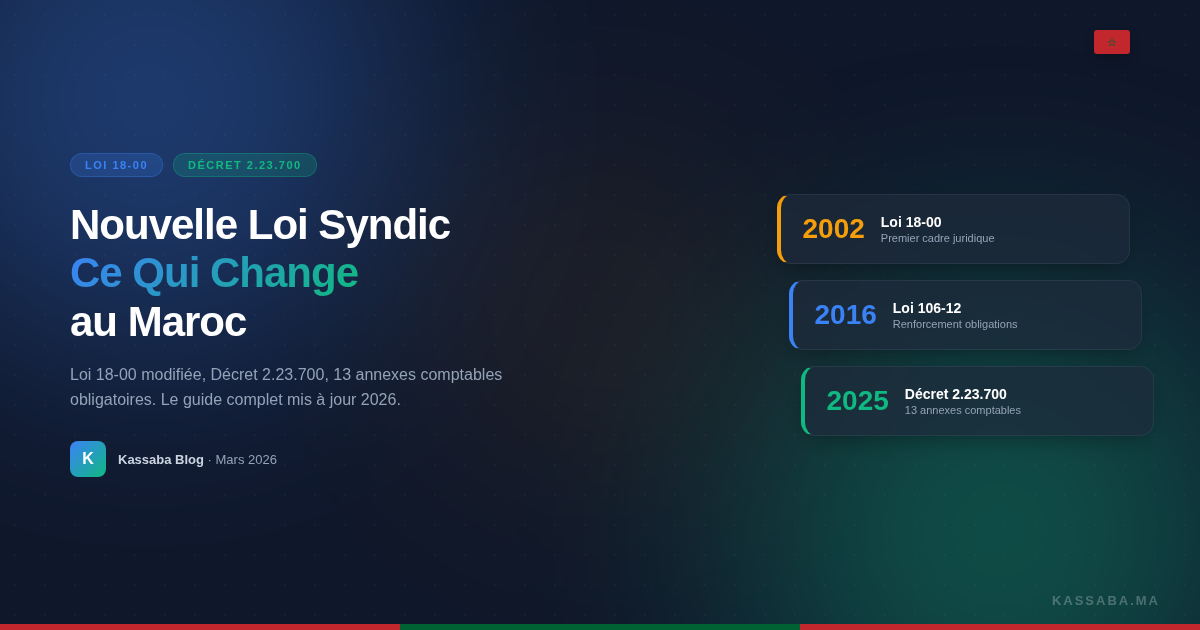
New Syndic Law in Morocco: What Changes in 2025-2026
Everything about the new syndic law in Morocco. Law 18-00 amendments, Decree 2.23.700, new accounting obligations and penalties. Updated guide 2026.
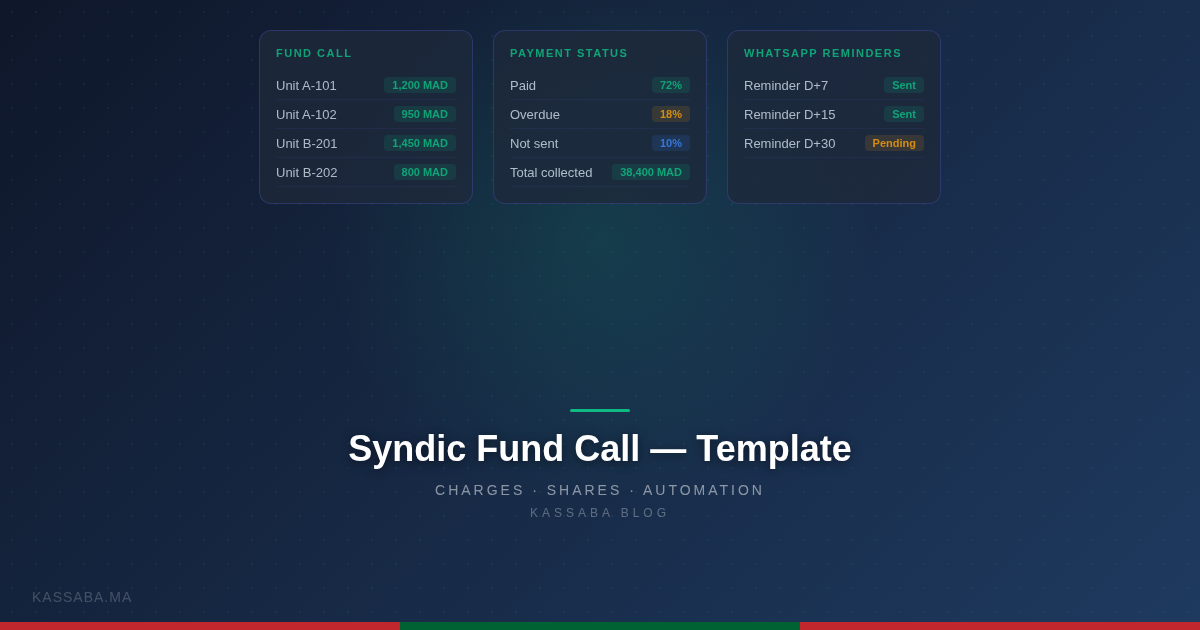
Charge Calls for Syndics in Morocco: Templates and Automation
How to draft a charge call as a syndic in Morocco, calculate tantièmes, and follow up on unpaid charges. Concrete template and practical tips.