
Volunteer vs Professional Syndic in Morocco: Which Should You Choose?
The real debate in Moroccan co-ownership
You're a co-owner and your building needs to elect a syndic (property manager). The question comes up at every general assembly: do we pick someone from among ourselves, or hire a professional?
It's a fair question. And contrary to what some people think, the answer isn't always the same. It depends on the building, the city, the budget, and the co-owners involved.
This comparison gives you the concrete facts to make a decision. No sales pitch, no one-size-fits-all answer. Just the numbers, the law, and what actually happens on the ground.
If you're already a volunteer syndic looking for an operational guide, check our volunteer syndic guide or the in-depth article on the topic.
What the law says (spoiler: nothing about the distinction)
The first thing to understand, and it's crucial: Law 18-00 makes zero distinction between a volunteer syndic and a professional one.
Zero. Not a single article. Not a single line.
The obligations are strictly identical:
- Bank account in the co-ownership's name (Article 26)
- Accounting compliant with Décret 2.23.700, with the annexes matching the tier of charges called
- Annual AG within 30 days of the fiscal year end (Article 16ter)
- Notices by registered mail, 15 days minimum (Article 16quinquies)
- Charge collection and payment of common expenses
- Maintenance of common areas
- Archives and minutes
The term is exactly 2 years (Article 19), whether volunteer or professional. Election requires a 3/4 majority of all co-owners' votes (Article 21). Legal liability is the same. Resignation rules are the same (30 days to convene the AG, Article 26ter). Document handover rules are the same (15 days, Article 28).
In short: in the eyes of the law, a syndic is a syndic. Period.
The comparison table
Here are the real differences. They're practical and financial, not legal:
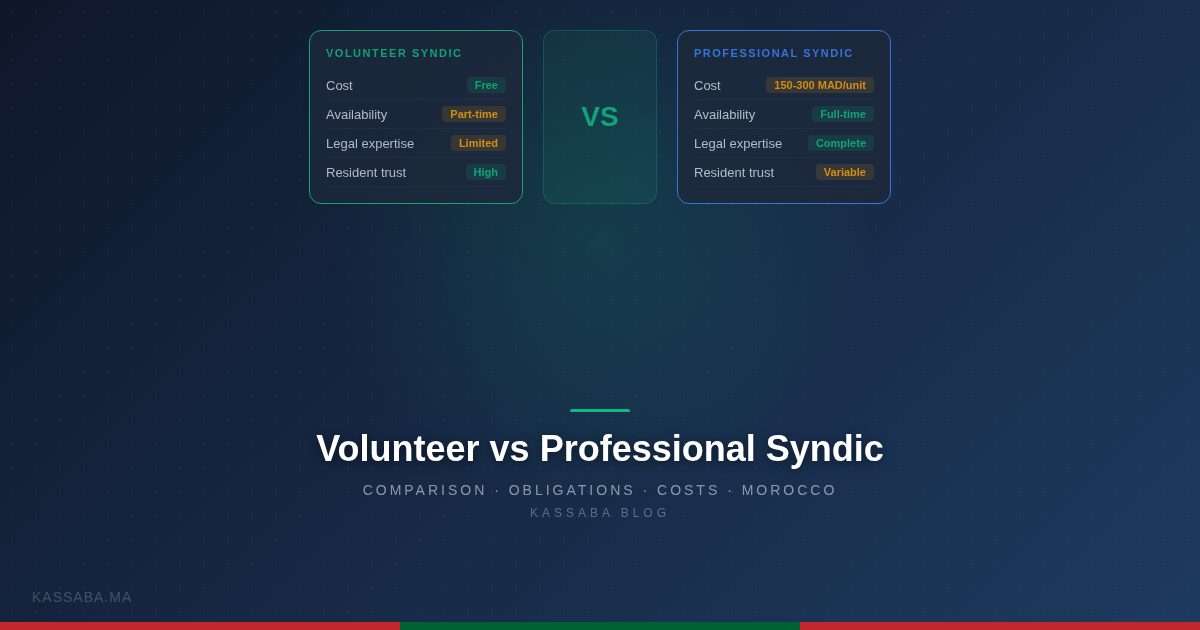
| Criterion | Volunteer Syndic | Professional Syndic |
|---|---|---|
| Who is it? | A co-owner elected from among residents | An external person or company |
| Compensation | None (expense reimbursement possible) | Fees voted at the AG (Art. 21) |
| Term | 2 years, renewable (Art. 19) | 2 years, renewable (Art. 19) |
| Election | 3/4 of all votes (Art. 21) | 3/4 of all votes (Art. 21) |
| Legal obligations | All of Law 18-00 | Identical |
| Liability | Personal, identical | Personal, identical |
| Availability | Spare time only | Core activity |
| Building knowledge | Lives there, knows residents | Discovers the building, manages multiple sites |
| Accounting skills | Varies, often limited | Usually developed through experience |
| Conflict management | Harder (they're a neighbor) | Easier (neutral position) |
| Cost to the co-ownership | Almost zero | 150 to 300 MAD/unit/year (varies) |
Real advantages of a volunteer syndic
They know the building
The volunteer syndic lives there. They know the water pump has been making a weird noise since Tuesday. They see the leak on the 3rd floor on their way home. They run into the concierge every day. No professional can replicate that proximity.
It costs (almost) nothing
No fees to pay. For a 20-unit co-ownership on a tight budget, that's a compelling argument. The volunteer can request reimbursement for actual expenses (travel, phone, supplies), but it's rarely more than a few hundred dirhams a year.
They're motivated by shared interest
The volunteer lives in the building. If charges aren't collected, it's their elevator that breaks down too. If accounts aren't kept, it's their co-ownership that suffers too. That built-in motivation often makes a real difference.
Co-owners trust them
A neighbor managing the co-ownership's money often inspires more trust than an outside professional. Residents know them, can talk to them in the stairwell, know where they live.
Real limitations of a volunteer syndic
Time
Managing a co-ownership is work. Between charge collection, chasing late payers, coordinating with the concierge, getting repair quotes, preparing the AG, and keeping the accounting... a volunteer syndic easily spends 10 to 15 hours a month for a mid-size building.
That's unpaid time, carved out of evenings and weekends.
Accounting competence
With Décret 2.23.700, co-ownership accounting is no longer a simple Excel spreadsheet. Depending on the total charges called, you must produce standardized annexes:
- Small tier (up to 200,000 MAD): Annexes 10, 13-1, 13-2
- Medium tier (200,000 to 500,000 MAD): Annexes 10, 11, 12
- Large tier (500,000 MAD or more): Annexes 3 through 10
A volunteer without accounting training can manage with good software (more on that below). But without the right tools, it's a nightmare.
The neighbor dynamic
Knocking on the 4th-floor neighbor's door to demand their unpaid charges when you share the elevator every morning is uncomfortable. Some volunteers don't dare follow up firmly. Others end up in conflict with half the building. Conflict management is the number one weak point for volunteer syndics.
Burnout
After one or two terms, many volunteers are worn out. They feel like they're working for free for people who don't thank them, and sometimes criticize them. Volunteer turnover is a real problem in many Moroccan co-ownerships.
Real advantages of a professional syndic
Expertise
A good professional syndic knows Law 18-00, Décret 2.23.700, AG procedures, unpaid charge recovery, and local service providers. They've managed dozens of buildings and have seen most situations before.
Neutrality
The professional isn't anyone's neighbor. Following up on a late payer, rejecting an overpriced quote, settling a dispute between co-owners: they do it without personal feelings. That professional distance is valuable in buildings with frequent tensions.
Structured availability
It's their job. They have dedicated hours, an office, sometimes staff. Co-owners have a professional contact, not a neighbor being interrupted at dinner.
Multi-building management
A professional managing 10 or 20 co-ownerships gets economies of scale. They negotiate better rates with service providers (maintenance, insurance, elevator) because they bring volume.
Real limitations of a professional syndic
Cost
This is the first objection, and it's legitimate. Professional syndic fees in Morocco vary by building size and city:
- Small co-ownership (under 20 units): 150 to 300 MAD per unit per year
- Medium co-ownership (20 to 50 units): 100 to 250 MAD per unit per year
- Large residence (50+ units): negotiated flat rate, often 80 to 200 MAD per unit per year
For a 30-unit building at 200 MAD per unit per year, that's 6,000 MAD annually. That's not trivial for co-ownerships where monthly charges are already hard to collect.
These fees are voted at the AG by a 3/4 majority (Article 21), like any significant expense.
Distance
The professional doesn't live in the building. They don't see the leak on their way home. They depend on reports from residents or the concierge. Response time is inevitably longer.
The risk of "minimum effort" management
Some professional syndics manage so many buildings that they do the bare minimum. The AG is rushed, the accounts are bare-bones, reminders are rare. Not all professionals are equal.
Trust
Handing the co-ownership's money to an outsider requires trust. Stories of dishonest professional syndics in Morocco do exist. Check references, ask for reports from their other co-ownerships, and insist on regular access to bank statements.
When to switch from volunteer to professional
There's no legal threshold. The law never requires you to hire a professional. But certain signals suggest it might be time:
The building exceeds 30 units. The more co-owners, the more complicated management gets. Reminders multiply, AGs are harder to organize, accounting gets heavier.
The volunteer is burned out. If nobody wants to take over and the current syndic is exhausted, it's better to pay a professional than to operate without a syndic (which is illegal, by the way).
Major works are coming. Facade renovation, roof repairs, elevator replacement... these projects require follow-up, bidding processes, coordination. A professional is better equipped for that.
Many co-owners live abroad. MRE (Moroccans living abroad) can't easily participate in building life. A professional with digital tools can better manage remote communication. For more on this topic, check our page on property management in Morocco which addresses the MRE question.
Unpaid charges are becoming unmanageable. When a volunteer can no longer collect charges and the building is accumulating debts, a professional with a firmer approach can break the deadlock.
Conflicts are paralyzing the building. If AGs consistently turn into shouting matches, a professional's neutrality can help restore calm.
The "augmented" volunteer syndic: the third option
There's an option between the volunteer muddling through with a notebook and the professional charging thousands of dirhams: the volunteer syndic equipped with good software.
The idea is simple. You keep the volunteer's advantages (zero cost, proximity, motivation) while compensating for their weaknesses (time, accounting skills, reminders) with the right tool.
A co-ownership management app designed for Morocco lets the volunteer:
- Automatically generate Décret 2.23.700 accounting annexes (the software detects the tier based on charges called)
- Automate charge reminders by SMS or WhatsApp (no more knocking on the neighbor's door)
- Give co-owners access to their balance and payment history via a property management app
- Prepare AG documents in a few clicks
- Track expenses and income without being an accountant
With Kassaba, for example, a volunteer can manage a 20-unit building in 3 to 4 hours per month instead of 15. The accounting is compliant, co-owners have access to their information, and reminders go out automatically.
It's not a magic solution. The volunteer is still a volunteer. But the quality gap with an average professional syndic shrinks considerably. For help choosing a tool, check our guide to choosing property management software.
Questions to ask before deciding
Before voting at the AG, consider these practical questions:
How many units in the building? Under 20: a well-equipped volunteer is more than enough. Between 20 and 50: depends on the volunteer's profile. Over 50: a professional will likely be a better fit.
What's the available budget? If charges barely cover routine maintenance, a professional's fees will be hard to absorb. A volunteer with software is more economical.
Is there a motivated, organized volunteer candidate? A good volunteer beats a bad professional. The reverse is also true.
Does the building have chronic unpaid charge problems? If so, a professional's firmness may be necessary. Volunteers often hesitate to send formal notices to their neighbors.
Are major works planned? For facade renovation or an elevator replacement, a professional's expertise justifies the cost.
What proportion of co-owners are MRE? The higher it is, the more digital tools you need. A volunteer with good software can manage just fine, but they need to be comfortable with technology.
The hybrid model: an often overlooked option
Some co-ownerships make an intermediate choice. The elected syndic is a volunteer, but the co-ownership votes a budget for an external accountant to keep the books and prepare the Décret annexes.
It's cheaper than a professional syndic (an accountant charges between 2,000 and 5,000 MAD per year for a small co-ownership). The volunteer keeps control of day-to-day management but delegates the technical part they lack.
This model works well for medium co-ownerships that want to stay in control without sacrificing accounting quality.
What you should absolutely avoid
A few classic mistakes:
Having no syndic at all. It's illegal (Law 18-00 requires a syndic) and dangerous. Without a syndic, nobody collects charges, nobody maintains the building, and deterioration piles up.
Choosing a professional based only on price. The cheapest isn't always the best. A professional managing 50 buildings for rock-bottom fees won't spend much time on yours.
Leaving a volunteer to manage alone without tools. A notebook, a pen, and good intentions aren't enough anymore in 2026. Décret 2.23.700 demands a level of accounting rigor that requires, at minimum, proper software.
Not reviewing the professional's accounts. Professional doesn't mean infallible. Co-owners must review accounts every year at the AG, ask for bank statements, and verify that accounting annexes are actually being produced.
So, which one?
There's no universally better choice. A motivated, well-equipped volunteer will do a better job than a disengaged professional. And a competent professional will add more value than an overwhelmed volunteer.
The question isn't "volunteer or professional?" in the abstract. It's: "What's the best choice for our building, with our co-owners, our budget, and our specific challenges?"
Answer that question honestly, and the right choice becomes clear.
Volunteer or pro, Kassaba adapts. Décret 2.23.700 compliant accounting, automated reminders, mobile app for residents. Try Kassaba syndic software for free
FAQ
Is there a legal difference between a volunteer and professional syndic in Morocco?
None. Law 18-00 makes no distinction between the two. Both have exactly the same obligations: opening a bank account in the co-ownership's name (Art. 26), keeping accounts per Décret 2.23.700, convening the annual AG (Art. 16ter), collecting charges, and maintaining common areas. The term is 2 years for both (Art. 19).
How much does a professional syndic cost in Morocco?
Fees vary by building size and city. For a small co-ownership (under 20 units), expect 150 to 300 MAD per unit per year. For a medium building (20 to 50 units), 100 to 250 MAD per unit per year. For large residences, fees are often negotiated as a flat rate. These amounts are voted at the general assembly by a 3/4 majority (Art. 21).
Can a volunteer syndic use management software?
Yes, and it's recommended. Software like Kassaba lets a volunteer syndic handle Décret 2.23.700 compliant accounting, automate charge reminders, and give co-owners access to their balance through a mobile app. It significantly reduces time spent on administrative tasks.
When should you switch from volunteer to professional syndic?
Common signals: a co-ownership with more than 30 units, major works ahead, chronic non-payment problems, frequent disputes, or a volunteer who no longer has the time. There's no legal threshold. It's a practical decision voted at the AG by a 3/4 majority.
Simplify your property management
Kassaba automates accounting, payment reminders, and resident communication.
Create your free syndic accountFree during beta. No credit card required.
Related articles
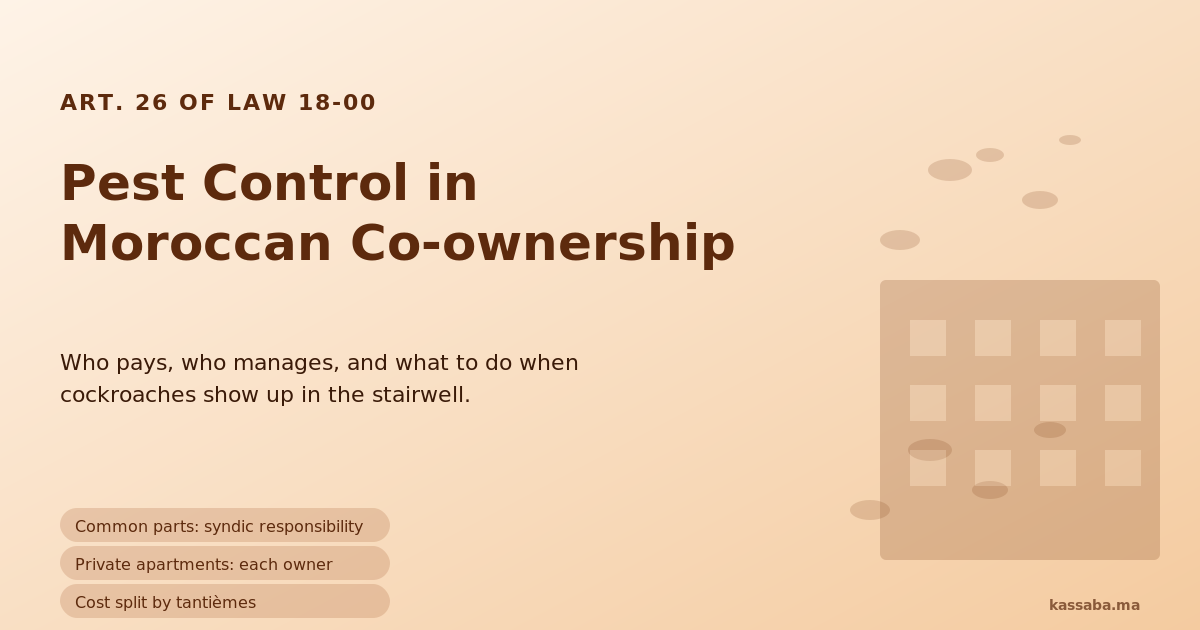
Pest Control in Moroccan Co-Ownership: Who Pays, Who Manages
Who pays for pest control in Moroccan co-ownership? Common areas usually fall under the syndic's Article 26 duties; private units need separate proof.
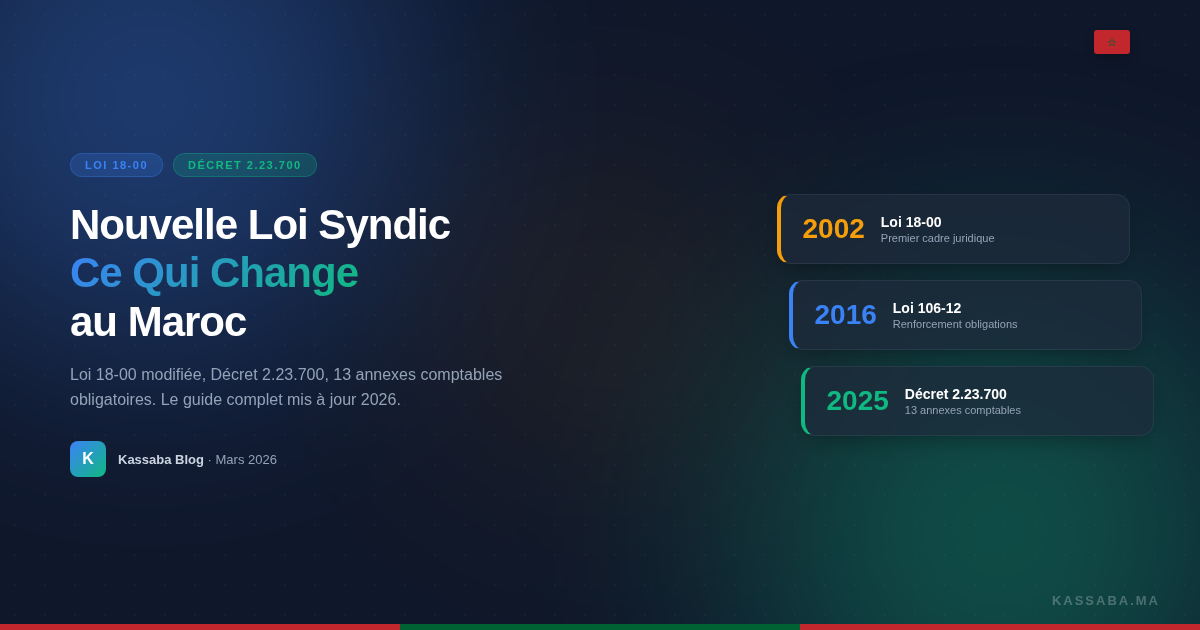
New Syndic Law in Morocco: What Changes in 2025-2026
Everything about the new syndic law in Morocco. Law 18-00 amendments, Decree 2.23.700, new accounting obligations and penalties. Updated guide 2026.
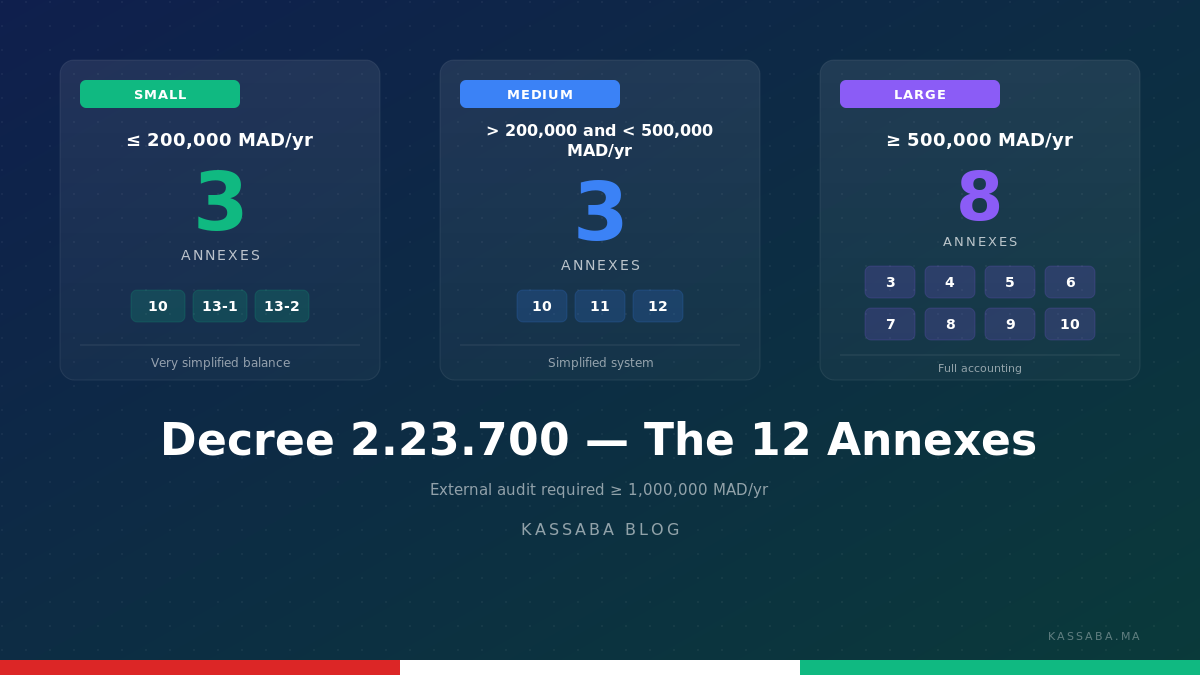
Décret 2.23.700: All 12 Accounting Annexes Explained
The 12 accounting annexes of Décret 2.23.700 broken down one by one: what each contains, which tier it applies to, and practical tips for Moroccan syndics.